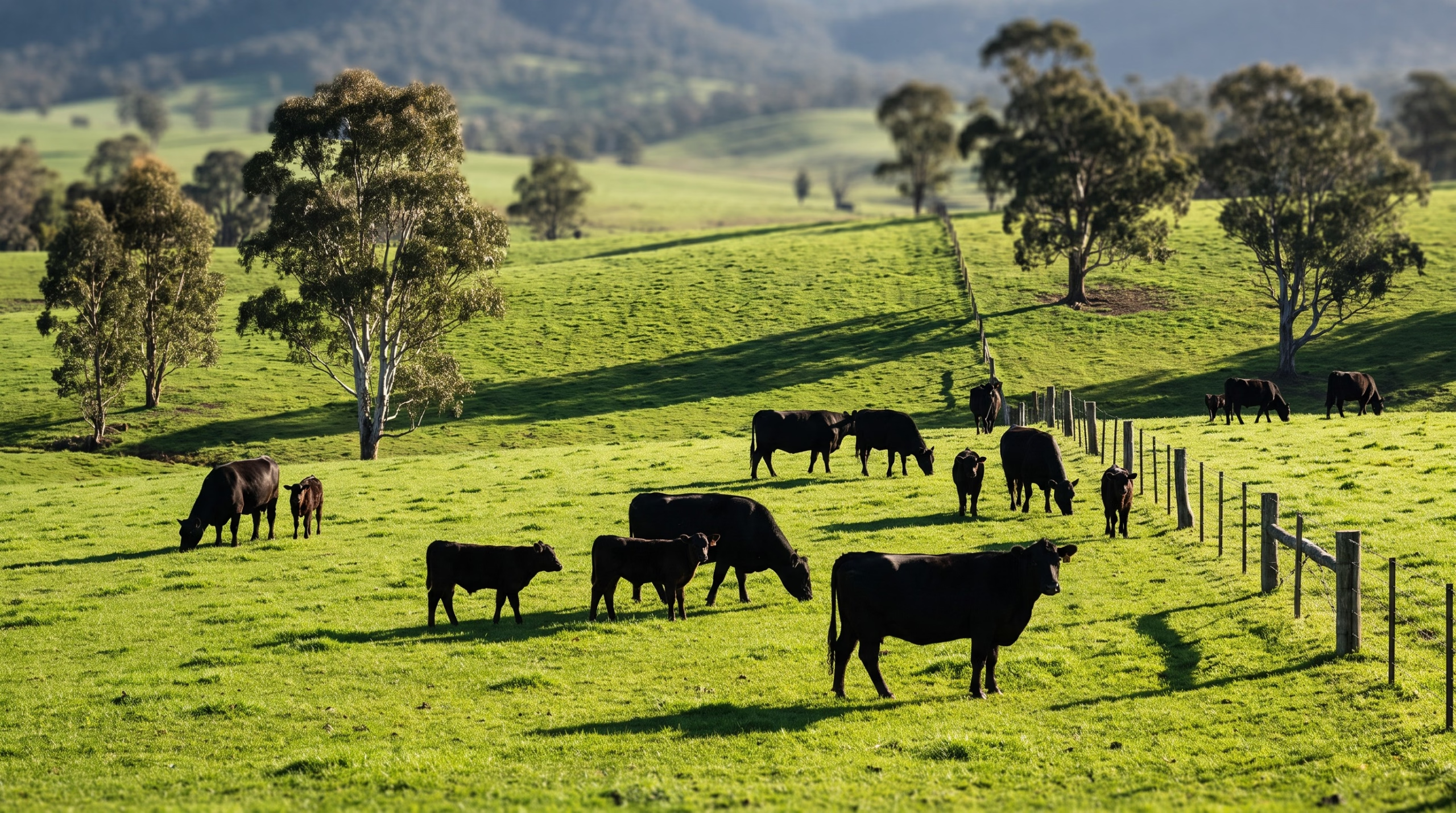

Angus cattle lead the Australian beef herd for four reasons. The cows calve easily and mother well. The steers marble well and grade well. The breed crosses well with other breeds. And the genetic data on Angus bulls is deep, so you know what you buy. This guide covers each reason, plus the places where Angus do not suit.
Angus Australia, the breed society, calls Angus “Australia’s most trusted and profitable beef breed” on its Why Angus page. Treat any breed society claim with care. Then test it against your own country, your own market and your own numbers.
This article sits under our complete guide to beef cattle farming in Australia.
Where Angus Cattle Come From
Angus cattle come from north-east Scotland, in the old counties of Aberdeen and Angus. The full breed name is Aberdeen Angus.
The breed is naturally polled. You do not need to dehorn Angus calves. Most Angus are black. Red Angus carry a red coat and run as a separate group in some markets.
Angus Australia formed in 1919. The society runs from Armidale in New South Wales. It keeps the herd book, runs genetic evaluations and runs youth programs for young producers.
Reason 1: Strong Maternal Traits
A beef business lives on calves weaned per cow joined. Angus cows score well on the traits behind this figure.
Angus Australia describes Angus females as known for strong mothering ability, milk production and calving ease. The society also says Angus heifers reach puberty early and get in calf quickly.
Each of these traits saves you money:
- Calving ease means fewer assisted births and fewer dead calves and heifers.
- Milk means heavier calves at weaning.
- Early puberty means you join heifers younger and get a calf from them sooner.
- Polled cattle mean no dehorning cost and less bruising in the yards and on trucks.
Read our cattle breeding management tips for joining and calving plans.
Get the latest cattle market updates straight to your inbox. Subscribe free to Cattle Weekly’s weekly newsletter. Subscribe here.
Reason 2: Marbling and Eating Quality
Angus cattle lay down marbling, the fat within the muscle. Angus Australia lists this as a core breed trait, along with tenderness, flavour, texture and colour.
Marbling matters because buyers pay for eating quality. In Australia, Meat Standards Australia (MSA), run by MLA, grades beef on eating quality. MSA graders score marbling on the carcase. Cattle with higher marbling suit grain-fed and premium brands.
Grain-fed and grass-fed options
Angus fit both ends of the market. Angus Australia says the breed grows to heavy weights without getting too fat. This suits long-fed grain programs. The breed also finishes at lighter weights on grass for the domestic trade.
If you plan to sell into a feedlot, read our guide to grain finishing cattle in Australian feedlots. Feedlots buy on weight, frame and history. Angus steers with known genetics are an easy sale.
Angus brand programs
Many beef brands in Australia carry the Angus name. Angus Australia runs a verification program for Angus beef brands. Each brand sets its own rules for how much Angus content cattle must carry. Ask your buyer for the rules before you sell.
Reason 3: Angus Cattle Cross Well
Angus Australia says producers use Angus widely in crossbreeding. Crossbreeding lifts maternal traits, growth, market value, hardiness and beef quality.
Common Angus crosses in Australia include:
- Angus x Hereford. This cross is often called the black baldy. The F1 female is a popular breeder in southern Australia.
- Angus x Brahman. This cross forms the base of the Brangus breed. It brings Angus carcase traits into country where pure Angus struggle.
- Angus x Wagyu. Many Wagyu programs use Angus cows as the base. The cross adds Wagyu marbling to Angus growth.
A cross gives you hybrid vigour. Crossbred cattle often outperform the average of both parent breeds on fertility and survival. Pick the cross to match your market and your country.
Reason 4: Deep Genetic Data
When you buy an Angus bull, you get a large body of data on him and his relatives. This lowers your risk.
Angus Australia runs the TransTasman Angus Cattle Evaluation, or TACE, with Angus New Zealand. BREEDPLAN runs the analysis through the Agricultural Business Research Institute (ABRI). TACE produces Estimated Breeding Values (EBVs) for growth, carcase and fertility traits. You find the details on Angus Australia’s genetic evaluations page.
How to use EBVs when you buy a bull
- Decide your breeding goal first. A self-replacing herd needs fertility and calving ease. A terminal herd selling to feedlots needs growth and marbling.
- Pick three or four EBVs tied to your goal. Ignore the rest.
- Compare each bull against the breed average and against the other bulls in the sale.
- Check the accuracy figure next to each EBV. Higher accuracy means more data behind the figure.
- Look at the bull himself. Check his feet, legs, temperament and structure.
Then test him. Our guide to bull fertility testing in Australia explains what a breeding soundness exam covers. A bull with top EBVs and poor fertility gets no calves on the ground.
Where Angus Cattle Do Not Suit
Angus are a British breed, from the Bos taurus group. They suit temperate country best. They face limits in the hot, humid north.
- Ticks. Bos taurus cattle carry less natural resistance to cattle tick than Bos indicus breeds such as Brahman. Read our guide to tick fever in northern Australia.
- Heat. Black coats absorb more heat. Pure Angus need shade and water in hot weather. See our guide to heat stress in cattle.
- Poor feed. Angus need good quality feed to show their growth and marbling. On poor, dry northern pasture, tropical breeds and crosses often do better.
Angus Australia says Angus perform from the Monaro to northern Australia. In the north, most producers run Angus through crossbreds such as Brangus. Check with your local agent and your state department of agriculture for what works in your district.
How to Start or Build an Angus Herd
- Set your market. Decide who buys your cattle. A feedlot, a processor, a brand program or the store market.
- Check your country. Match the breed or the cross to your rainfall, your feed and your tick risk.
- Buy bulls on data. Use EBVs and a fertility test.
- Join heifers on calving ease. Use a bull with a strong calving ease EBV for first-calf heifers.
- Record your results. Weigh calves at weaning. Track which cows rear the heaviest calves and which cows go empty.
- Cull hard. Sell empty and late-calving cows. Keep the cows with an early calf every year.
Selling Angus Cattle in Australia
Good genetics only pay when you sell well. Angus cattle give you several ways to sell.
Weaner and store sales
Most southern Angus calves sell as weaners or yearlings through the saleyards or online. Buyers look for even lines, good weight for age and a known vaccination history. Draft your calves into even lines by weight and sex. Sell on a vendor declaration with full health details. Our guide to cattle saleyard prices shows how to compare markets.
Watch the Eastern Young Cattle Indicator, or EYCI, before you sell. The EYCI tracks young cattle prices across eastern saleyards. MLA publishes it each sale day. Read our guide to the EYCI explained to see how it works.
Feeder steers
Feedlots buy steers to set weight and age specs. Angus steers with a history of vaccination and known sires fit these specs well. Some feedlots buy direct from the breeder. Ask your agent about direct consignment.
Over the hooks
Selling direct to a processor pays you on carcase weight and grade. You get feedback on each carcase, including the MSA grade. Use this feedback to pick your next bulls. It tells you which sire lines produce the best carcases.
Paperwork for every sale
Every animal you sell needs an NLIS tag and moves on a National Vendor Declaration. Integrity Systems Company, part of MLA, runs both systems. Brand programs often ask for Livestock Production Assurance accreditation as well. Keep these up to date so you never miss a sale.
Angus Herd Health Basics
Angus cattle face the same health risks as other British breeds. A few areas need extra care:
- Vaccination. Vaccinate against clostridial diseases at marking and weaning. Add other vaccines to suit your district. See our cattle vaccination schedule.
- Genetic conditions. Angus Australia tests and reports on some inherited conditions. Ask the seller for the bull’s genetic condition status before you buy.
- Parasites. Plan worm, lice and fly control for your area. Weaners carry the highest risk.
- Heat. Give black cattle shade and plenty of water in summer.
Our guide to cattle breed selection compares Angus with other breeds in more detail.
Frequently Asked Questions
Why are Angus cattle so popular in Australia?
Angus cows calve easily, milk well and get in calf young. The steers marble well, which suits grain-fed and premium beef brands. The breed also crosses well and has deep genetic data through BREEDPLAN.
Are Angus cattle good for beginners?
Yes, in temperate country. Angus are polled, calve easily and are easy to sell. Buy quiet cattle, as temperament varies between herds. Pick bulls with a strong calving ease EBV for your heifers.
Do Angus cattle do well in Queensland?
Pure Angus suit the cooler south and south-east of Queensland best. In the hot, tick-prone north, most producers use Angus crosses such as Brangus. These crosses add heat and tick tolerance.
Do Angus cattle get a price premium?
Angus Australia says Angus and Angus-cross cattle attract price premiums. The size of any premium depends on the buyer, the brand program and the market on the day. Ask your agent for recent sale results in your area.
What is the difference between Black Angus and Red Angus?
The main difference is coat colour. Red Angus carry a red coat. Check the rules of any brand program, as some programs accept only black cattle.