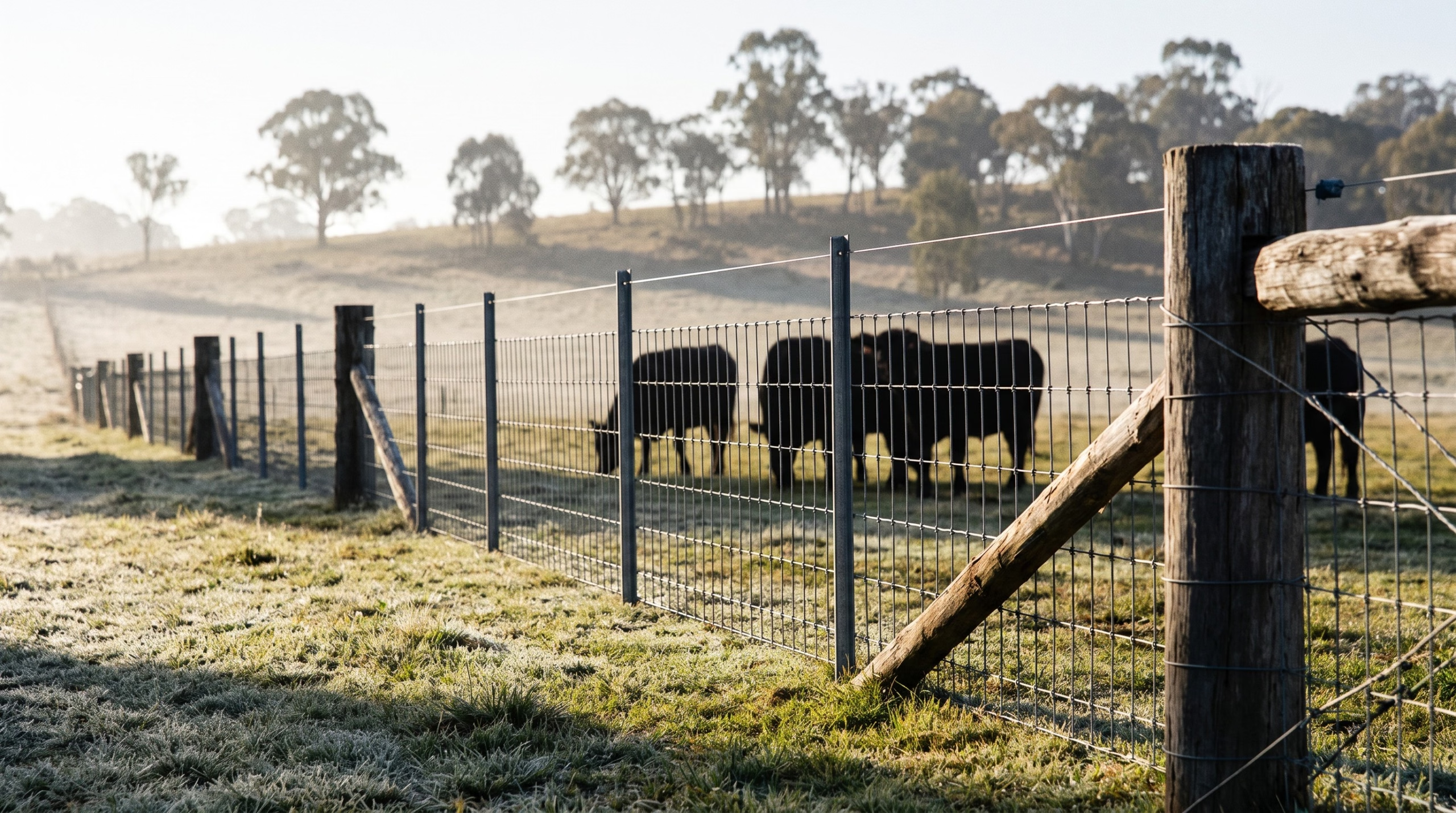

Cattle fencing in Australia comes in five main types. These are plain wire, barbed wire, hinge-joint mesh, electric and virtual fencing. Most producers use a mix. A strong boundary fence holds stock in and keeps neighbours’ stock out. Cheaper internal fences split paddocks for grazing. Your choice turns on stock class, soil, terrain, rainfall and budget.
This guide walks you through each option. You will see where each type works, where each one fails, and what the law now says about virtual fencing. You will also get a planning checklist to take to your fencing contractor.
Boundary fences and internal fences do different jobs
Start with the job before you pick the wire. A boundary fence carries legal and neighbour risk. Stock on a road put drivers in danger. Stock in a neighbour’s crop cost money and goodwill. Build boundaries to the highest standard your budget allows.
Internal fences carry less risk. A breach means mixed mobs, not a crash on the highway. Internal fences set your paddock size, and paddock size sets how well you control grazing. Our guide on how much land you need to farm cattle shows why paddock layout matters as much as total area.
Questions to answer first
- Is the fence a boundary, a laneway or an internal split?
- Which class of stock will test the fence? Bulls and weaners push harder than settled cows.
- Does the line cross creeks, gullies or flood country?
- Will you add sheep or goats later? Mesh suits mixed stock better than plain wire.
- Do you have mains power or solar for an electric energiser?
The five main fence types for cattle
Plain wire
Plain high-tensile wire is the cheapest permanent fence per kilometre in most districts. Cattle respect a tight plain wire fence once they learn the line. Plain wire suits internal splits on settled cattle. Plain wire alone does a poor job on bulls or on stock new to the property.
Barbed wire
Barbed wire has been the standard cattle fence across much of Australia for generations. Cattle avoid the barbs, so a barbed fence holds stock with fewer wires. The cost comes in hide damage and injury. Barbs tear hides, and hide damage lowers carcase value at the works. Barbs also trap wildlife. Many producers now use barbed wire on the top strand only, or drop barbs from new internal fences.
Hinge-joint mesh
Hinge-joint mesh, often called ringlock, is a woven wire fence. Mesh holds calves, sheep and goats as well as adult cattle. Mesh costs more to buy and more to erect than plain wire. Mesh earns its keep on boundaries, laneways and small paddocks near the yards. A single plain or barbed wire above the mesh stops cattle from leaning over and flattening the top.
Electric fencing
Electric fencing uses a short, sharp pulse to train cattle to stay off the line. A permanent electric fence needs fewer wires and lighter posts than a conventional fence. Portable electric tape and polywire let you set up temporary cells for strip grazing or rotational grazing.
Electric fences fail for three main reasons. The earth system is too small, the line voltage is too low, or grass and scrub drain the current. Fence makers such as Gallagher advise at least 3.5 kV on the line to hold stock. Check the voltage at the far end of the fence, not next to the energiser.
Never electrify barbed wire. The Australian electric fence standard, AS/NZS 3014, rules out electrified barbed wire because stock and people get caught on the barbs while the current pulses.
Virtual fencing
Virtual fencing uses a GPS collar on each animal. The collar plays a sound as the animal nears a boundary you set on a phone or computer. If the animal keeps walking, the collar gives a mild electrical pulse. Cattle learn to turn at the sound.
Virtual fencing is now legal in most states, with conditions. NSW changed its regulation on 12 December 2025 to allow virtual fencing for beef and dairy cattle. The NSW Government said the change brought the state into line with Queensland, the Northern Territory, Western Australia and Tasmania. Victoria brought in regulations in December 2025, and Dairy Australia reported the first approved system soon after. South Australia has also approved the technology. The federal Department of Agriculture tracks the welfare guidelines behind these rules.
In NSW, the supplier must train you before you use the collars. You must also be on the property when you switch a device on. Read your own state’s rules before you buy.
Virtual fencing does not replace a boundary fence. Collars go flat, and new stock need training time. Treat virtual fencing as a tool for internal grazing control, inside a sound physical boundary.
Get the latest cattle market updates straight to your inbox. Subscribe free to Cattle Weekly’s weekly newsletter. Subscribe here
Compare the options side by side
| Fence type | Best use | Main strength | Main weakness |
|---|---|---|---|
| Plain wire | Internal splits, settled cattle | Low cost per km | Weak against bulls and new stock |
| Barbed wire | Boundaries, extensive country | Holds cattle with few wires | Hide damage, wildlife deaths |
| Hinge-joint mesh | Boundaries, laneways, mixed stock | Holds calves, sheep and goats | Highest material and labour cost |
| Electric | Internal cells, rotational grazing | Light build, easy to move | Needs power, earthing and upkeep |
| Virtual | Internal grazing control | No posts or wire to move | Collar cost, battery life, state rules |
Build the fence to last
Strainer assemblies carry the load
Every tensioned fence pulls against its end and corner strainers. A weak strainer lets the whole line sag. Set strainer posts deep, brace them well, and use solid timber or steel. Spend money here before you spend money on extra wires.
Posts and droppers
Intermediate posts hold the wires off the ground at the right height. Droppers sit between posts and keep the wire spacing even. Droppers also spread pressure across all wires when stock push on one. Wider post spacing with more droppers saves money on flat ground. Rough or hilly ground needs closer posts to follow the contour.
Creek crossings and flood country
Floodwater brings down more fences than cattle do. Use a separate floodgate or a drop section across creeks. Build the crossing so debris breaks a short, cheap section and leaves the main line standing. Fence off creek banks where you want to protect water quality and control access.
Electric fence earthing
Your earth system completes the circuit. Dry soil conducts poorly, so dry country needs more earth stakes. Space the stakes apart and test them with a fence voltmeter. A poor earth is the most common cause of a weak electric fence.
Plan your fencing budget
Fencing costs change with steel prices, timber supply, labour, terrain and distance from town. Prices quoted in one district rarely hold in the next. Get at least three written quotes from local contractors. Ask each one to price the same specification, so you compare like with like.
Ask each quote to list:
- Cost per kilometre for materials and for labour, shown apart
- Number and type of strainer assemblies
- Post type and spacing, and dropper spacing
- Number and type of wires
- Clearing of the fence line
- Gates, creek crossings and floodgates
Fencing is one of the largest set-up costs on a new cattle block. Our guide on what it costs to start a cattle farm in Australia shows where fencing sits against land, water and stock costs.
Fencing and your grazing plan
Good fencing lets you rest paddocks and control where cattle graze. Smaller paddocks give you more control over pasture use. More paddocks also mean more water points, so plan fences and water together.
Run your fence lines along land type boundaries where the country allows. Cattle graze the best country first and ignore the rest. A fence between a creek flat and a ridge lets you graze each land type on its own timetable. Meat & Livestock Australia (MLA) publishes grazing land management resources to help you match paddock layout to land type.
Fences also matter for mustering. Laneways and wings funnel cattle to the yards with less stress and fewer riders. Plan the laneway network before you split the paddocks.
A planning checklist before you start
- Map the property on an aerial photo. Mark boundaries, land types, creeks and water points.
- Talk with your neighbours about shared boundary fences before you build.
- Check your state rules on dividing fences and on virtual fencing.
- Choose a fence type for each line based on stock class and risk.
- Plan laneways and gates so stock flow to the yards.
- Get three written quotes to the same specification.
- Budget for upkeep. Check electric fences each week and walk boundaries after storms.
For the wider picture on running a beef operation, see our complete guide to beef cattle farming in Australia. If you are new to cattle, our cattle farming for beginners guide covers the first steps.
Frequently asked questions
What is the best fence for cattle in Australia?
No single fence suits every job. Most producers use hinge-joint mesh or barbed wire on boundaries, and plain or electric wire for internal paddocks. Match the fence to the stock class and the risk of a breach.
Is virtual fencing legal for cattle in Australia?
Yes, in most states, with conditions. NSW and Victoria changed their rules in December 2025. Queensland, the Northern Territory, Western Australia and Tasmania already allowed the technology, and South Australia has since approved it. Check your own state rules before you buy collars.
Is electrified barbed wire allowed for cattle?
No. The Australian electric fence standard, AS/NZS 3014, rules out electrified barbed wire. Stock and people get caught on the barbs while the current pulses.
What voltage does an electric fence need to hold cattle?
Fence makers such as Gallagher advise at least 3.5 kV on the line to hold stock. Measure the voltage at the far end of the fence, since grass, scrub and poor earthing drain the current.
How much does cattle fencing cost per kilometre in Australia?
Costs change with steel prices, timber, labour, terrain and distance from town. Get at least three written quotes to the same specification, with materials and labour shown apart.