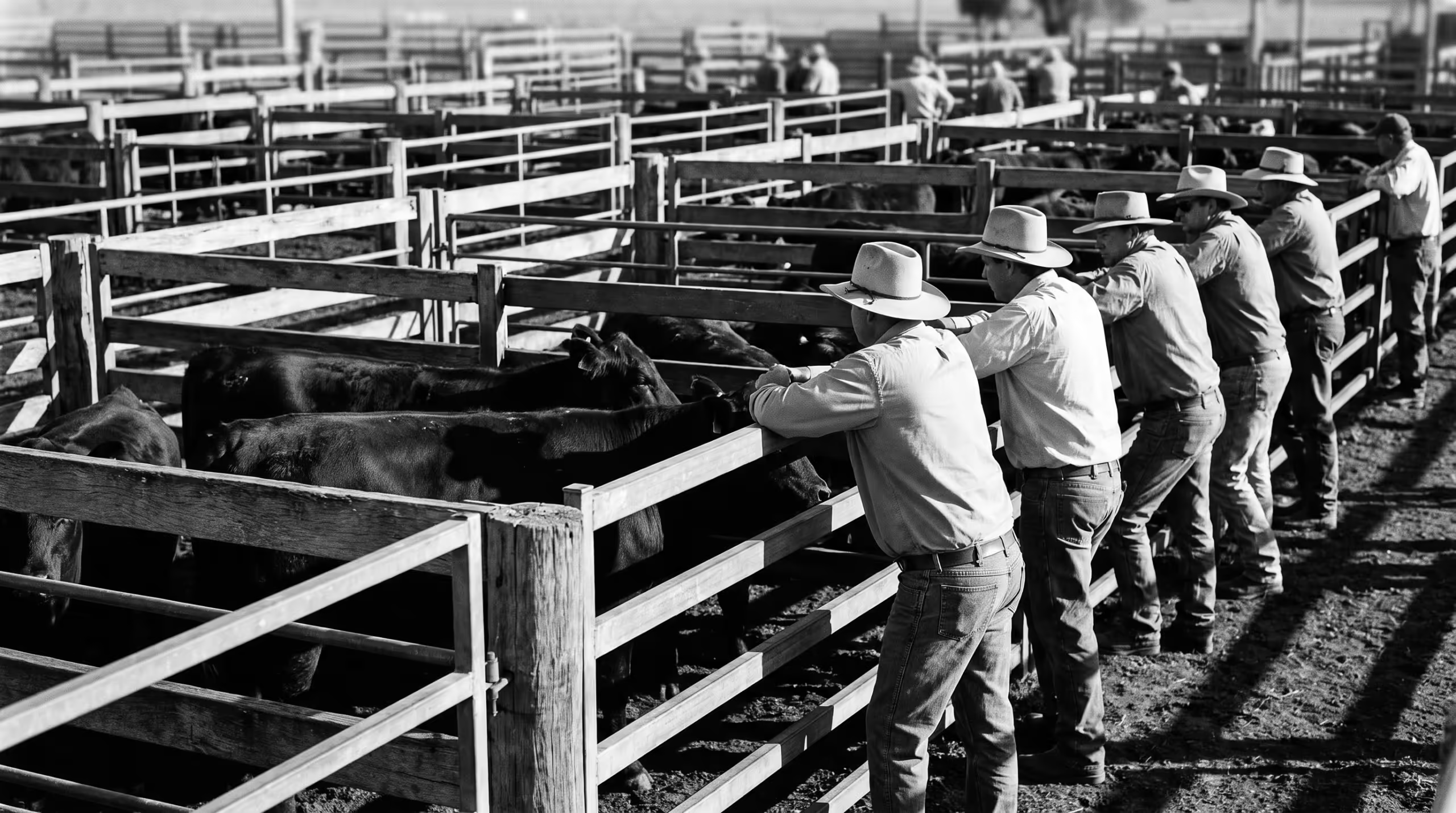

Australian cattle prices come from buyers bidding against each other for the cattle on offer. Saleyards, online platforms and direct deals with processors all set a price. Meat & Livestock Australia (MLA) collects those prices and publishes them as market indicators such as the Eastern Young Cattle Indicator (EYCI). You use the indicators to see where the market sits and to judge when and where to sell.
This guide is the hub for market and price coverage on Cattle Weekly. It explains how the market works, how to read the indicators, what moves prices, and where Australian beef goes. Each section links to deeper articles.
How the Australian cattle market works
Australia has no single cattle price. You sell into a set of connected markets. Each one has its own buyers, its own cattle types and its own price. The main ways to sell are:
- Saleyards. You send cattle to a physical sale. Buyers bid in the ring. The result is public.
- Online auctions. Platforms such as AuctionsPlus let buyers bid on cattle where they stand, with no trucking before the sale.
- Direct to processor. You agree a price per kilogram with a meatworks, often before the cattle leave the property.
- Feedlot contracts. A feedlot agrees to take cattle at set weights and pays on a grid or a flat rate.
- Private sales. You and a buyer, or an agent acting for you, agree a price outside the public system.
Prices from these sales feed back into the indicators. Saleyard results carry the most weight in public data because they are open to everyone. Direct and private sales are harder to see, so MLA reports what it is able to collect. Read the weekly figures as a guide, not as a promise for your own mob.
Different buyers want different cattle. Restockers and backgrounders buy young, lighter cattle to grow out. Feedlots buy feeder steers and heifers to finish on grain. Processors buy finished cattle and cows for meat. Each group chases its own supply, and each group sets its own price. A dry season in one region changes the supply of one type and leaves the others alone.
Prices, weights and units
Two price units cause most of the confusion.
- Cents per kilogram liveweight (c/kg lwt). You get paid for the weight on the scale at the yard.
- Cents per kilogram carcase weight (c/kg cwt). You get paid for the weight of the dressed carcase, after the hide, head, feet and gut are removed.
A carcase price always looks higher than a liveweight price for the same animal. This is because a carcase weighs less than the live animal. Never compare a liveweight figure with a carcase figure. Convert both to the same basis first, or compare dollars per head.
Quality grades also matter. Buyers pay more for cattle with good fat cover, good muscle and a clean bill of health. Cattle outside the usual specifications sell at a discount. Weight and breed type shift the price too. A lighter yearling steer and a heavy export steer sit in different price bands even on the same day in the same yard.
Always know the basis before you act on a number. Ask your agent which unit a quote uses and what the cattle must weigh to earn it.
Get the latest cattle market updates straight to your inbox. Subscribe free to Cattle Weekly’s weekly newsletter. Subscribe here
The Eastern Young Cattle Indicator (EYCI) explained
The EYCI is the most quoted cattle price in Australia. MLA publishes it. It is a seven-day rolling average of young cattle prices from a set list of saleyards in Queensland, New South Wales and Victoria. MLA’s prices and markets section holds the current specification.
Here is how it works. Each day, MLA takes the average carcase price in cents per kilogram for cattle matching the indicator’s rules. It adds the last seven days of results and divides by seven. The figure updates daily.
The rules limit which cattle count. The EYCI covers vealer and yearling steers and heifers between 200 and 400 kilograms liveweight, in the C2 and C3 fat scores. Cattle outside this range stay out of the calculation. AuctionsPlus sales also stay out of it, because the indicator uses saleyard data.
The EYCI has limits you must know about.
- It covers one type of cattle. It tells you about young cattle in the east. It tells you little about cows or heavy steers.
- It averages seven days. A sudden move shows up slowly.
- It reflects saleyard volumes. A small yarding at a few yards moves the number more than a large yarding does.
- It does not cover your district. A producer in Western Australia or the Northern Territory sells into a different market.
Farm media has covered these limits. Producers still use the EYCI as a benchmark because its history runs back for decades. Use it to see direction, not to price a particular mob. Pair it with a saleyard report from your own region. Our article on current cattle saleyard reports across Australia shows where to find them.
Other indicators worth watching
MLA publishes more than the EYCI. Each indicator tracks a different part of the market, so check the one to match your cattle.
- Feeder steer indicator. It tracks the cattle feedlots buy to grain feed.
- Heavy steer indicator. It tracks finished steers heading to processors.
- Restocker yearling steer indicator. It tracks lighter cattle bought to grow out on pasture.
- Processor cow indicator. It tracks cows sold for meat. Cull cow prices drive much of your income if you run a breeding herd.
Read at least two of these together. When the young cattle indicator rises and the cow indicator falls, buyers want growing cattle more than manufacturing meat. The gap tells you which of your cattle is worth holding and which is worth selling.
For a look at what the figures mean in practice, read our cattle prices market report and our summary of the latest MLA cattle report findings.
What moves cattle prices
Four forces move prices. They work together, so a single cause rarely explains a change.
Supply
The number of cattle offered sets the baseline. When seasons are dry, producers sell more cattle, and more cattle on the market pushes prices down. When rain returns, producers hold stock and rebuild herds. Fewer cattle then reach the market and prices lift. This pattern creates the cattle cycle. MLA’s market information and industry projections track herd and turnoff numbers. Our article on the Australian cattle industry forecast sets out the outlook for the herd.
Seasonal conditions
Rain decides how much feed you have. Good feed lets you carry cattle to heavier weights. Poor feed forces early sales. The Bureau of Meteorology publishes climate outlooks you use to plan. Watch rainfall in the main cattle regions of Queensland, New South Wales and Victoria, because their sales shape the eastern indicators.
Export demand
Australia exports a large share of its beef. When overseas buyers pay more, processors bid more for cattle, and your price follows. Trade rules, tariffs, freight costs and the Australian dollar all change the export price. Our guide to the China beef tariff shows how one trade measure feeds back to the farm gate.
Competing supply
Australian beef competes with beef from other exporters. If the United States, Brazil or other suppliers produce more, buyers have more choice, and prices soften. If they produce less, demand for Australian beef rises. ABARES publishes agricultural commodity forecasts covering these global trends.
Where Australian beef goes
Australia sends beef to many countries. The largest markets include the United States, Japan, China and South Korea. MLA publishes monthly and annual export data by market, and the Department of Agriculture, Fisheries and Forestry reports exports by product type.
Each market wants a different product. Japan and South Korea buy chilled and frozen beef in cuts. The United States buys large volumes of lean manufacturing beef, which comes from cows and bulls. China buys a wide range, including frozen cuts and offal. A shift in one market changes prices for one class of cattle more than the others.
Read our history of how Australia became one of the world’s largest beef exporters to see how these markets grew. Our article on Aussie beef on track to break records covers a recent export run.
Trade agreements shape market access. They cut tariffs and open quotas. They also change where processors send product. When a new agreement starts, check which cattle types and cuts it affects, and watch the price signal over the following months.
The cattle cycle
Cattle prices move in cycles, which run for several years. Understanding the cycle helps you decide when to buy, when to hold and when to sell.
A cycle has two halves. In the first half, seasons are poor. Producers sell breeders as well as young cattle because feed runs short. Slaughter numbers rise, the herd shrinks and prices fall under the weight of supply. In the second half, rain returns. Producers keep heifers and cows to rebuild. Fewer cattle reach the market, so processors and feedlots compete for supply and prices rise.
The turn between the halves is hard to pick. Prices often stay low while the herd rebuilds, then lift fast once supply tightens. Producers who sell breeders at the bottom of the cycle often buy them back at a higher price. Producers who hold their core herd through a drought have a lower rebuild cost.
MLA publishes herd and turnoff data in its industry projections. Check the latest edition before you make a big buy or sell decision. Your own cost of production and your own feed position matter more than any projection.
Managing price risk
You cannot control the market, but you control how much of your income depends on one sale date. Several tools spread your risk.
- Forward contracts. A processor or feedlot agrees to buy your cattle at a set price on a set date. You lock in a return and give up the chance of a higher price.
- Grid pricing. A processor pays on a grid of weight and fat score. You earn more for cattle which hit the grid, and less for those which miss.
- Staggered sales. You sell part of the mob early and part later, so one bad week does not set your whole result.
- Different channels. You split sales between the saleyard, online auctions and direct deals.
- Feed reserves. Stored hay or grain gives you the option to hold cattle when prices are weak.
Each tool has a cost. Forward contracts have conditions on weight and quality. Read the terms and ask questions before you sign. A farm accountant or adviser helps you test the numbers.
What the market means for your type of business
The same price move affects producers in different ways.
Breeders
You sell weaners and cull cows. Weaner prices and cow prices matter most. When the market is strong, review your cull rate and keep only the best females. When it is weak, check whether holding weaners to a heavier weight pays you more than selling now.
Backgrounders and restockers
You buy light cattle and grow them out. The gap between your buying price and your selling price decides your margin, so watch both ends. A rise in feeder prices helps you if you already own cattle and hurts you if you need to buy.
Finishers and feedlot operators
You buy feeders and sell finished cattle. Your grain cost matters as much as the cattle price. Check the processor price and the feed price together before you fill pens.
Dairy producers
Dairy farms also sell cattle, in the form of bull calves and cull cows. These sales are small beside milk income, but they add up. Read our guide to dairy cattle farming in Australia for the wider business picture.
Reading a saleyard report
A saleyard report tells you what sold, how many head sold and at what price. Read it in this order.
- The yarding. The number of head offered. A large yarding often leads to softer prices. A small one often leads to firmer prices.
- The quality. Reports describe the mix as good, fair or plain. Plain cattle sell at a discount.
- The price range. Look at the range for your class of cattle and weight. The top of the range goes to the best cattle.
- The buyers. Reports note who bought. Strong feedlot or restocker demand tends to lift the market.
- The trend. Compare this week against last week and last month, not against a single sale.
MLA’s National Livestock Reporting Service collects saleyard data across the country. The MLA prices and markets pages publish the results. If you farm in Queensland, our guide to the cattle market in Queensland adds regional detail.
Choosing when and where to sell
Your sale plan matters as much as the market. Use these steps.
- Know your cost of production. Add feed, labour, health, freight and interest. Never sell below a figure you have not calculated.
- Know your target weight and class. Match your cattle to a buyer, not to a hope.
- Compare channels. Check the saleyard, the online auction and a direct quote on the same day. Compare net prices after freight, commission and shrink.
- Check the season. If feed runs short, selling early beats paying for hay.
- Talk to more than one agent. Ask each what they see on the buyer side.
Freight and shrink cut your return. Cattle lose weight on long trips. A saleyard 400 kilometres away needs a much higher price to beat a yard 50 kilometres away. Work out the net, not the headline.
Welfare and traceability rules apply to every sale. Your cattle need an NLIS tag, and a National Vendor Declaration travels with them. Our guide to the Australian animal welfare standards for cattle covers the transport rules.
How to track the market each week
You do not need to watch the market every day. Set a short routine.
- Check the main MLA indicators once a week.
- Read your regional saleyard report after each sale near you.
- Note the weather outlook for your district and for the main buying regions.
- Read export news for the markets taking your class of cattle.
- Keep a simple log of prices, weights and dates for your own sales.
Your log builds a record of your own results. After a year, you see which channel paid best for your cattle, and which month gave the best return in your district.
Cattle Weekly covers the market in the newsletter and on this site. Our article on key trends in the beef cattle market sets out the longer view.
Frequently asked questions
What is the EYCI?
The EYCI is the Eastern Young Cattle Indicator. MLA publishes it as a seven-day rolling average of young cattle prices from saleyards in Queensland, New South Wales and Victoria. It covers vealer and yearling steers and heifers of 200 to 400 kilograms liveweight.
How are cattle prices set in Australia?
Buyers and sellers set prices by bidding at saleyards and online auctions, and by negotiating direct deals with processors and feedlots. Supply, seasonal conditions, export demand and competing beef supply all move the price.
What is the difference between liveweight and carcase weight prices?
A liveweight price pays for the animal’s weight on the scale. A carcase weight price pays for the dressed carcase. Carcase prices look higher because a carcase weighs less than the live animal. Compare prices only on the same basis.
Where do I find current Australian cattle prices?
MLA publishes indicators and saleyard reports on its prices and markets pages. State agencies and farm media also report sale results. Your local stock agent knows the prices in your district.
Why do cattle prices change so much?
Seasons change supply fast. Dry weather forces sales and lowers prices. Good rain lifts prices as producers hold cattle. Export demand, trade rules and the Australian dollar add further swings.