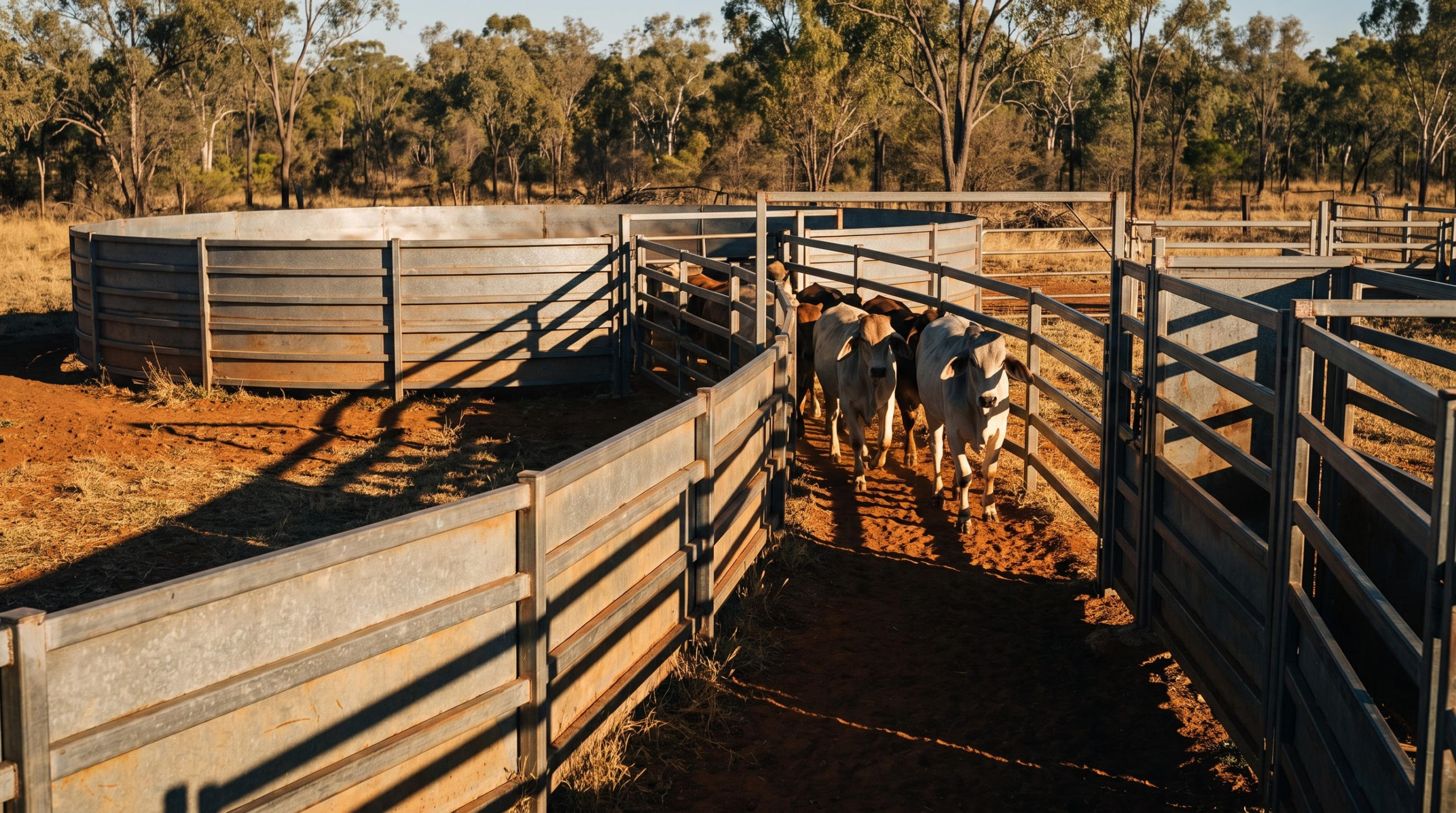

Good cattle yard design in Australia rests on five parts. These are holding yards, a forcing yard, a race, a crush and a loading ramp. Cattle should flow from one part to the next without stopping. Curved races, solid sides and a round forcing yard keep stock calm. Calm cattle move faster and hurt fewer people.
This guide sets out the key measurements from state agriculture departments. You will also find a site checklist and the common mistakes to avoid before you pour a single post.
Why yard design matters
Your yards decide how safe and how fast every job runs. Drafting, drenching, vaccinating, pregnancy testing, weaning and loading all happen in the yards. A poor layout turns a two-hour job into a full day. A poor layout also puts people in the path of stressed cattle.
Safe Work Australia publishes a guide to managing risks in cattle handling. The guide includes a yard design safety checklist and a loading ramp checklist. Run your plan against both before you build.
Good yards also protect carcase value. Bruising and stress before sale cost you money at the works. The Australian animal welfare standards for cattle set out your legal duty for handling stock.
Pick the right site
Site choice comes before design. Get the site wrong and no layout will fix the problem.
- Drainage. Build on a gentle slope with a firm base. Yards on flat clay turn to bog after rain.
- Access. Trucks need all-weather access and room to turn. Plan the truck route before the yard layout.
- Central location. Place the yards where laneways from most paddocks meet. Short walks mean less stress and less weight loss.
- Shade and water. Stock held for long periods need both.
- Room to grow. Leave space to add pens if your herd grows.
Get the latest cattle market updates straight to your inbox. Subscribe free to Cattle Weekly’s weekly newsletter. Subscribe here
The parts of a cattle yard
Receival and holding yards
Holding yards take the mob as it comes in from the paddock. Size them for the largest mob you will work at one time. There is no national standard for yard area per head. Yard makers use figures between 1.5 and 2 square metres per head in their sample designs. Treat these figures as a starting point, and size up for large or horned cattle.
Forcing yard
The forcing yard funnels cattle into the race. A round or half-round forcing yard works best. Agriculture Victoria recommends a half-circle forcing yard because it has no corners for cattle to push their heads into.
A gate inside the forcing yard lets you push cattle up from behind. Western Australian guidance notes a half-circle yard with a gate swinging through 300 degrees lets you work stock from behind the gate at arm’s length. This keeps you out of the mob.
Keep the forcing yard small. A large forcing yard lets cattle turn and break back. Fill the forcing yard to half or two thirds, not to the brim.
The race
The race holds cattle in single file on the way to the crush. Width matters most. NSW DPI sets the internal race width at 675 mm for a straight race and 700 mm for a curved race. NSW DPI also recommends a 750 mm entry from the forcing yard into a curved race. The wider entry stops cattle from bumping their shoulders as they enter.
Agriculture Victoria’s guide for herds of 10 to 50 head sets race panels at 1.5 metres high. A race too wide lets young cattle turn around. A race too narrow jams big steers and cows.
Curve the race where space allows. Cattle move more freely through a curved race because they do not see people standing beside them. A cow standing in the forcing yard should see at least two body lengths up the race. If the race looks like a dead end, she will baulk.
Solid sides
Solid sheeting on the race and forcing yard blocks the view of people, dogs and vehicles outside. Cattle settle and follow the animal in front. Leave a walkway beside the race so you work from outside the race, not from inside.
Crush and head bail
The crush holds one animal for treatment. Place the crush at the end of the race with a clear exit into a drafting area. Put good light on the crush but avoid light shining into cattle’s eyes as they enter. Cattle walk from dark into light more readily than from light into dark.
Set up a side gate or palpation gate behind the head bail if you plan to pregnancy test your cows. Add a vet bench and storage near the crush for drench guns, vaccines and records.
Drafting gates
Drafting gates after the crush split the mob into pens. Plan at least three drafts. Common splits are keepers, sale cattle and stock for treatment. Make the drafting gates easy for one person to swing.
Loading ramp
The loading ramp is often the most dangerous part of the yards. Agriculture Victoria recommends a loading height of 1.2 metres, 750 mm between the rails, and a ramp at least 3.5 metres long. Western Australian guidance adds a level landing of at least 0.8 to 1 metre at the top of the ramp. The landing helps stock step on and off the truck.
WorkSafe Victoria advises any new or replacement ramp meet the livestock ramp standard AS 5340:2020. MLA’s transport hub also covers ramp and forcing yard design for safe loading.
Key measurements at a glance
| Part | Measurement | Source |
|---|---|---|
| Straight race, internal width | 675 mm | NSW DPI |
| Curved race, internal width | 700 mm | NSW DPI |
| Entry from forcing yard to curved race | 750 mm | NSW DPI |
| Race panel height (10 to 50 head) | 1.5 m | Agriculture Victoria |
| Loading ramp height | 1.2 m | Agriculture Victoria |
| Loading ramp width between rails | 750 mm | Agriculture Victoria |
| Loading ramp length | At least 3.5 m | Agriculture Victoria |
| Level landing at ramp top | 0.8 to 1 m | WA DPIRD |
Materials: steel, timber or portable panels
Most new yards in Australia use steel pipe or rail. Steel lasts, needs little upkeep and resists termites. Timber yards cost less to start in some districts but need more repair over time. Portable steel panels suit small herds, leased land, or producers who want to test a layout before they build a permanent yard.
Whatever you choose, check these points:
- No sharp edges, bolts or wire ends at cattle height
- Gate latches you work with one hand from outside the pen
- Escape gaps or steps for people in every pen
- Non-slip flooring in the race, crush and ramp
Size the yards to your herd
A yard built for 30 head will not cope with 300. A yard built for 300 wastes money on a 30-head block. Count the largest mob you will bring in at one time, then add room for growth.
NSW DPI publishes plans by herd size. One of its small-herd plans holds and works about 30 to 35 head. Another handles around 45 head. Agriculture Victoria publishes separate plans for herds of 10 to 50 head and 50 to 300 head. Pick the plan closest to your herd, then adjust.
Small herds and lifestyle blocks
Small herds still need a race and a crush. A vet will not pregnancy test or treat cattle in an open pen. A short race, a crush, one forcing yard and two holding pens cover most jobs on a small block. Portable panels let you add pens later.
Larger commercial herds
Large herds need more holding pens, a longer race and several drafts. Work out how many cattle you put through the crush per hour on a busy day. Size the race and forcing yard to keep the crush full without a break. Add a separate loading pen so the truck does not wait on drafting.
Common yard design mistakes
- Square forcing yards. Corners trap cattle and slow the flow.
- Races too wide. Weaners turn around and block the line.
- Open sides on the race. Cattle see people and baulk.
- Dark crush entries. Cattle stop at the shadow.
- No man gates. Workers climb rails to escape, and falls follow.
- Poor drainage. Mud slows work and causes lameness.
- Truck access as an afterthought. Drivers struggle to back up to a ramp they cannot reach in a straight line.
Plan, draw, then build
Draw the yard to scale on paper or with a free design tool before you buy steel. Walk the plan with the people who will work the yards. Ask your stock agent, vet and transport driver to look at the plan. Each one spots different problems.
State departments publish free sample plans sized for different herd sizes. Start with a plan matched to your herd, then adjust for your site. Yards sit near the top of your set-up costs, so see our guide to the cost of starting a cattle farm in Australia. For the full picture, read our complete guide to beef cattle farming in Australia.
Frequently asked questions
How wide should a cattle race be in Australia?
NSW DPI sets the internal race width at 675 mm for a straight race and 700 mm for a curved race. Use a 750 mm entry from the forcing yard into a curved race.
How high should a cattle loading ramp be?
Agriculture Victoria recommends a loading height of 1.2 metres, 750 mm between the rails and a ramp at least 3.5 metres long. Add a level landing at the top so stock step on and off the truck with ease.
Why use a round forcing yard for cattle?
A round or half-round forcing yard has no corners for cattle to push into. Stock flow toward the race instead of jamming, and you work from behind a gate at arm length.
How much room per head do cattle yards need?
There is no national standard. Yard makers use 1.5 to 2 square metres per head in their sample designs. Size up for large or horned cattle and for long holding times.
Are curved races better than straight races?
Curved races help cattle flow because stock do not see people beside the race. Straight races cost less and suit small yards. Either works if the width and solid sides are right.