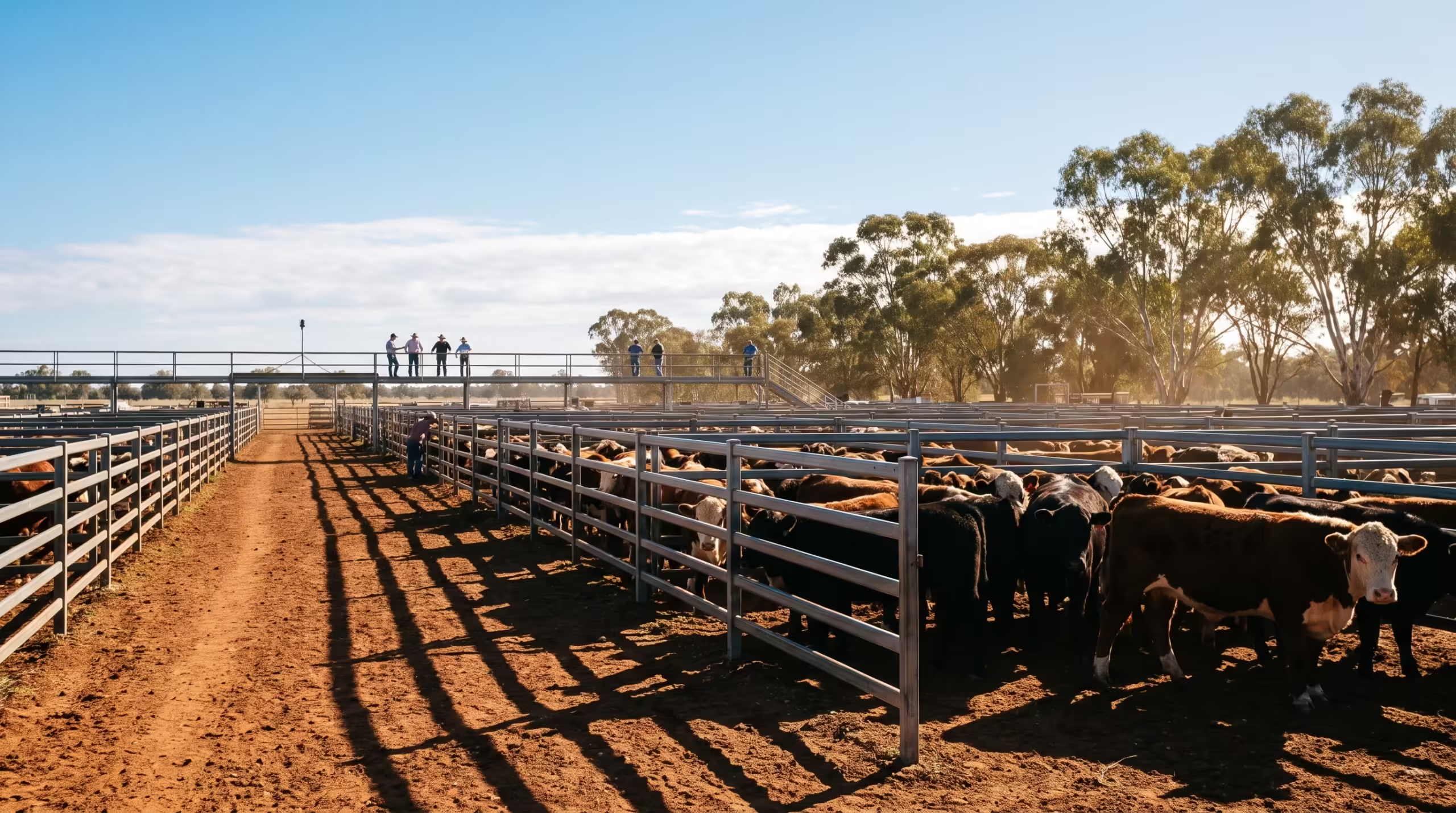

No single saleyard pays the best price for every mob. The best market for your cattle is the one with the most buyers for your type of animal, after you take off freight, fees and shrink. A big feeder sale suits heavy steers. A strong store sale suits weaners. Compare net return per head, not the top price in the paper.
This guide shows you how to compare saleyards on facts. It covers where to find saleyard prices, which costs to count, and when another selling method beats the saleyard. It does not rank named saleyards, because results change with every season and every yarding.
Where to Find Cattle Saleyard Prices
Start with Meat & Livestock Australia (MLA). Its National Livestock Reporting Service (NLRS) sends reporters to sales across the country. According to MLA’s NLRS indicator guide, its reporters cover saleyards across Australia. Each report lists prices by category, weight range and buyer type.
Use these sources each week:
- MLA saleyard reports. Free on the MLA prices and markets page. Filter by saleyard, category and weight.
- MLA indicators. The EYCI, feeder steer, heavy steer and restocker indicators show the wider trend. Our EYCI guide explains how to read them.
- Agent market reports. Your stock agent sees which buyers attend each sale and how hard they bid.
- Cattle Weekly reports. Our state by state cattle market report pulls the main moves together each month.
Read prices in the right unit. Saleyards quote cents per kilogram liveweight. MLA indicators quote cents per kilogram carcase weight. Never compare the two without a conversion.
What Makes One Saleyard Pay More Than Another
Price at a saleyard comes down to competition. More buyers chasing your type of cattle means higher bids. Five factors decide how much competition you get.
Buyer depth for your category
Every sale has its own buyer mix. Some draw strong feedlot buyers. Others draw restockers from a wide area. Processor buyers attend prime sales more than store sales. Ask your agent which buyers attend each sale you consider. Then check the NLRS report for the buyer split on your category.
Get the latest cattle market updates straight to your inbox. Subscribe free to the Cattle Weekly newsletter. Subscribe here.
Size of the yarding
Large sales attract more buyers because buyers fill orders in one trip. A big yarding also lets you sell an even line next to similar cattle. Even lines draw bidders who want volume. Small sales still pay well for good cattle when local demand runs strong. But one missing buyer at a small sale cuts your price hard.
Sale type
Prime sales sell finished cattle to processors. Store sales sell cattle to grow out or feed. Special weaner and female sales draw buyers who travel for numbers. Send each mob to the sale built for it. A pen of light weaners at a prime sale meets the wrong buyers.
Timing
Prices move with the season. Weaner sales in autumn bring large yardings across the south. Rain shifts restocker demand within days. Track your target saleyard’s prices across the year, so you learn when its buyers pay the most for your cattle.
Presentation
Buyers pay for even lines. Draft your cattle into tight weight and condition groups. Keep them quiet, watered and handled well before sale day. Our guide on cattle sales tips for new producers covers drafting and presentation step by step.
How to Compare Saleyards on Net Return
The top price in the sale report tells you little. What matters is the money in your account per head. Work it out the same way for each saleyard you consider.
- Estimate the gross price. Take the recent price range for your category and weight at each saleyard. Use the middle of the range, not the top.
- Estimate the sale weight. Cattle lose weight on the truck and in the yards. Longer trips mean more shrink. Ask your agent what shrink to expect for each trip.
- Work out gross return per head. Multiply the price by the expected sale weight.
- Take off selling costs. Count every fee listed in the table below.
- Take off freight. Get a quote per head or per deck for each trip.
- Compare the net figure. The saleyard with the highest net return per head wins, even if its prices look lower.
Selling costs to count
| Cost | Who sets it | Notes |
|---|---|---|
| Agent commission | Your stock agent | Usually a percentage of the gross sale. Ask for it in writing. |
| Yard dues | The saleyard owner, often the local council | Charged per head. Rates differ between saleyards. |
| Transaction levy | Federal government | Funds MLA, Animal Health Australia and residue testing. Deducted on sale. |
| Transit insurance | Your agent or insurer | Optional at some sales. Check what it covers. |
| Freight | Your carrier | Grows with distance. Often the biggest cost gap between saleyards. |
| NLIS and scanning fees | The saleyard | Some saleyards charge to scan and transfer NLIS devices. |
Fees change. Ask each saleyard and agent for their current schedule before you decide. Write the figures down and run the same sum for each option.
The freight trap
Producers often truck cattle a long way to chase a bigger sale. Sometimes it pays. Often the extra freight and shrink eat the gain. Run the net return sum for both the near and the far saleyard. Only make the long trip when the net figure clearly beats the local sale.
Curfew and shrink
Shrink is the weight your cattle lose between the paddock and the scales. It comes from empty guts, stress and time off water. Every kilogram lost costs you the full sale price per kilogram. Cut shrink with these steps:
- Muster quietly and early, so cattle settle before loading.
- Keep cattle on water until they load.
- Book a carrier who loads on time and drives the shortest route.
- Avoid sales where your cattle wait overnight in the yards before the auction.
Questions to ask your agent
A good agent knows the buyers at each sale. Ask these questions before you book a pen:
- Which buyers attended the last three sales for my category?
- How many head of my type do you expect in the yarding?
- What shrink do you expect on the trip to each saleyard?
- What is your commission rate, and what other fees come off the account?
- Would an online or over the hooks sale suit this mob better?
When to Sell Outside the Saleyard
The saleyard is not your only choice. The FutureBeef program, run by the Queensland, NT and WA agriculture departments with MLA, lists four main selling methods: saleyard auction, paddock sales, over the hooks sales and online auction.
Over the hooks
You sell direct to a processor. MLA defines it as a sale on a cents per kilogram carcase weight basis on delivery. You avoid yard dues and saleyard shrink. You also get a feedback sheet with carcase weight, fat and grading results. The trade off: price grids penalise cattle outside the specification, and you carry the risk until the carcase is graded. This suits finished cattle bred to a known grid.
Online auction
AuctionsPlus sells cattle from the paddock through an online catalogue. Buyers from across the country bid. MLA added AuctionsPlus to its NLRS reports in 2021 and now publishes an online young cattle indicator from its data. Your cattle stay home until sold, so shrink and stress drop. You need a good assessor and honest descriptions to earn buyer trust.
Paddock sales
You sell direct to a buyer at an agreed price, often through an agent. This suits large even lines and repeat buyers. You need a clear contract on weighing, curfew and delivery terms.
Whichever method you choose, your paperwork must be right. Every beast needs an NLIS device and a current National Vendor Declaration. Integrity Systems runs NLIS and the Livestock Production Assurance program. Mistakes on the NVD delay sales and cost money.
Build Your Own Saleyard Record
The best data on your cattle comes from your own sales. Keep a simple record for every mob you sell:
- Date, saleyard or method, and agent.
- Head count, breed and sex.
- Paddock weight and sale weight.
- Price per kilogram and price per head.
- Every fee and the freight cost.
- Net return per head.
- The EYCI and the relevant MLA indicator for the same week.
After two or three years, you will see which sale and which month pay best for your cattle. You will also see how your results track the MLA indicators. ABARES farm survey data gives you a wider benchmark on returns for beef farms in your region.
For the wider market picture, read our Australian cattle market and prices guide. It links every price and trade guide on Cattle Weekly in one place.
Frequently Asked Questions
Which saleyard pays the most for cattle in Australia?
No single saleyard pays the most for every mob. The best sale for you has the most buyers for your type of cattle after freight, fees and shrink. Compare net return per head.
Where do I find cattle saleyard prices?
MLA publishes free saleyard reports through its National Livestock Reporting Service. Each report lists prices by category, weight and buyer type. Your agent adds detail on who bid.
What fees come off a saleyard cattle sale?
Expect agent commission, yard dues, the transaction levy, NLIS scanning fees and optional transit insurance. Freight comes on top. Ask each saleyard and agent for their current rates.
Is it better to sell cattle over the hooks or at the saleyard?
Over the hooks suits finished cattle bred to a processor grid. You avoid yard dues and get carcase feedback. Saleyards suit mixed lines and store cattle where buyer competition lifts price.
Are AuctionsPlus prices included in MLA reports?
Yes. MLA added AuctionsPlus to its NLRS reports in 2021 and publishes an online young cattle indicator from its sales data.