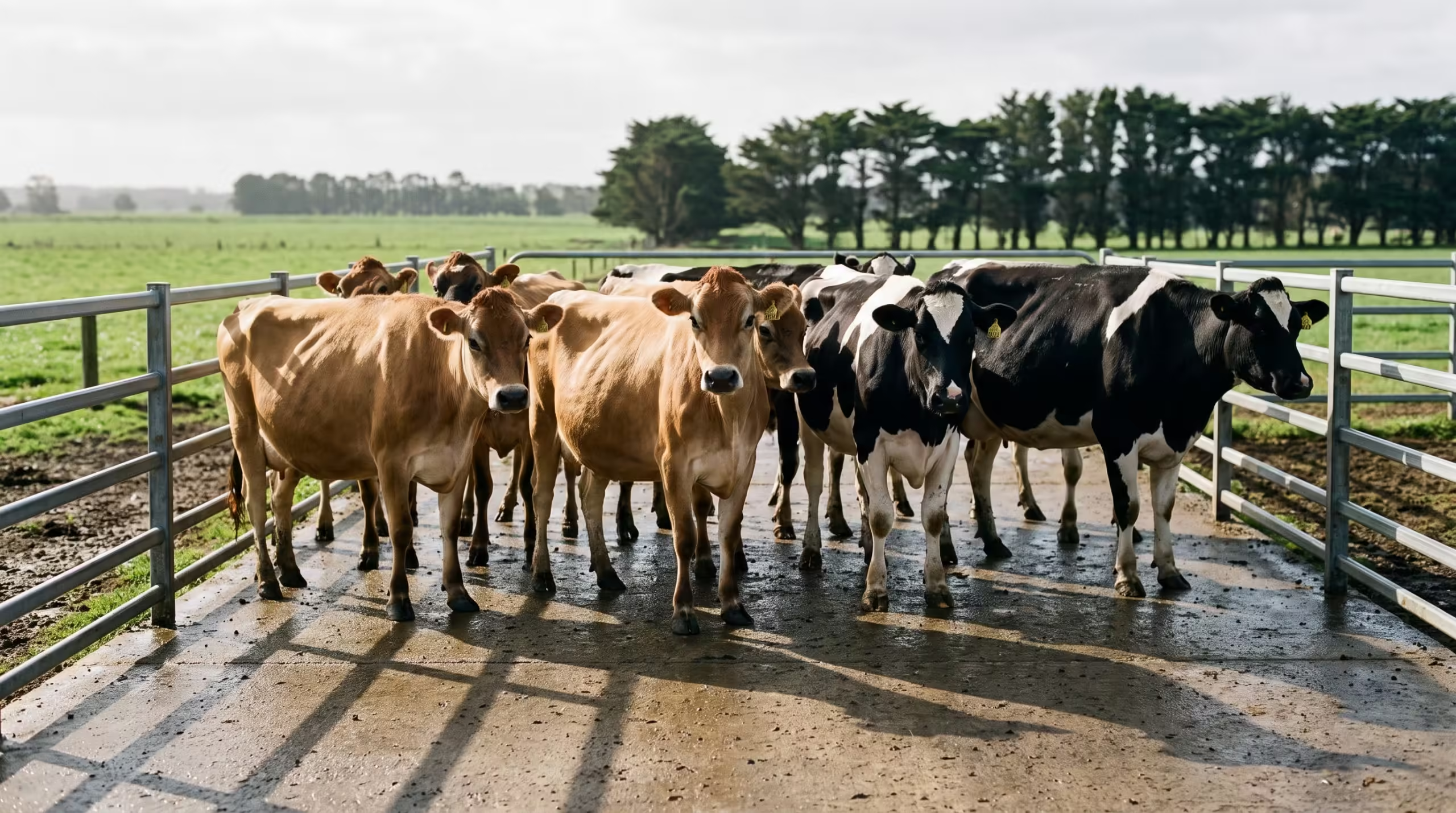

A2 milk farming in Australia pays only if a processor signs you to a contract with a premium. Without a contract, you carry the testing cost and the breeding limits for no extra income. Check the buyer first. Then work out how long your herd needs to convert and what you give up in genetics.
This guide covers the market, the genetics, the conversion steps and a simple sum for your own farm. It looks at the farming decision only. Our separate article covers A2 milk as a consumer product.
What A2 farming means
Beta-casein is a milk protein. A cow carries two copies of the gene for this protein. Each copy is either A1 or A2. A cow with two A2 copies, known as A2/A2, produces milk with no A1 beta-casein.
A2 farming means you milk only A2/A2 cows into a separate milk pool. One A1 carrier in the vat breaks the claim. Your whole system then depends on correct testing and correct records.
The gene passes down in a fixed pattern:
| Bull | Cow | Calves born A2/A2 |
|---|---|---|
| A2/A2 | A2/A2 | All |
| A2/A2 | A1/A2 | Half, on average |
| A2/A2 | A1/A1 | None |
Use A2/A2 bulls only. Every calf from an A1/A1 cow still carries one A1 copy, so test those heifers before you rear them for the A2 herd.
Who buys A2 milk in Australia
The A2 milk market runs on a small number of supply deals. The A2 Milk Company built the category here. By June 2013 it held more than 7.4 per cent of supermarket fresh milk sales by value. This is an old figure. Check the current share before you plan around it.
Two supply arrangements show how the market works:
- Victoria. Kyvalley Dairy Group has supplied the company since 2003. In August 2020 it reported supplying about 55 per cent of the company’s raw milk. It extended the alliance in the same announcement.
- Western Australia. Brownes began packing a2 fresh milk in Perth in 2013 from local herds. Its 2022-23 supply agreement required an a2 certification before milk joined the pool.
These deals tell you one thing. A few businesses control access to this market. Ring them before you buy a straw of semen. Ask whether they want more milk in your district. Ask what certification they require. Ask how long they will commit.
Get the latest cattle market updates straight to your inbox. Subscribe free to the Cattle Weekly newsletter. Subscribe here.
What the premium looks like
Processors rarely publish A2 premiums. We found no current public figure for Australian suppliers. Get the number in writing from your buyer.
The closest public number comes from New Zealand. In 2018, New Zealand farm systems writer Keith Woodford wrote Synlait paid its A2 farmers 20c per kg of milk solids. Woodford disclosed consulting work for dairy companies. Treat this as a reference point and not a price you will receive.
Set any premium against your base price. Opening offers for 2026-27 ran from about $8.20 to $8.80 per kg of milk solids. A 20c premium would add about 2 per cent to these prices. Your processor gap might be larger than the premium. Read our guide to dairy farm profitability before you compare offers.
What the genetics research found
Researchers from Agriculture Victoria and La Trobe University studied Australian Holsteins in 2023. Their findings matter for your breeding plan:
- The share of A2/A2 Holstein cows rose from 32 per cent to 52 per cent between 2000 and 2017.
- A2/A2 cows had better breeding values for protein, by 0.24 of a genetic standard deviation.
- A2/A2 cows had worse breeding values for fertility, by 0.2 of a genetic standard deviation.
- The advantage on the Balanced Performance Index was small, at 0.05 of a standard deviation.
- A2/A2 animals had higher inbreeding, most of all on chromosome 6, where the gene sits.
The authors concluded strong selection for A2 has likely raised inbreeding. They warned this might harm genetic progress over the long term.
You face a real trade-off. Each time you rule out a bull for his A1 status, you shrink your choice of sires. Keep your index and fertility targets in place. Choose the best A2/A2 bulls on those targets. Then manage your matings to limit inbreeding. Dairy Australia publishes bull and herd improvement resources to help with sire choice.
Breed also sets your starting point. New Zealand data cited by Woodford put A2 at 44 per cent of Friesians and 66 per cent of Jerseys. Test your own herd for the real figure. Our guide to dairy breeds covers the other traits to weigh.
How to convert your herd
Step 1: DNA test every animal
Test cows, heifers and calves with a tail hair or tissue sample. A standard milk herd test does not confirm A2 status. Record each result against the animal’s NLIS tag and herd number.
Step 2: Use A2/A2 bulls only
Switch all semen and any natural service bulls on the first day of your next joining. Confirm the status of each bull on paper.
Step 3: Rear only A2/A2 replacements
Your first target is a calf crop where every replacement is A2/A2. Test heifer calves before you spend money rearing them.
Step 4: Cull A1 carriers over time
Sell A1 carriers as your replacements come through. Keep fertility and production in your culling decisions. Test results alone should not decide which cow goes.
Step 5: Separate milk until you finish
Many herds will need a split milking and a separate vat during conversion. Ask your processor what it accepts. Some buyers require the whole herd to be A2/A2.
How long conversion takes
Woodford put the time at six or seven years after all replacements reach A2/A2. This assumed at least 20 per cent replacement each year and steady culling. Herds starting with few A2/A2 cows take longest.
Work out your own minimum. Take a 300-cow herd at the 2017 Holstein average of 52 per cent A2/A2. These numbers show the maths only.
- A2/A2 cows: 156
- Cows to replace: 144
- Replacements each year at 20 per cent: 60
- Fastest possible replacement: 144 divided by 60, or 2.4 years
Your real time runs longer. You need two years to rear each heifer from birth. You will also lose some A2/A2 cows to normal culling, which slows the count.
Questions to ask an A2 buyer
Get each answer in writing. Your contract matters more than any market report.
- Do you need more A2 milk in my collection area?
- What premium do you pay, and how do you calculate it?
- How long does the contract run, and what happens at the end?
- Must the whole herd be A2/A2, or will you accept a split pool?
- Which test results and records do you require?
- What happens if a test finds A1 protein in my vat?
- Who pays for testing and certification?
What goes wrong in A2 herds
Most risks come from records and from the contract. Plan for each one before you start.
- A mixed-up calf. A wrong tag puts an untested animal in the A2 mob. Tag at birth and test against the same tag.
- A bought-in cow. A purchased animal brings an unknown status. Test each one before she enters the dairy.
- A vat error. One wrong cow in the line affects the full vat. Draft A1 carriers into a fixed group and milk them last.
- A lost contract. You keep the narrow bull choice after the premium ends. Keep your genetic index strong so the herd still earns on the base price.
- A fertility slip. Track your six-week in-calf rate each year. Compare it with the years before you changed bulls.
Is A2 farming worth it for your farm?
Run this sum before you commit:
- Multiply the written premium by your annual kg of milk solids.
- Take off yearly DNA test costs and certification costs.
- Take off any extra costs for split milking and record keeping.
- Take off a value for lost genetic gain and any fertility loss.
- Count the years before you receive the premium on all milk.
At 200,000 kg of milk solids, each 10c of premium equals $20,000 a year. Compare this with your costs across the full conversion. Then test the sum with a shorter contract, because your premium ends when the contract ends.
Testing your herd costs little compared with conversion and gives you the facts. Start there even if you do not yet have a buyer. Read more in our guide to dairy cattle farming in Australia and our cattle breeding management tips.
Frequently asked questions
Do farmers get paid more for A2 milk in Australia?
Some do, under a contract with a buyer of A2 milk. Processors rarely publish the premium. Get the figure in writing before you change your breeding plan.
How do you know if a cow is A2/A2?
Use a DNA test on a tail hair or tissue sample. A standard milk herd test does not confirm the status of a cow. Record each result against the NLIS tag.
How long does it take to convert a dairy herd to A2?
Plan on several years. One New Zealand analysis put the time at six or seven years after all replacements reach A2/A2, with at least 20 per cent replacement each year.
Which dairy breed has the most A2 cows?
New Zealand data put A2 at about 66 per cent of Jerseys and 44 per cent of Friesians. In Australian Holsteins, the share of A2/A2 cows reached 52 per cent in 2017. Test your own herd.
Does breeding for A2 hurt herd performance?
A 2023 study of Australian Holsteins found A2/A2 cows had higher protein breeding values, lower fertility breeding values and higher inbreeding. Keep your index and fertility targets when you choose A2/A2 bulls.
See also: Holstein vs Jersey Australia: Which Dairy Breed Pays?.