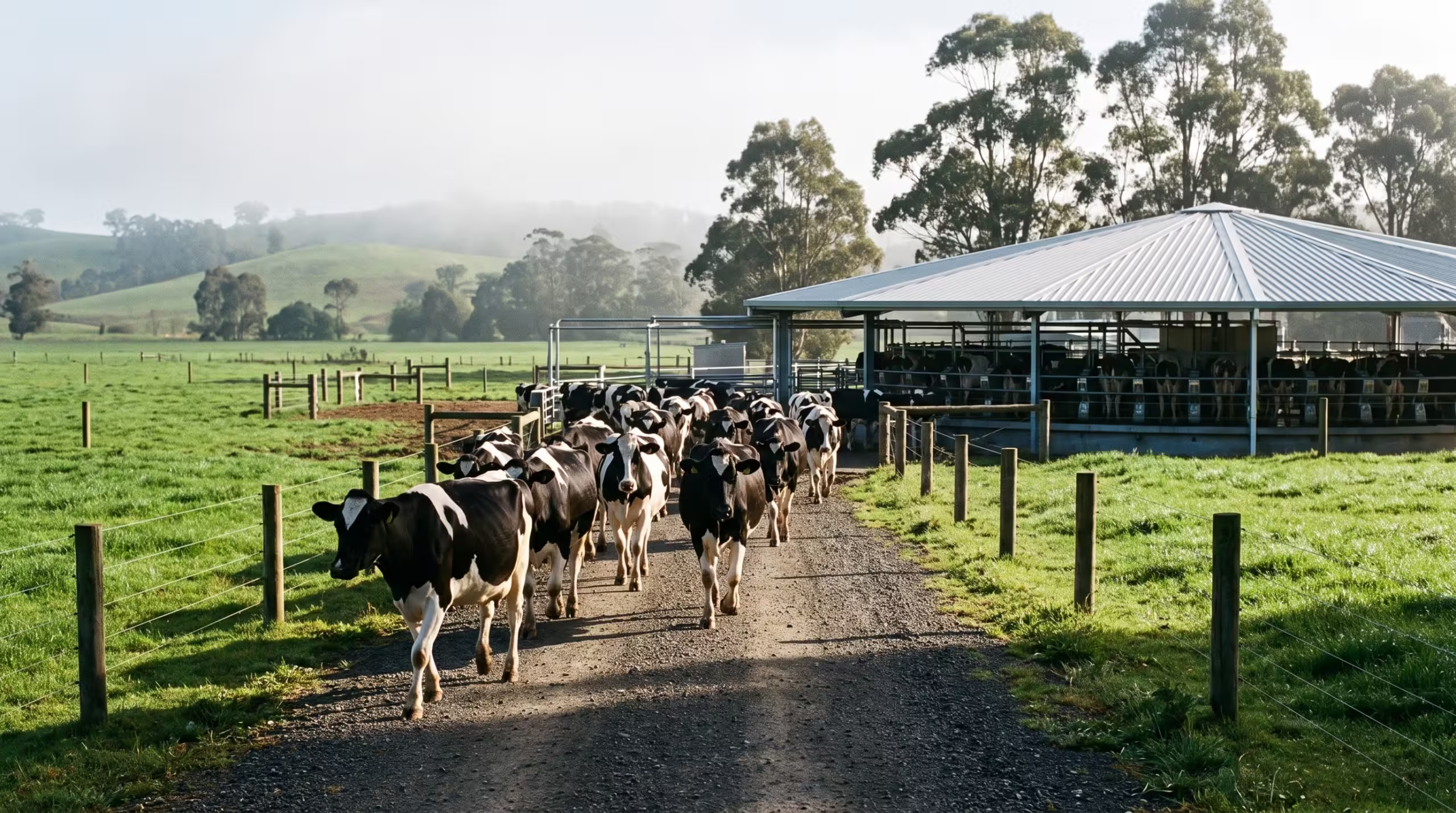

To start a dairy farm in Australia, you need a milk buyer, reliable water, land with a feed base, a dairy and a herd. Secure the milk contract first. Most new entrants do not buy a farm on day one. They lease, sharefarm or work for an owner while they build equity.
This guide walks through each step in order. It shows you what to settle before you spend money. It also names the groups who publish the data you need.
Start with the milk market
Every litre you produce needs a buyer. In Australia, processors collect milk from the farm gate by tanker. A processor will only collect from farms inside its collection area. A farm in the wrong place has no market, however good the pasture is.
Call the processors in the region you like. Ask whether they are taking on new suppliers. Ask what milk quality standards they set. Ask how they price milk and when they announce the opening price for the season.
The Dairy Code sets rules for how processors deal with farmers. It requires a written milk supply agreement and a published farmgate price. The Australian Competition and Consumer Commission (ACCC) administers the code. Read the code before you read any contract.
Dairy Australia, the industry service body, publishes market and price reports each season. Use them to see how prices have moved over time. Read the current Dairy Australia industry reports before you set a budget.
Choose your region
Victoria is the largest dairy state. Its main regions are Gippsland, Western Victoria and the northern irrigation districts. Tasmania has a strong dairy sector on reliable rainfall. New South Wales, South Australia, Queensland and Western Australia also have dairy regions, each with its own feed and climate limits.
Three things decide a region for you:
- Water. Rainfall, irrigation entitlements or both. A dairy herd drinks a lot, and pasture and fodder crops need water to grow.
- Feed supply. Pasture growth across the year, plus the cost of hay, silage and grain nearby.
- Service network. A local vet, an AI technician, a feed merchant, a milking machine service and a reliable processor.
Our Victoria dairy and beef guide covers the state in detail. For the full picture of the industry, start with the complete guide to dairy cattle farming in Australia.
Get the latest cattle market updates straight to your inbox. Subscribe free to Cattle Weekly’s weekly newsletter. Subscribe here.
Pick your entry path
Land is the largest cost in dairy. Few people start by buying a farm outright. You have four main paths.
Work for an owner
You learn the business on someone else’s money. You build skills, savings and a record. Lenders and farm owners look at this record when you ask for a lease or a loan.
Lease a dairy farm
You rent the land, the dairy and the plant, and you buy your own herd. The lease cost is a fixed bill every month. It does not move with the milk price. Test your budget against a low milk price before you sign.
Sharefarm
The owner supplies the land and usually the dairy. You supply labour and, in many deals, the herd. You split income and some costs by agreement. The split varies from deal to deal. Get a lawyer and an accountant to read the contract. Agree in writing who pays for feed, water, repairs and vet bills.
Buy
Buying gives you full control and full risk. Lenders look closely at the milk contract, the water entitlement and your skills. Have your numbers checked by a rural accountant before you make an offer.
Check the land and the water
Look at the land with a plan for feed in mind. A dairy herd eats more per head than a beef herd, and it eats every day of the year. Ask how much of the feed you will grow and how much you will buy.
Stocking rate sets your income. Work out how many cows the farm carries on its own pasture in a normal year, and in a dry one. Our guide on how much land you need to farm cattle in Australia explains the method.
Check water in three ways:
- Does the farm hold a water licence or entitlement, and is it transferable?
- How reliable is the supply in a dry year, and what does extra water cost?
- Is there enough stock water, dairy wash-down water and irrigation water?
Your state agriculture department explains the rules on water access and licensing. Start with Agriculture Victoria or the NSW Department of Primary Industries, depending on your state.
Plan the dairy, plant and effluent
The dairy is the most expensive building on the farm. If you lease or sharefarm, inspect it before you sign. Look at the age of the plant, the number of milking units, the cooling vat and the yards. A tired dairy slows every milking, and you pay for it in labour.
Ask these questions about the plant:
- How many cows does the dairy milk per hour, and how many people does it need?
- When was the last service on the vacuum pump and the vat?
- Does the farm have an effluent system to meet state rules?
Your state regulates dairy food safety. In Victoria, Dairy Food Safety Victoria licenses dairy farms. In New South Wales, the NSW Food Authority does it. Your state environment agency sets effluent rules. Ask both before you build or change anything.
Choose your herd
Buy cows to suit your feed system. Holstein-Friesian is the most common dairy breed in Australia. Jersey cows are smaller and produce milk with a higher fat and protein content. Crossbreds, Australian Reds and other breeds also have a place. Match the breed to your pasture, your climate and the way your processor pays.
Use the genetic data. Datagene publishes Australian Breeding Values and the Balanced Performance Index for dairy bulls. These tools rank animals by profit potential in Australian conditions. Use them to compare bulls and to buy replacement heifers.
Inspect every animal before you buy. Ask for health records and test results. Ask about mastitis history and cell counts. Our guide to cattle breeding management covers the basics of herd fertility.
Register and meet the rules
Every dairy farm needs the same core registrations as any cattle property.
- Property Identification Code (PIC). Your state agriculture department issues it. You need it before cattle move onto the farm.
- NLIS tags. All cattle carry an NLIS ear tag. Integrity Systems runs the national scheme.
- Animal welfare standards. Read our summary of the Australian animal welfare standards for cattle.
- Biosecurity. Keep a visitor log, isolate new animals and know which diseases you must report.
Set up a vaccination and health plan with your vet from the start. Our cattle vaccination schedule is a good base to take to your vet. For the wider picture, see our cattle health hub.
Build the feed plan
Feed is the largest running cost on most dairies. Know where each kilo of dry matter comes from. Pasture is the cheapest source when it grows. You fill the gaps with hay, silage, grain and mixed rations.
Write a feed budget for each month of the year. Mark the months when pasture falls short. Price the extra feed for those months. Then check your milk income covers the bill.
Dairy cows also need the right minerals, or fertility and milk yield fall. Read our guide to cattle mineral supplements. Our cattle nutrition and feeding hub covers the rest.
Test your numbers before you commit
A dairy farm earns money when the milk income beats the cost of production by a safe margin. Build your budget before you buy. Then stress test it.
Use real data to build it. Dairy Australia offers DairyBase, a benchmarking tool for dairy farm businesses. Agriculture Victoria’s Dairy Farm Monitor Project publishes cost of production results for Victorian farms. Compare your budget with farms like yours.
Run your budget at three milk prices: a low one, an average one and a high one. Ask what happens to your cash flow in a dry year. Ask what happens if interest rates rise. If the farm only works at a high milk price, the plan is too tight.
Take the plan to a rural accountant and a rural lender early. They will find gaps you have missed.
Build your skills first
Dairy farming is a daily job with early starts. Cows need milking twice a day, every day. Be sure you like the work before you commit your savings.
Work on a dairy for a season or more. Learn milking routines, calf rearing, pasture grazing and herd health. Dairy Australia and your state agriculture department list training courses and regional programs. A mentor with a similar farm is worth more than any book.
Your first 12 months: a short checklist
- Confirm a processor will collect your milk and read the supply agreement.
- Pick your entry path: work, lease, sharefarm or buy.
- Confirm water access and a feed plan for a dry year.
- Inspect the dairy, plant and effluent system.
- Register your PIC, fit NLIS tags and set a health plan with your vet.
- Build a budget with DairyBase data and have an accountant check it.
- Choose a herd using Datagene breeding values.
Frequently asked questions
How much does it cost to start a dairy farm in Australia?
The cost depends on the region, the size of the herd and whether you buy, lease or sharefarm. Land, water, the dairy and the herd are the four big items. Use Dairy Australia benchmarking data and a rural accountant to build a budget for your own case before you sign anything.
Do you need a milk contract before you buy cows?
Yes. Secure a milk supply agreement with a processor first. A processor must be willing to collect from your gate. Without a buyer the milk has no market, and a herd is a large cost to carry while you wait.
Is sharefarming a good way into dairy?
It lowers the up-front cost because the farm owner supplies the land and often the dairy. You supply labour and, in many deals, the cows. Read the agreement with a lawyer and an accountant. The split of income and costs is where deals succeed or fail.
What licences and registrations does a dairy farm need?
You need a Property Identification Code, NLIS tags for your cattle, a water licence where required and a dairy food safety licence from your state regulator. You also need to meet your state effluent rules. Check each with your state agriculture department before you build.
Which state is best for a new dairy farm?
Victoria produces the largest share of Australian milk, and it has a deep service network. Tasmania, New South Wales, South Australia, Queensland and Western Australia all have dairy regions. The best state is the one where a processor will collect your milk and where you have reliable water and feed.
See also: Best Dairy Cattle Breeds for Australian Conditions.
See also: Mastitis in Dairy Cattle: Prevention and Treatment.