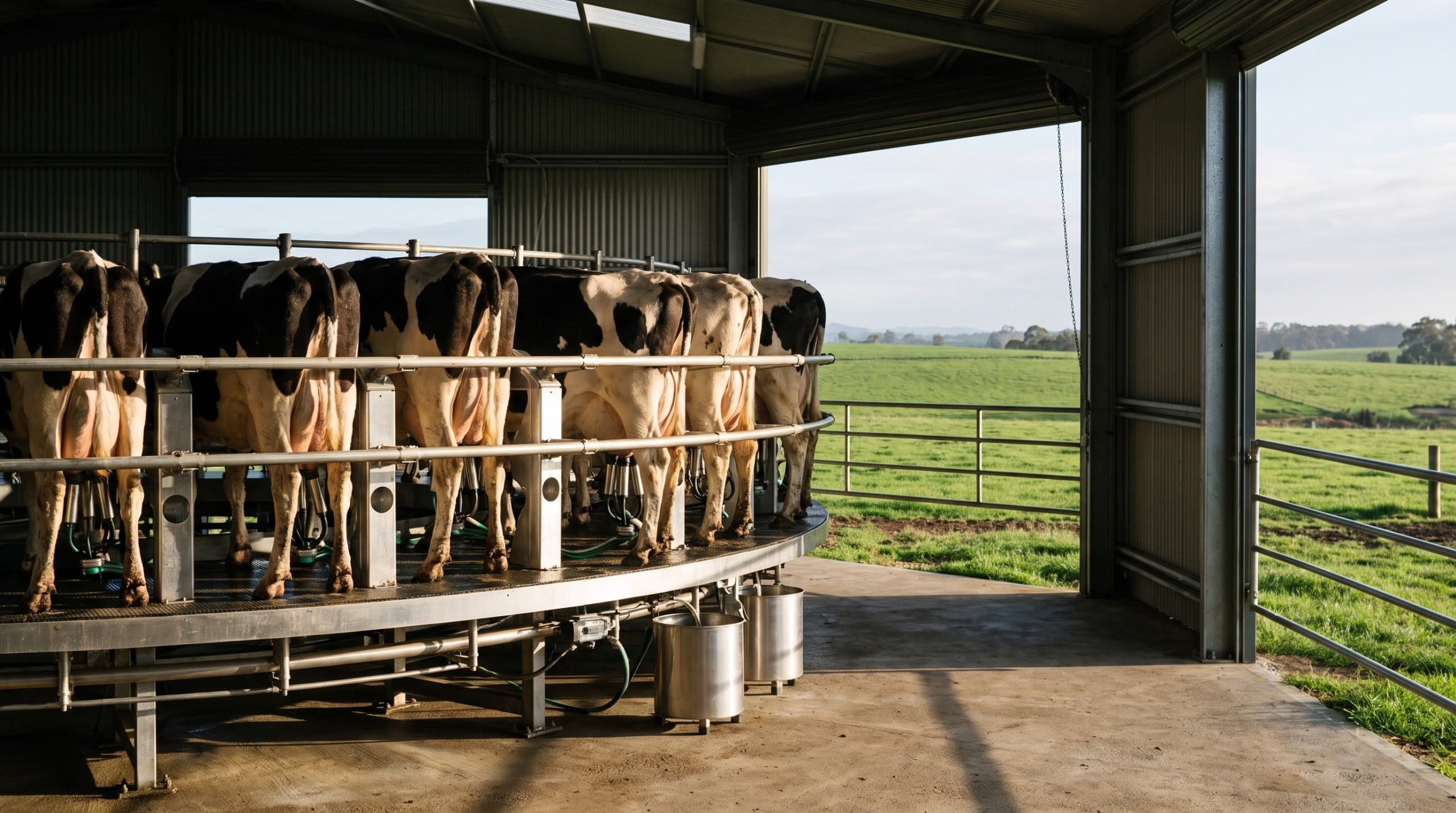

Australian dairy farms use three main milking systems. These are the herringbone shed, the rotary shed and the automatic milking system, or AMS. Herringbones suit small and mid-size herds. Rotaries suit large herds and fast milking. An AMS uses robots and lets cows choose when to be milked. The right choice depends on your herd size, your labour and your debt.
This guide walks through each system. You will see how each one works, what the research says about speed and labour, and which add-on technology pays its way. It also lists the questions to ask before you sign a quote for a new shed.
The three main milking systems in Australia
Every milking shed does the same job. It gets cups on, gets milk out, and gets cows back to the paddock. The layout decides how fast the job gets done and how many people you need.
Herringbone sheds
The herringbone is one of the most common sheds in Australia. Dairy Australia’s consumer guide describes the layout. The operator stands in a sunken pit. Cows stand on a raised platform on each side, at an angle to the pit.
There are two common set-ups:
- Double-up herringbone. Each side has its own set of milking units. You milk both rows at once.
- Swing-over herringbone. One set of units swings across the pit. You milk one side while the other side loads.
Herringbones cost less to build than rotaries. They are simple to fix and easy to extend by a few bails. The weak point is speed. Each row has to finish before the next row comes in. One slow cow holds up the whole row.
Rotary sheds
A rotary shed is a large round platform. It turns slowly while cows are milked. Each cow steps on, gets cups on at the entry point, and steps off after one turn. The operator stays in one place. The cows come to you.
Rotaries suit large herds. The flow is steady, so one slow cow does not stop the rest. You set the platform speed to match your herd. A cow not finished by the exit goes round a second time.
The trade-off is cost. A rotary needs a bigger shed, a bigger platform and more units. It also needs more power and more parts to service.
Automatic milking systems (robots)
An AMS milks cows without a person at the cups. A robot arm finds the teats, cleans them, attaches the cups and takes them off. Cows walk in when they choose. Feed in the bail or in the paddock draws them in.
Dairy Australia lists three types of AMS sold in Australia:
- Single box systems. One robot milks in one stall.
- Multi box systems. One robot arm serves several stalls.
- Automatic rotary. Robots attach cups on a rotary platform. Cows face out and the robots sit in the centre.
Robots still need people. You fetch cows who do not come in, check alerts and keep the units clean. The work moves from the pit to the paddock and the computer.
What the research says about speed and labour
Speed matters because milking time is your biggest daily labour cost. Two milkings a day, every day, add up fast.
Herringbone vs rotary throughput
Irish research compared herringbone and rotary sheds on working farms. Teagasc found herringbone farms milked an average of 94 cows an hour. Rotary farms milked 170 cows an hour. Rotaries also milked more cows per operator.
The same study looked at a second operator. A second person lifted cows per hour in both shed types. But each person milked fewer cows. So the extra wage bought speed, not efficiency.
Irish farms run pasture-based herds like many in southern Australia. Use these figures as a guide, not a promise. Your own numbers depend on bail count, cow flow and how your yard fills.
Robots vs conventional sheds
The Milking Edge Project looked at AMS farms in Australia. NSW DPI ran it with Dairy Australia and DeLaval. The 2025 release found AMS on about 1.5% of Australian dairy farms.
The key findings:
- AMS farms got economic and physical results close to conventional farms.
- The main gain was labour. Staff spent more time on pasture and other jobs.
- Profit depended more on cows milked per robot than on how often each cow was milked.
The last point matters. A robot is a fixed cost. Each extra cow through the box spreads the cost further. A robot milking too few cows will struggle to pay its way.
Get the latest cattle market updates straight to your inbox. Subscribe free to Cattle Weekly’s weekly newsletter. Subscribe here.
Milking technology you add to any shed
You do not need a new shed to cut milking time. Several add-ons fit herringbones and rotaries.
Automatic cup removers
Automatic cup removers, or ACRs, take the cups off when milk flow drops. They stop over-milking and free the operator to move on.
A study in the Australian Farm Business Management Journal tested the economics of ACRs. It modelled double-up herringbones, swing-over herringbones and rotaries. The study used a cost of $1,700 per cluster, plus $15 a year in upkeep. Those are 2012 figures, so get current quotes. The study found ACRs a good investment in a 50-unit rotary at any herd size it tested. It assumed ACRs cut the labour needed, not the time taken to milk.
Some research suggests a higher ACR take-off setting can shorten milking time without hurting yield. Talk to your milking machine technician before you change settings.
Rapid exits and backing gates
Rapid exit bails let a whole herringbone row leave at once. Backing gates push cows forward in the yard. Both cut the dead time between rows. Teagasc found ACRs and rapid exits cut row times in herringbones.
Milk meters, ID and herd software
Electronic ID reads each cow as she enters. Milk meters record her yield. Herd software links the two. You spot a cow whose yield drops before she looks sick.
Many systems also track conductivity in the milk. A rise in conductivity often comes before clinical mastitis. Early warning means earlier treatment. Read our guide to mastitis in dairy cattle for the full prevention plan.
Activity collars and heat detection
Collars and tags measure how much each cow walks and ruminates. A jump in activity flags a cow on heat. A drop in rumination flags a cow off her feed. These tools pay best in herds where you struggle to watch every cow.
How to choose the right system for your farm
No single system wins on every farm. Work through these five questions.
1. How many cows will you milk in ten years?
A shed lasts decades. Build for the herd you plan to run, not the herd you run today. A herringbone you outgrow in five years costs you twice.
2. What does labour cost you, and is it easy to find?
Many dairy districts struggle to find milkers. If labour is your main limit, a rotary with ACRs or an AMS deserves a close look. If family labour is cheap and reliable, a herringbone keeps your debt down.
3. How does your farm lay out?
Robots need cows to walk to the dairy on their own. Long walks cut visits to the box. Farms with a central dairy and short laneways suit AMS best. Farms with long runs often suit a conventional shed better.
4. How much debt will the business carry?
A new shed is often the biggest single spend on a dairy farm. Run the numbers on your milk price, your cost of production and your interest rate. Our guide to dairy farm profitability in Australia sets out the key benchmarks.
5. Who will service it?
Check the nearest technician for each brand. A robot down at 3 am needs a fast call-out. Ask other farmers on the same brand how long they wait for parts.
Running costs to plan for
The purchase price is only the start. Budget for these costs every year:
- Power. Vacuum pumps, milk cooling and hot water use the most. Variable speed drives on vacuum pumps cut power use.
- Rubberware. Liners wear out and need regular change. Worn liners hurt teat health.
- Machine testing. Have a trained technician test your plant at least once a year.
- Water and chemicals. Plant wash and yard wash use large volumes.
- Service contracts. Robots often need a paid service plan.
Ask each supplier for a full running cost estimate. Compare them on the same herd size and the same milkings per day.
Getting started
Start with a visit. Most dairy farmers will show you their shed if you ask. See a herringbone, a rotary and a robot farm close to you. Ask what they would change.
Then use the DairyNZ shed efficiency calculator to test layouts. It estimates milking time and labour for herringbone and rotary sheds.
If you are still planning your farm, read how to start a dairy farm in Australia. For the full picture of the industry, see our guide to dairy cattle farming in Australia.
Frequently asked questions
What is the most common milking shed in Australia?
The herringbone is one of the most common sheds in Australia. Cows stand on a raised platform on each side of a sunken pit. Rotary sheds are common on larger farms.
How many Australian dairy farms use robotic milking?
A 2025 NSW DPI release on the Milking Edge Project put automatic milking systems on about 1.5% of Australian dairy farms. The project ran with Dairy Australia and DeLaval.
Is a rotary dairy faster than a herringbone?
Yes, in most cases. Irish research by Teagasc found rotary farms milked an average of 170 cows an hour. Herringbone farms milked 94 cows an hour.
Are robotic milking systems profitable in Australia?
The Milking Edge Project found robot farms got results close to conventional farms. Profit depended most on the number of cows milked per robot. The main gain was freed-up labour.
Do automatic cup removers pay for themselves?
An Australian study found ACRs a good investment in a 50-unit rotary at the herd sizes it tested. They cut the labour needed during milking. Get current quotes, since the study used 2012 prices.