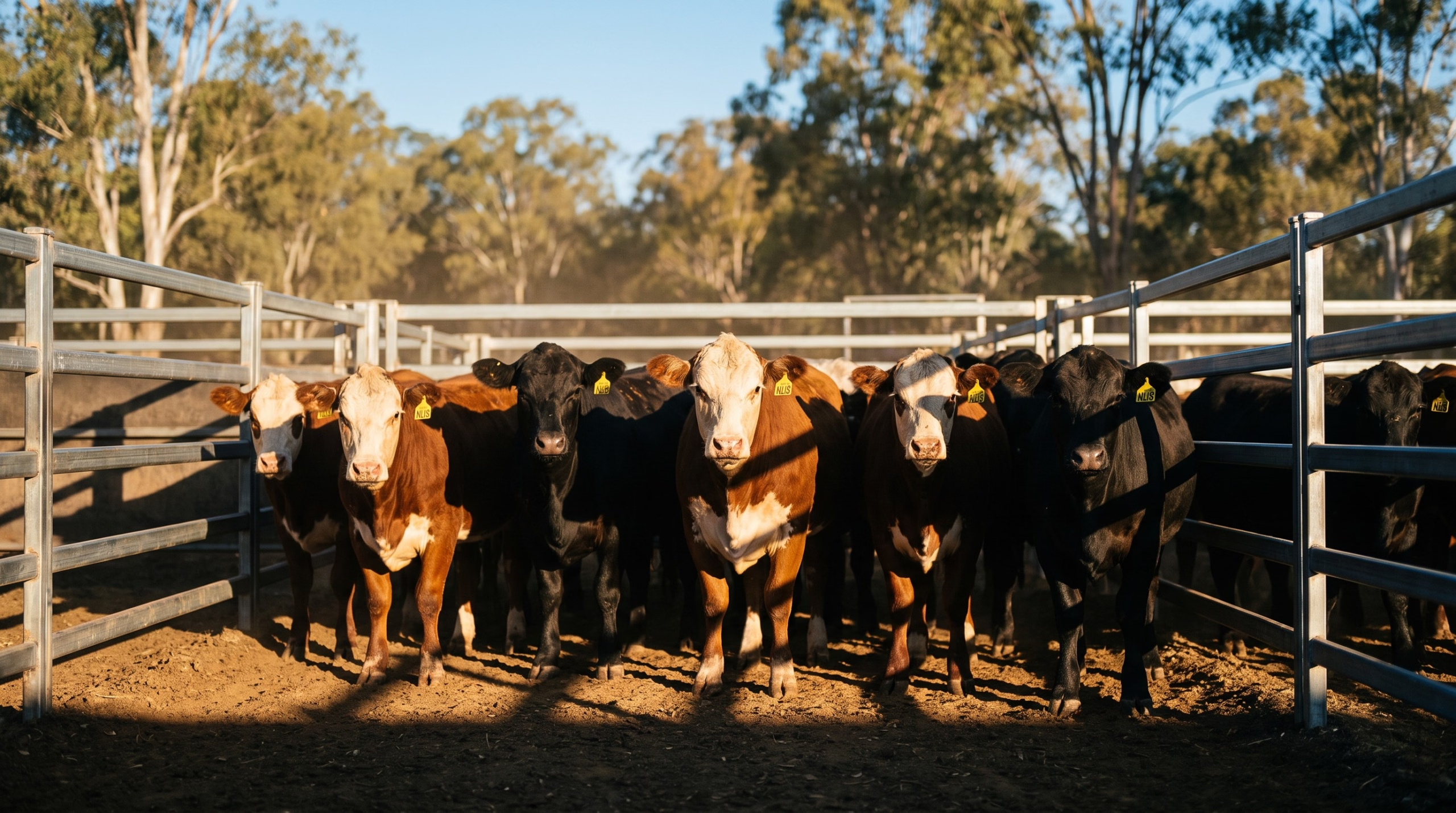

Australian beef exports run under the Export Control Act 2020. The Act took effect on 28 March 2021. Export beef must come from a registered establishment. The exporter needs an export meat licence and an export permit for each consignment. Each buyer country then adds its own rules. Producers feed this system through NLIS tags, LPA accreditation and the National Vendor Declaration.
You do not need an export licence to sell cattle to a processor. But your paperwork decides which markets your cattle qualify for. A missing tag or a wrong tick on an NVD will rule a mob out of a premium market. This guide sets out the whole chain, from your yards to the ship.
The law behind Australian beef exports
The Department of Agriculture’s outline of the Export Control Act 2020 sets out how the system works. The Act sits on top of a set of Export Control Rules. The rules for beef sit in the Export Control (Meat and Meat Products) Rules 2021.
Under these rules, you cannot export prescribed meat unless you meet the set export conditions. The rules cover four main things:
- Establishment registration. Abattoirs, boning rooms and cold stores must register.
- Licensing. Exporters of beef, sheep meat and goat meat need an export meat licence.
- Permits. Each consignment of prescribed goods needs an export permit.
- Approved arrangements. Each registered site runs an approved plan for how it meets the rules.
Registered establishments
Registration is the main tool the department uses to make sure exports meet buyer country rules. The department’s registration page explains the process. A registered site has inspection staff on hand. It runs to a written approved arrangement. It faces audits.
Some buyer countries also list approved plants by name. A plant must be on the list for each market it ships to. So two processors near you might pay different prices for the same steer. One might hold China and the EU listings. The other might not.
Export meat licences
Anyone exporting beef must hold an export meat licence. The export meat licence fact sheet explains who needs one. The department assesses the applicant and each nominated person. The licence sits with the exporting business, not the farmer.
Export permits and certificates
Each shipment needs an export permit. Many shipments also need a government certificate. The certificate tells the buyer country the beef meets its rules. The department issues both through its electronic systems.
Get the latest cattle market updates straight to your inbox. Subscribe free to Cattle Weekly’s weekly newsletter. Subscribe here.
Where producers fit in the export chain
Exporters and processors carry the licences. Producers carry the proof. Every export certificate rests on records from the farm. Three systems hold those records. Integrity Systems Company, a subsidiary of MLA, runs all three.
NLIS: tracking every animal
The National Livestock Identification System, or NLIS, tracks cattle for life. Each animal carries an electronic tag linked to its Property Identification Code, or PIC. Every move between PICs goes into the NLIS database.
Buyer countries trust Australian beef because of this trace. If a disease or residue problem shows up, the system finds every property the animal lived on. Untagged or wrongly transferred cattle weaken the trace. Our article on cattle tracking technology covers the tags and readers in more detail.
LPA: on-farm food safety
Livestock Production Assurance, or LPA, is the on-farm food safety program. LPA-accredited producers agree to rules on chemical use, animal treatment records and biosecurity. You renew LPA every three years. Accreditation lets you use LPA NVDs.
The National Vendor Declaration
The NVD travels with every mob you sell. On it you declare:
- Whether the cattle were treated with a hormone growth promotant, or HGP.
- Whether any animal is in a withholding period for a chemical or vaccine.
- Whether the cattle were fed animal products.
- How long the cattle lived on your property.
Processors read the NVD to decide which markets each carcase qualifies for. A wrong answer sends beef to the wrong market. It also puts you in breach of the law. Fill in every question. If you are unsure, ask your agent before the truck leaves.
Market rules reaching back to the farm
Each buyer country sets its own rules. The department lists them in the Manual of Importing Country Requirements, called MICoR. MICoR is the main reference for exporters. Rules change often, so exporters check it before each shipment.
HGP-free markets and the EU
The European Union bans beef from cattle treated with HGPs. To supply the EU, cattle must come from properties in the EU Cattle Accreditation Scheme, known as EUCAS. EUCAS cattle need a full HGP-free history from birth. Every property in the chain must hold EUCAS accreditation. One untracked move or one HGP-treated animal breaks the chain for the animal.
Some domestic and export programs also pay a premium for HGP-free cattle. Ask your processor which programs they buy for.
Grid specs and grain-fed programs
Japan, Korea, China and the USA each buy different cuts and grades. Many programs set limits on age, fat, marbling and days on feed. AUS-MEAT language sets how these traits are described in the trade. Your processor’s grid tells you which specs earn a premium. Our guide to grain finishing cattle explains how feedlots target these grids.
Trade access and tariffs
Market access deals set the tariff each country charges on Australian beef. A tariff change moves the price processors pay at the saleyard. Read our analysis of the China beef tariff and its impact on Australian farmers for one recent example. For the history of how Australia built these markets, see how Australia became one of the world’s largest beef exporters.
Live cattle exports follow separate rules
Live cattle exports sit under different rules from boxed beef. Exporters must meet the Australian Standards for the Export of Livestock, known as ASEL. They also run an approved supply chain under the Exporter Supply Chain Assurance System, or ESCAS. ESCAS covers animal welfare and tracking in the buyer country, through to slaughter.
For producers, the farm-level duties look much the same. Cattle need NLIS tags, an NVD and a clean treatment record. The exporter or their agent sets the extra specs for weight, breed and pregnancy status.
What happens to your cattle at the processor
Your cattle arrive at the plant with an NVD and NLIS tags. Staff scan each tag on arrival. The scan links each animal to your PIC and its full move history. The plant then checks the NVD answers against the markets it plans to supply.
Government vets and meat inspectors check each animal before and after slaughter. They look for disease, injury and signs of chemical residue. The National Residue Survey tests samples from export plants. A positive residue test traces back to the property of origin through NLIS.
After grading, each carcase gets sorted by market. A carcase from an EUCAS animal with clean records goes to the EU list. A carcase with a missing tag history might only qualify for markets with looser rules. The price gap between those markets comes back to you through the grid.
Common mistakes and what they cost you
Most export problems start with small paperwork slips. Here are the ones processors and agents see most:
- Lost tags not replaced. An animal with a replacement tag needs the old history linked. Without the link, the animal loses its lifetime trace.
- Late NLIS transfers. Cattle bought in and not transferred still sit on the seller’s PIC. The trace then shows the wrong property.
- Blank NVD questions. A blank answer counts as a fail for many programs. The processor has to assume the worst.
- Out of date NVD books. Integrity Systems updates the NVD form from time to time. Use the current version or the eNVD.
- Treatment records kept in your head. An LPA audit asks for written records. Memory does not pass an audit.
Each slip costs money. Downgraded cattle earn a lower grid price. A residue breach leads to trace-back, extra testing and loss of program access. Ten minutes on records before each sale protects the whole mob.
The eNVD system helps. It fills in your PIC and LPA details for you and sends the form to the buyer before the truck arrives. Many agents and processors now prefer it.
A compliance checklist for producers
Work through this list before each sale:
- Check your PIC. Make sure your PIC details are current with your state department.
- Tag every animal. Use an NLIS tag before cattle leave your property.
- Record every move. Complete NLIS transfers on time for cattle you buy in.
- Keep LPA current. Diarise your three-year renewal date.
- Keep chemical records. Log every drench, pour-on, vaccine and treatment, with dates.
- Respect withholding periods. Check export slaughter intervals, not only the domestic period.
- Fill in the NVD in full. Answer every question. Sign and date it.
- Keep EUCAS status clean. If you hold EUCAS, never mix in non-EUCAS cattle.
For more on how export demand flows through to the price you get, read our hub on the Australian cattle market.
Frequently asked questions
What law controls beef exports from Australia?
The Export Control Act 2020 controls beef exports. It took effect on 28 March 2021. The Export Control (Meat and Meat Products) Rules 2021 set the detailed rules for beef.
Do farmers need an export licence to sell cattle for export beef?
No. The exporter holds the export meat licence and the processor holds the site registration. Producers supply NLIS tags, LPA accreditation and a complete NVD.
What is EUCAS?
EUCAS is the EU Cattle Accreditation Scheme. It lets Australian cattle supply the European Union, which bans beef from cattle treated with hormone growth promotants. Every property in the chain must hold EUCAS accreditation.
What is MICoR?
MICoR is the Manual of Importing Country Requirements. The Department of Agriculture keeps it. It lists the rules each buyer country sets for Australian exports.
How often do you renew LPA accreditation?
You renew LPA accreditation every three years. LPA lets you use LPA National Vendor Declarations when you sell cattle.