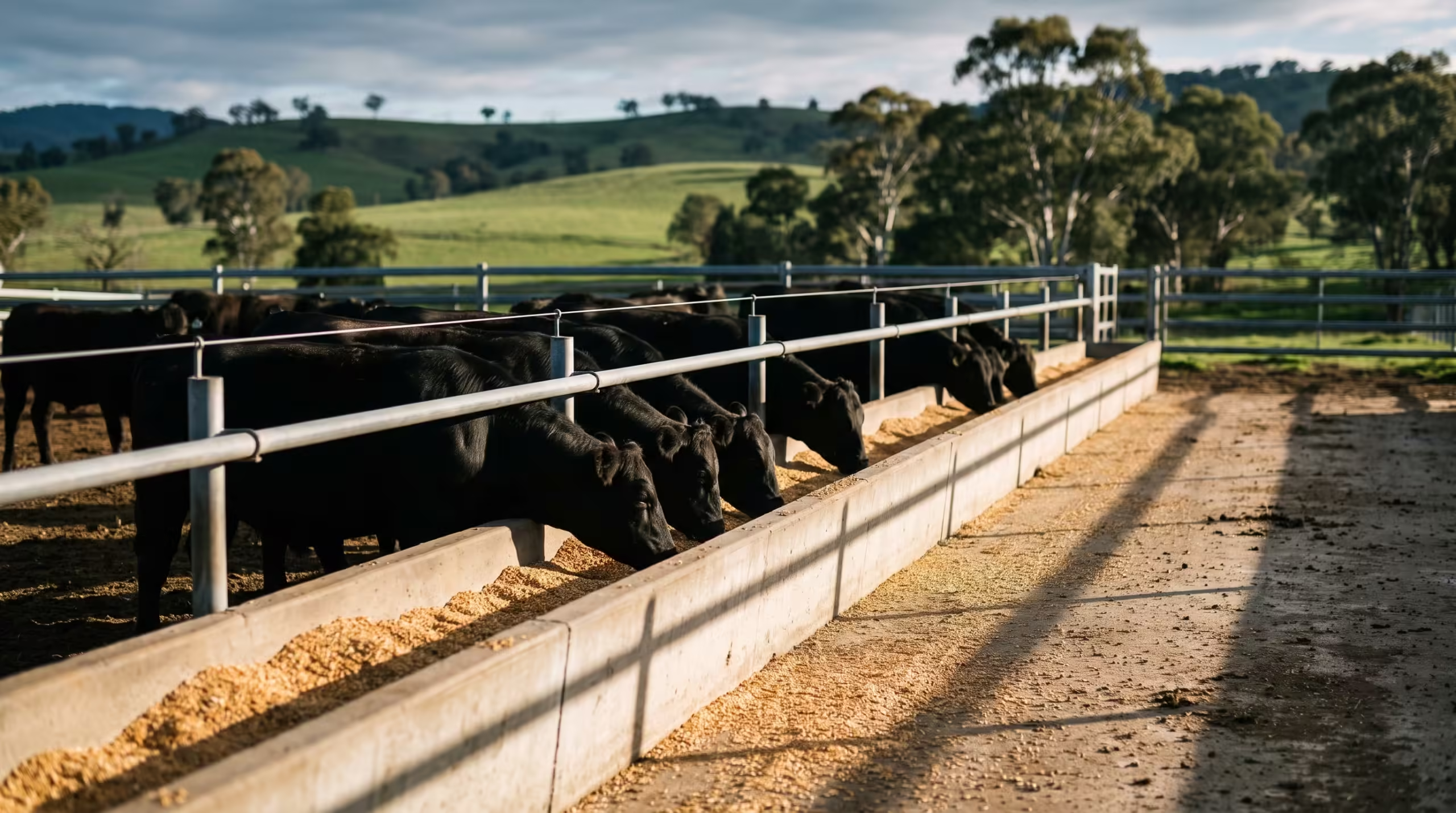

Feed efficiency tells you how much beef your cattle turn out from the feed they eat. You measure it two main ways. Feed conversion ratio (FCR) divides the feed eaten by the weight gained. Net feed intake (NFI) compares what an animal eats with what it should eat for its size and growth. Feed is the biggest cost in most beef systems, so a small gain in efficiency flows straight to your margin.
This guide shows you how to work out each measure, where each one fits, and how to use feed efficiency figures when you buy bulls. It also covers grazing herds, where you rarely weigh the feed at all.
What Feed Efficiency Means
Feed efficiency is output divided by input. The output is liveweight gain, carcase weight or calves weaned. The input is feed, measured as dry matter (DM). Dry matter is the feed left once you take out the water. Always compare feeds on a dry matter basis, since silage and green pasture carry a lot of water.
Producers and researchers use several measures. Each one answers a different question.
- Feed conversion ratio (FCR). Kilograms of feed eaten per kilogram of liveweight gain. A lower number is better.
- Feed conversion efficiency (FCE). The same figure flipped. Kilograms of gain per kilogram of feed. A higher number is better.
- Net feed intake (NFI). Actual intake minus predicted intake for an animal of the same weight and growth. A negative number is better. Researchers overseas call this residual feed intake (RFI).
- Beef per hectare. Kilograms of beef produced per hectare per year. This suits grazing businesses, where pasture is the feed.
Why FCR and NFI give different answers
FCR rewards fast growth. A big, fast growing steer often posts a good FCR because he puts on more weight each day. He also eats more and grows into a bigger cow herd over time if you keep his daughters. NFI strips out size and growth. It asks one question: does this animal eat less than expected for the work it does? Two steers with the same weight and the same gain still differ in NFI. The one eating less is the efficient one.
How to Measure Feed Conversion Ratio
FCR is the easiest measure to run on your own place. You need two numbers for a mob over a set period.
- Feed eaten. Record every load fed out in kilograms. Convert to dry matter using the DM percentage from a feed test.
- Weight gained. Weigh the mob at the start and the end. Use the same scales and the same time of day. Curfew the cattle the same way both times.
Divide total dry matter eaten by total kilograms gained. Here is a worked example. These are example figures only, not industry benchmarks. A pen of 50 steers eats 70,000kg of dry matter over 100 days. The pen gains 10,000kg in total. Your FCR is 70,000 divided by 10,000, which gives 7.0. Those steers ate 7kg of dry matter for every 1kg of gain.
Track FCR for each mob, each year. The trend tells you more than any one figure. Compare mobs on the same ration and the same weight range. A light weaner and a heavy feeder steer never post the same FCR, because heavier cattle need more feed to hold their own weight.
Common FCR mistakes
- Ignoring dry matter. Wet feeds look like more feed than they are. Test every new batch of silage or hay.
- Not counting waste. Feed trampled into the ground or blown off the bunk never reached the animal. Estimate waste and take it off.
- Weighing full cattle. Gut fill swings by many kilograms. Weigh after the same curfew at the start and end.
- Short test periods. A two week test picks up gut fill, not growth. Run the test for a full feeding period.
Get the latest cattle market updates straight to your inbox. Subscribe free to the Cattle Weekly newsletter. Subscribe here.
How Net Feed Intake Works
NFI needs the feed intake of each animal, not the mob. Single animal testing takes special gear. Automated feeders read each animal’s ear tag and weigh every mouthful it takes. The animal gets weighed often over the same period.
The MLA final report on NFI testing at Tullimba describes the method. The University of New England’s Tullimba research feedlot uses GrowSafe feeders. Each animal has its intake and liveweight measured on an ad lib ration for at least 70 days.
The test then runs in three steps:
- Measure each animal’s daily dry matter intake.
- Predict the intake each animal needs for its average weight and its daily gain. The prediction comes from the whole test group.
- Subtract predicted intake from actual intake. The gap is the NFI.
An animal with an NFI of minus 1kg ate 1kg of dry matter a day less than expected for its size and growth. An animal with an NFI of plus 1kg ate 1kg more. Both reached the same weight and gain. The first one did the job on less feed.
Why you rarely test NFI yourself
Single animal intake testing costs a lot. The MLA research found the time needed to collect stable data drives most of the cost. Seed stock breeders and research herds do this testing. Commercial producers buy the result through the bulls they choose.
Using NFI EBVs When You Buy Bulls
Feed efficiency is partly genetic. You lift it in your herd through the bulls you buy. BREEDPLAN reports estimated breeding values (EBVs) for net feed intake in some breeds. An MLA research report notes Angus NFI EBVs came into BREEDPLAN at the end of 2013. Ask your breed society which of its bulls carry one.
Read the NFI EBV like this:
- A negative NFI EBV means the bull’s progeny are expected to eat less for the same weight and growth.
- A positive NFI EBV means his progeny are expected to eat more.
- Check the accuracy figure next to the EBV. Low accuracy means few measured relatives. Treat the figure with caution.
Do not select on NFI alone. Weigh it against growth, carcase traits, fertility and temperament. A bull with a great NFI EBV and poor fertility costs you more than he saves. Our guide to choosing the right cattle breed covers how breed choice sets the base you select from.
Gene research continues. An MLA gene mapping project found one DNA region with genes that could lower feed intake by 14% and lift net feed efficiency by 10%. That is a research finding, not a proven result in herds. Ask your seed stock supplier which genomic tests they run and what the results mean for your herd.
Measuring Efficiency on a Grazing Property
Most Australian beef cattle spend their lives on pasture. You cannot weigh what they eat. You still have useful measures.
Kilograms of beef per hectare
Add up the liveweight you sold or transferred out in a year. Take off the liveweight you bought in. Divide by your grazing hectares. The result is kilograms of beef per hectare. Track it over several years, since one season tells you little. Compare it against your rainfall for the same years.
Daily weight gain against feed on offer
Weigh a sample of each mob every few months. Pair the weight gain with a pasture assessment of the same paddock. Record the kilograms of dry matter per hectare on offer and the pasture quality. If gains fall while feed on offer stays high, check pasture quality, water, worms and minerals before you blame the cattle.
Kilograms weaned per cow joined
For a breeding herd, this is the measure to watch. Divide the total weight of calves weaned by the number of cows joined. A cow who misses a calf eats all year and returns nothing. Our cattle calving guide covers the steps to lift calving rates.
Farm Factors Behind Feed Efficiency
Genetics sets the ceiling. Management decides how close you get to it. Work through these first.
| Factor | What goes wrong | What to do |
|---|---|---|
| Feed quality | Low energy feed fills the gut but drives little growth | Test hay, silage and grain for energy and protein |
| Ration changes | Sudden grain increases upset the rumen and cut intake | Step rations up over two to three weeks |
| Parasites | Worms and ticks eat into weight gain | Run worm egg counts and treat on results |
| Water | Poor or short water supply cuts feed intake | Check flow rates and water quality each season |
| Heat | Hot cattle eat less and grow less | Provide shade and plan feeding for cool hours |
| Feed waste | Uncovered hay and poor bunks waste feed | Use feeders, rings or covered storage |
For ration detail, start with our guide to grain finishing cattle. For dry seasons, read our guide to supplementary feeding in drought. Both explain how ration choices change what you get back from each tonne of feed.
Put a Dollar Figure on Efficiency
Feed efficiency matters because feed costs money. Turn your FCR into a cost per kilogram of gain.
- Work out your feed cost per tonne of dry matter, delivered and fed out.
- Multiply your FCR by the cost per kilogram of dry matter.
- The result is your feed cost per kilogram of liveweight gain.
Here is an example with made up figures. Your ration costs $400 a tonne of dry matter, or 40 cents a kilogram. Your FCR is 7.0. Your feed cost of gain is 7.0 times 40 cents, which gives $2.80 per kilogram. Compare this figure against the price you expect per kilogram when you sell. If the cost of gain sits above the sale price, every extra kilogram loses you money.
Grain and hay prices move with the season. ABARES publishes crop and fodder forecasts in its agricultural commodities reports. Read them before you lock in a feeding program. Check your expected sale price against the indicators on our Australian cattle market page.
Where to Start This Season
- Weigh every mob at the start and end of each feeding period.
- Test the dry matter and energy of every feed batch.
- Record feed fed out, by mob, in one notebook or app.
- Work out FCR and cost per kilogram of gain for each mob.
- Ask for NFI EBVs when you buy your next bull.
- Track kilograms of beef per hectare each year on grass.
Feed efficiency sits inside your wider feeding plan. For the full picture, read our cattle nutrition and feeding guide.
Frequently Asked Questions
What is a good feed conversion ratio for beef cattle?
FCR depends on the weight of the cattle, the ration and the climate. Heavier cattle post a higher FCR because they need more feed to hold their weight. Compare your figure against your own past mobs on the same ration and weight range.
What is the difference between NFI and RFI?
They are the same measure. Australian breeders and BREEDPLAN use the term net feed intake. Overseas research papers often use residual feed intake.
Is a negative NFI good?
Yes. A negative NFI means the animal ate less than expected for its weight and growth. For NFI EBVs, a negative figure means the bull’s progeny are expected to eat less for the same performance.
How do you measure feed efficiency in grazing cattle?
Track kilograms of beef per hectare each year, daily weight gain against feed on offer, and kilograms weaned per cow joined. These measures work without weighing the pasture your cattle eat.
How long does a feed efficiency test take?
Research feedlots such as Tullimba measure intake and liveweight for at least 70 days. On your own place, run an FCR test for a full feeding period with the same weighing routine at the start and the end.