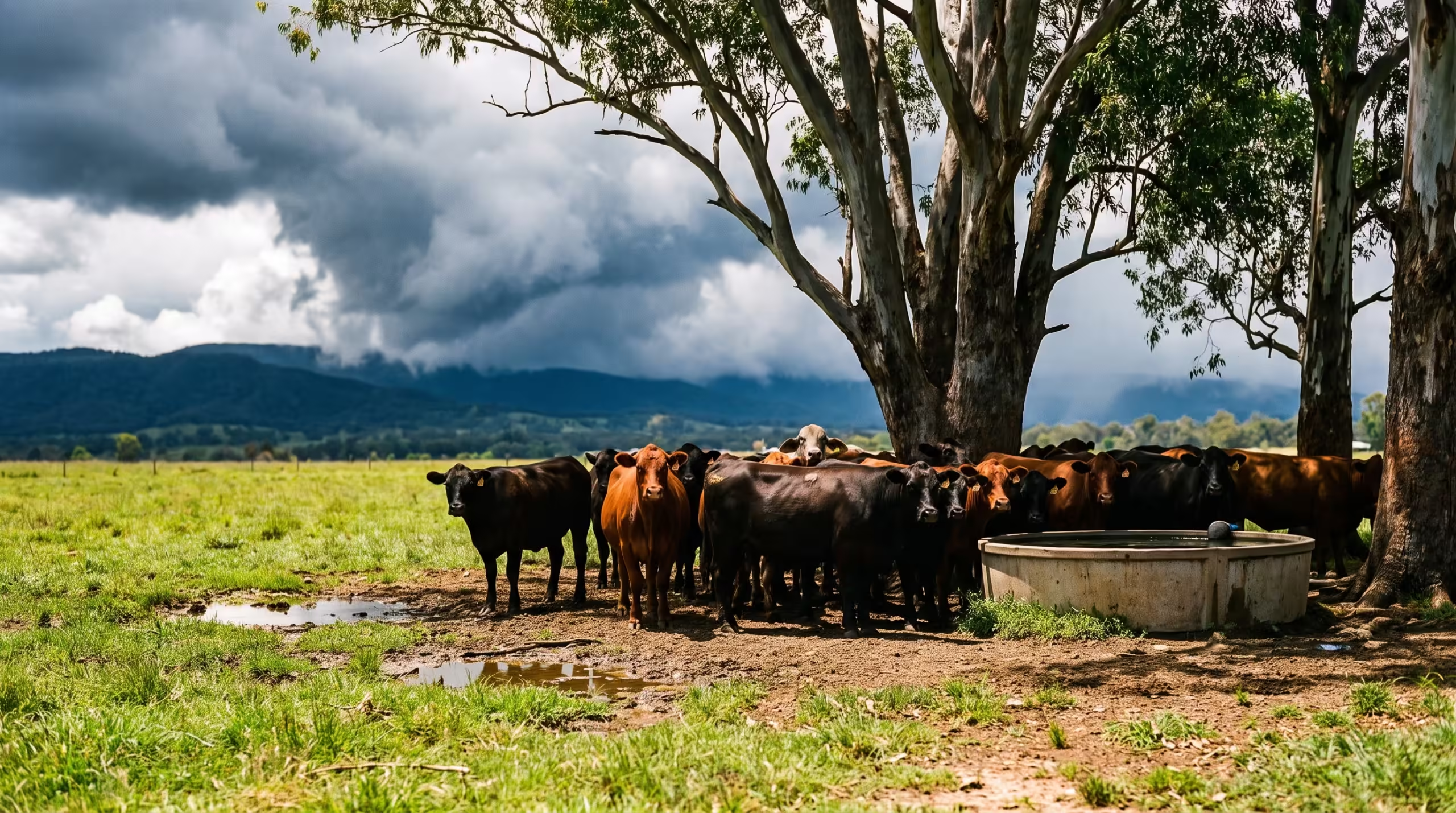

The Bureau of Meteorology expects a hot start to summer across most cattle country. Its outlook for November 2026 to January 2027 says temperatures are very likely to be above average for most of Australia. Above average rain is forecast for parts of western, central and eastern Australia. Parts of the south-east and the far north are likely to be drier than average. This guide sets out what the outlook means for your herd, your feed and your selling plan.
The Bureau issued this outlook on 29 October 2026. Check the current BOM long-range forecast for your own district before you act. The national picture hides big local differences.
The outlook at a glance
Here are the main points from the Bureau for November to January.
- Days: temperatures are very likely to be above average for most of Australia.
- Nights: there is a very high chance of unusually warm nights.
- Hot days: there is a higher chance of unusually warm days.
- Wetter areas: above average rain is forecast for parts of western, central and eastern Australia.
- Drier areas: parts of the south-east and the far north are likely to see below average rain.
The Bureau calls a day “unusually warm” when it falls in the top 20% of temperatures for this time of year. Check the Bureau maps to see the odds for your own district.
What drives this outlook
A strong El Niño is under way. On 5 November the Bureau said it is likely to peak around November to December. A positive Indian Ocean Dipole is also in place.
Many producers link El Niño with drought. This year the Bureau’s outlook still shows above average rain for parts of the east. El Niño is only one of several drivers of Australian weather.
Warm seas matter too. The Bureau expects sea surface temperatures around Australia to warm over the coming months. Warmer water can feed more moisture into storms, which can lift the chance of heavy rain.
The practical message is simple. Plan for heat everywhere. Plan for rain where the map shows rain. Do not plan around the El Niño label alone.
Get the latest cattle market updates straight to your inbox. Subscribe free to the Cattle Weekly weekly newsletter. Subscribe here.
Heat is the biggest risk this summer
Hot days hurt cattle. Hot nights hurt them more. Cattle shed heat overnight. When nights stay warm, they start the next day with heat already stored. Heat load builds over several days in a row, and losses follow.
The outlook gives a higher chance of unusually hot days across much of the country. Open the Bureau map of unusually warm days and find your district.
If your district shows high odds, prepare now. Do not wait for the first heatwave in January.
Water
Cattle drink far more in hot weather. Check every trough, float valve, pump and pipe before the first hot spell. Make sure each trough refills fast enough for the whole mob to drink after a long walk. Clean troughs often, since algae grows fast in warm water. Plan a backup for any water point where one pump failure leaves cattle dry.
Shade and handling
Give cattle shade in the paddocks they use in the hottest weeks. Move mobs to shaded paddocks before a forecast heatwave, not during one. Work cattle at first light and finish yard work by mid-morning. Avoid trucking in the heat of the day.
Feedlots and dark-coated cattle
Black cattle, heavy cattle on grain and cattle with no shade carry the most risk. Feedlots use heat load forecasting tools funded by Meat & Livestock Australia (MLA) to flag high risk days. If you feed grain, review your heat plan now. Our guide to heat stress in cattle covers the signs and the response step by step.
Wet signal: south-east Queensland and much of NSW
The Bureau’s 5 November update for December to February puts rain above average in south-east Queensland and much of New South Wales. Good rain grows grass. Heavy rain in hot weather also brings problems.
Pasture and feed quality
Fresh green pick looks good but holds a lot of water. Cattle on short green feed often lose condition before the pasture bulks up. Keep a supplement on hand for weaners and first-calf heifers until the feed has body. Our guide on what cattle eat explains how to match feed to each class of stock.
Flies, ticks and insect-borne disease
Warm, wet weather suits buffalo fly, cattle ticks and biting insects. Biting insects spread bovine ephemeral fever, known as three-day sickness. Heavy bulls and fat cattle suffer the most. Talk to your vet about vaccination before the insect season peaks. In the tick zone, cattle ticks carry tick fever. Read our guides on tick fever in northern Australia and cattle parasite control before you set your treatment plan.
Wet feet and wet yards
Long periods in mud raise the risk of footrot. Lift stock off the wettest flats where you have the option. Keep laneways and yards drained. Flies and grass seed heads also lift the risk of pinkeye. Check eyes each time you muster.
Access and turnoff
Rain closes roads and stops trucks. Plan your turnoff around the wet. Book processor space early. Keep a spare paddock for cattle you planned to sell and now need to hold.
Dry signal: parts of the south-east and the far north
Low rain odds plus heat make a hard season. Act early while you still have choices.
- Do a feed budget now. Count the days of feed in each paddock against your stocking rate.
- Buy hay or silage before demand climbs.
- Set your sale triggers in advance. Pick a date or a pasture level at which you sell.
- Sell cull cows and dry stock first. Keep your breeding core.
- Wean early if cows lose condition. A dry cow needs less feed than a cow with a calf at foot.
The tropical north enters the build-up and wet season in this period. The Bureau’s 5 November update puts December to February rain below average in the tropical north. That means slower early pasture growth. Check your dry season supplement stocks. Extend the program if storms arrive late. Our guide to supplementary feeding in drought sets out the options.
What the outlook means for the cattle market
Weather drives supply, and supply drives price. October rain has already slowed kills. Beef Central reported on 3 November the national kill fell to a little over 140,000 head in the week before last. It called it the smallest full national production week with no holiday impact. On 4 November, Beef Central reported the next week fell again, to 131,713 head.
Rain in the east tends to lift restocker demand, since producers want cattle to eat the grass. Dry regions tend to sell more cattle into the market. Watch the weekly MLA saleyard indicators to see how these forces play out in your area. Our explainer on how cattle prices are set in Australia covers the indicators in plain terms.
Your 90-day checklist
- Read the Bureau outlook for your own district, not only the national map.
- Test every water point and pump. Fix leaks now.
- Map shade in each paddock. Plan where each mob goes in a heatwave.
- Book a vet visit to set a three-day sickness and parasite plan.
- Do a feed budget for each paddock and each mob.
- Price hay, silage and supplements. Buy early if you sit in a dry area.
- Write down your sale triggers. Share them with your agent.
- Book processor space and trucks before the wet closes roads.
- Recheck the outlook each time the Bureau updates it.
For more seasonal and market news, visit the Cattle Weekly news hub. For long-term planning data on farm incomes and costs, see ABARES.
Frequently asked questions
What is the BOM summer outlook for cattle country?
The Bureau outlook issued on 29 October 2026 says temperatures are very likely to be above average for most of Australia from November to January. Rain leans above average in parts of the west, centre and east, and below average in parts of the far north and south-east.
Does El Niño mean drought for cattle producers this summer?
Not always. A strong El Niño is under way, yet the Bureau still forecasts above average rain for parts of the east, including south-east Queensland and much of New South Wales from December to February.
How do I protect cattle from heat stress?
Give cattle clean water and shade. Work them at first light. Avoid trucking in the heat of the day. Watch dark, heavy and grain-fed cattle closely, since they carry the most risk.
Which regions face the highest heat risk this summer?
The Bureau gives a higher chance of unusually warm days across much of Australia, with a very high chance of unusually warm nights. Check the Bureau map for your district.
Does a wet summer raise disease risk in cattle?
Yes. Warm, wet weather favours biting insects, buffalo fly and ticks. Biting insects spread three-day sickness, and ticks spread tick fever. Mud raises the risk of footrot. Set a vaccination and parasite plan with your vet early.