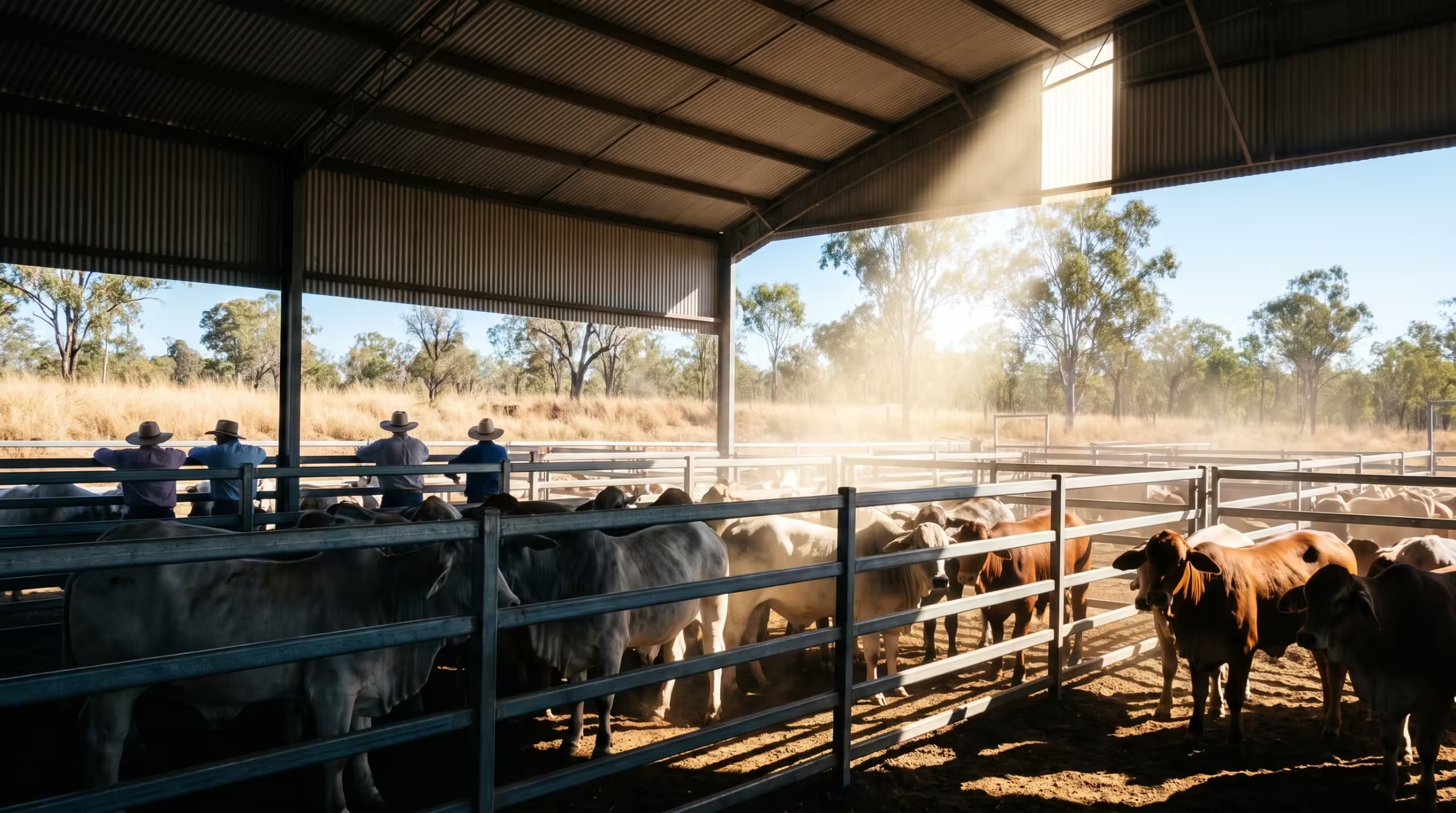

The biggest cattle policy decision this month is the vote on the grassfed cattle transaction levy. A review committee recommends lifting the levy from $5 to $6 a head by 1 July 2028. Grassfed levy payers vote on it at the Meat and Livestock Australia annual general meeting in Townsville on Tuesday 24 November 2026. This Policy Watch explains the proposal, the conditions attached, and what it means for your business. It also covers the China beef quota reset on 1 January.
Most of the detail below comes from the review’s final report and from coverage by Beef Central. Read the full resolution and explanatory notes from MLA before you vote.
The cattle levy vote at a glance
- Current levy: $5 per head on every grassfed cattle sale.
- Proposed levy: $6 per head by 1 July 2028.
- Condition: the recommended reforms must be in place in full by 1 July 2027.
- Extra funding: about $13 million a year.
- Vote: a separate ballot at the MLA AGM, Townsville, Tuesday 24 November 2026.
- Who votes: grassfed cattle transaction levy payers.
The $5 rate was set in 2006. The review found its real value has fallen by around 42% since then.
Where your $5 goes now
Each $5 levy splits four ways.
| Levy stream | Now | Proposed |
|---|---|---|
| Marketing | $3.66 | $4.35 |
| Research and development | $0.92 | $1.12 |
| National Residue Survey | $0.29 | $0.40 |
| Animal Health Australia | $0.13 | $0.13 |
| Total | $5.00 | $6.00 |
MLA receives most of the money. Beef Central reports MLA gets 89% of livestock levy revenue, with 67% for marketing and 22% for research. The National Residue Survey tests meat for chemical residues. Export markets rely on these tests. Animal Health Australia runs disease preparedness programs. Its share stays fixed at 13 cents.
Get the latest cattle market updates straight to your inbox. Subscribe free to Cattle Weekly’s weekly newsletter. Subscribe here.
What the review recommends
Cattle Australia set up the review committee. It ran 34 face-to-face meetings and a national online survey. More than 1,000 grassfed levy payers took part. Bryce Camm chaired the committee.
A $1 increase, with strings attached
The committee looked at a larger rise to $8.50 a head. It rejected this option. It found no clear benefit to levy payers from the bigger figure. The $1 increase comes with conditions. Each body receiving levy money must assess all its programs and report the results in public. This must happen before each body approves its 2027/28 budget.
A stand-alone Integrity Systems Company
The Integrity Systems Company runs the National Livestock Identification System, Livestock Production Assurance and the National Vendor Declaration. It sits inside MLA today. The review recommends it become a separate company with a majority independent board. It would receive at least 84 cents from every levy transaction. This money would also cover strategic biosecurity work. If you use NLIS tags and eNVDs, these are the systems in question. Our guide to cattle tracking and NLIS solutions explains how they work on farm.
Funding for industry representation
The review recommends at least 60 cents per head for industry representation. Cattle Australia is the peak body for grassfed producers. It runs on about $2.5 million a year, which the committee called inadequate. The extra money would fund advocacy, school education programs and community awareness. The aim is to defend the industry’s reputation.
More money for residue testing
The National Residue Survey share rises from 29 cents to 40 cents. This adds about $1.2 million a year in direct funding. Residue testing underpins access to markets like Japan, Korea and the United States.
Regular reviews
The committee recommends a full review at the start of every 10-year red meat industry plan. The next one starts in 2030. A mid-cycle report would follow every five years. The question of a flat levy versus a levy based on sale value is left for the 2030 review.
What the review found about value
The committee concluded the levy has delivered value over the past 20 years. It named market access, integrity systems and research leverage as the clearest benefits.
- Gross value of production rose from $7.5 billion to $17.7 billion since 2009.
- Thirteen trade agreements cover 83% of red meat exports.
- Meat Standards Australia is estimated to return more than $320 million to producers.
- MLA Donor Company has drawn more than $400 million in outside funds since 2012.
The report also cautions not all these gains come from the levy. Seasons, exchange rates, trade deals and private investment all play a part.
Where the review was critical
The committee found the case for more spending on international and domestic marketing “has not been made”. Domestic marketing scored low on benefit for cost. On research, it raised three concerns. Priorities lean too much on existing structures. Producer adoption is low. Delivery costs are rising. The marketing share still rises to $4.35, because the committee found 87 cents of each $5 now goes to other purposes such as communications and integrity systems.
What producer groups say
Cattle Australia chief executive Will Evans gave a clear view. “There is a case for an increase, but accountability has to come first,” he told Beef Central. Some state farming organisations have called for a business case before any overhaul of the levy. Talk to your state farming organisation about its position before 24 November.
The case for and against
The review itself sets out points on both sides. Here they are in one place.
For the increase
- The $5 levy has lost around 42% of its real value since 2006.
- Residue testing and integrity systems protect access to export markets.
- The committee found the levy has delivered value over 20 years.
- The peak body runs on a budget the committee called inadequate.
Against, or not yet
- The committee found the case for more marketing spend has not been made.
- Producer adoption of research is low.
- Cattle Australia wants accountability first.
- Some state farming organisations want a business case before any change.
The conditions on the increase try to answer the second list. The rise only happens if the reforms are in place by July 2027.
How to vote on the levy
Voting happens through a separate ballot at the MLA AGM. Grassfed levy payers receive the full resolution, explanatory notes, ballot papers and voting instructions before the meeting. Webinars and regional briefings run in the lead-up to the vote.
Here is a simple plan.
- Check you are listed as an MLA member and levy payer. Membership is free for levy payers.
- Look for your ballot pack in the mail or your inbox.
- Read the resolution and the conditions on the increase.
- Join a webinar or regional briefing if you have questions.
- Vote in Townsville, or follow the voting instructions in your pack.
What the increase costs you
The maths is simple. Every grassfed animal you sell costs $1 more in levy from July 2028. If you sell 300 head a year, you pay $300 more. If you sell 2,000 head, you pay $2,000 more. Weigh this against the programs the money funds.
China beef quota resets on 1 January
The second policy item to watch is trade with China. Australia filled its 205,000 tonne safeguard quota in mid-June 2026. Since then, Australian beef entering China has paid a 55% tariff. The tariff runs until 31 December. Exports to China dropped hard as a result. In the first ten months of 2026, China took 173,800 tonnes, down from 223,000 tonnes a year earlier.
Beef Central reports Australia’s tariff-free allowance for 2027 is 206,000 tonnes. It opens on 1 January. Exporters are likely to rush product into China early in the year. This should lift demand for the cattle China buys, mostly frozen grassfed beef. The 2026 quota filled by mid-June. Plan around a strong China market in the first half of 2027 and a weak one after the quota fills. For background, read our guide to the China beef tariff and its impact on Australian farmers.
The Australian Bureau of Agricultural and Resource Economics and Sciences (ABARES) tracks these trade shifts in its quarterly commodity forecasts.
What to watch next month
- Levy vote result: MLA announces it at the AGM on 24 November.
- Government response: Cattle Australia plans to brief Agriculture Minister Julie Collins and her department. Any levy change needs federal support.
- Integrity Systems Company: watch for a plan to separate it from MLA.
- China quota: track how fast the 2027 allowance fills from 1 January.
For more on the forces behind cattle prices, visit our Australian cattle market hub, or read the latest cattle news.
Frequently asked questions
How much is the cattle levy in Australia?
The grassfed cattle transaction levy is $5 per head. It splits into $3.66 for marketing, 92 cents for research, 29 cents for the National Residue Survey and 13 cents for Animal Health Australia.
Is the cattle levy going up?
A review committee recommends a rise to $6 per head by 1 July 2028. The rise depends on reforms being in place by 1 July 2027. Levy payers vote on it on 24 November 2026.
Who votes on the cattle levy?
Grassfed cattle transaction levy payers vote through a separate ballot at the MLA AGM. Ballot papers and instructions go to levy payers before the meeting.
Where does the cattle levy money go?
Most goes to Meat and Livestock Australia for marketing and research. The rest funds the National Residue Survey and Animal Health Australia. Under the proposal, a stand-alone Integrity Systems Company and Cattle Australia would get set minimum shares.
When does the China beef quota reset?
On 1 January 2027. Beef Central reports the 2027 tariff-free allowance is 206,000 tonnes. Beef over the allowance pays a 55% tariff.