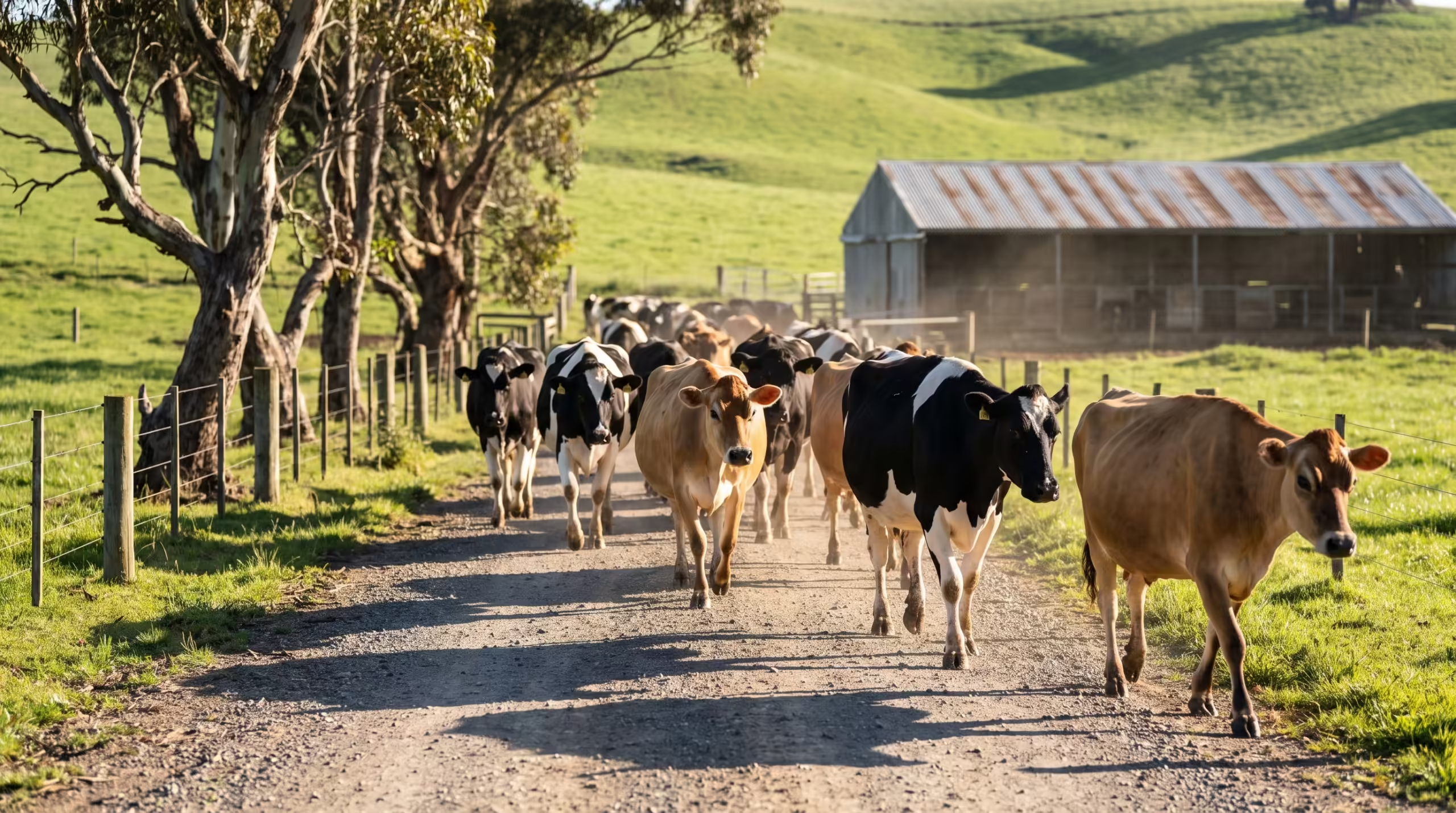

Holstein Friesians fill most Australian dairy sheds. Jerseys run second. Both breeds make money, but each makes it a different way. Your best choice depends on how your processor pays, what you feed, how hot your summers get and where your calves go.
This article compares the two breeds on the factors which drive your margin: milk solids, feed, climate, fertility, calves and culls. For the broader business side of dairying, read our complete guide to dairy cattle farming in Australia.
Start With Your Milk Price
Most Australian processors pay you for kilograms of butterfat and protein, not for litres. Many also apply a volume charge, which costs you money on every extra litre you ship. Under the mandatory Dairy Industry Code of Conduct, your processor publishes its milk supply agreements and minimum prices ahead of each season. Read yours before you look at a single cow.
Dairy Australia tracks farmgate prices, processor offers and seasonal outlooks. Use current figures, not last season’s memory, to test each breed against your contract.
Volume Versus Solids
A Holstein produces more litres. A Jersey produces milk with higher fat and protein percentages. On a per cow basis, a well-fed Holstein usually ships more total kilograms of milk solids than a Jersey. On a per kilogram of bodyweight basis, the Jersey closes much of the gap.
Your contract decides which breed wins. A solids-weighted price with a volume charge favours the Jersey. A price with a strong litre component, or a fluid milk contract, favours the Holstein.
DataGene publishes annual breed averages from Australian herd test records. Pull the latest DataGene figures for fat, protein and volume, then run both breeds through your own price sheet.
Holstein vs Jersey at a Glance
| Trait | Holstein Friesian | Jersey |
|---|---|---|
| Mature body size | Large | Small |
| Milk volume per cow | Higher | Lower |
| Fat and protein percentage | Lower | Higher |
| Total milk solids per cow | Usually higher | Usually lower |
| Feed for maintenance | Higher | Lower |
| Heat tolerance | Lower | Higher |
| Heifer calving ease | More assisted calvings | Fewer assisted calvings |
| Bull calf value | Suits beef and veal rearing | Low beef value |
| Cull cow value | Heavier carcase | Lighter carcase |
| Best fit | Feedpad, PMR and TMR systems | Pasture-based and hot regions |
Feed, Size and Stocking Rate
A mature Holstein outweighs a mature Jersey by a wide margin. Every extra kilogram of liveweight needs feed for maintenance before the cow produces any milk. Size drives your feed bill, your stocking rate and your pasture damage.
Dairy Australia measures this with comparative stocking rate. It expresses kilograms of liveweight per tonne of feed available to the herd. A Jersey herd runs more cows on the same feed base, because each cow weighs less. Set your herd size by liveweight, not head count, when you compare the two breeds.
Pasture-Based Herds
On grazing farms in Gippsland, south-west Victoria and Tasmania, the Jersey’s lighter frame suits wet winters. Lighter cows pug soft paddocks less and put less strain on their feet over long laneways. Jerseys also convert pasture into milk solids efficiently on a liveweight basis.
Feedpad and TMR Systems
In partial mixed ration and total mixed ration systems, the Holstein shows her yield potential. Feed a Holstein a balanced ration on a feedpad and she turns high intakes into high volume. Many intensive herds run Holsteins for this reason. If you buy in grain and fodder, the Holstein gives you more output per cow to spread fixed costs across.
Heat and Climate
Heat stress cuts feed intake, milk yield and conception rates. Jerseys handle hot, humid weather better than Holsteins. Their smaller bodies produce less metabolic heat, and their fawn coats absorb less sun than the black patches on a Holstein.
For herds in Queensland, northern New South Wales and inland regions with long summers, a Jersey or Jersey cross holds production better through heat. If you run Holsteins in hot country, budget for shade, sprinklers and fans. The Cool Cows program at Dairy Australia sets out heat management steps for dairy herds.
Fertility, Calving and Longevity
Seasonal and split calving herds need cows back in calf inside a tight joining window. Every cow which misses the window costs you milk and adds a cull decision.
Jersey heifers reach puberty early and calve with fewer assisted births. Jerseys also tend to show stronger fertility under pasture systems. Holsteins carry more yield, and Australian Holstein breeders have lifted fertility through selection for daughter fertility over recent decades.
Use the Indexes, Not the Breed Label
Breed sets the average. Bull choice sets your herd. DataGene publishes Australian Breeding Values for bulls marketed in Australia, plus three national indexes:
- Balanced Performance Index (BPI), for overall profit
- Health Weighted Index (HWI), with extra weight on fertility, mastitis and feed efficiency
- Type Weighted Index (TWI), with extra weight on conformation
Check Daughter Fertility, Calving Ease and Mastitis Resistance ABVs before you buy semen, whichever breed you run. For more on joining and heifer management, read our cattle breeding management tips for top Aussie breeds.
Calves, Culls and Beef Income
Dairy income does not stop at the vat. Calves and cull cows add to your annual income, and here the Holstein holds the advantage.
Bull Calves
Holstein bull calves grow into saleable beef or veal animals, and calf rearers buy them. Jersey bull calves carry little beef value, and many leave the farm as bobby calves. Many herds join lower-merit cows to Angus or Wagyu bulls to lift calf value. Use sexed semen over your best cows to breed replacements, and beef semen over the rest.
Whatever breed you run, tag every calf with an NLIS device before it leaves your property, and follow the national land transport standards for bobby calves. Your state agriculture department sets out the rules. Start with Agriculture Victoria or NSW DPI.
Cull Cows
A cull Holstein carries a heavier carcase and returns more dollars per head than a cull Jersey. Track cow prices through MLA market reports. MLA publishes saleyard indicators for cows alongside the Eastern Young Cattle Indicator. The EYCI tracks young cattle, so watch the cow categories, not the EYCI headline, when you budget cull income.
Benchmark the Whole Business
ABARES runs an annual survey of Australian dairy farms, with farm cash income and cost data by region. Dairy Australia’s Dairy Farm Monitor Project adds regional profit benchmarks. Compare your cost per kilogram of milk solids against these sources before you change breeds. A breed switch takes years to complete, so base it on your own numbers.
A2 Milk and Specialty Markets
Some processors pay a premium for A2 milk, which comes from cows carrying two copies of the A2 beta-casein gene. Both Holsteins and Jerseys carry A1 and A2 variants. Breed alone does not tell you a cow’s status; a tail hair DNA test does. Use A2A2 bulls to move your herd toward A2 over several generations. Read more in our article A2 milk: a healthier dairy option.
Some specialty cheese makers also seek high-solids milk, because fat and protein drive cheese yield. If you supply one, ask whether it pays extra for Jersey milk.
The Crossbred Option
Many Australian farmers no longer pick one breed. They cross Holstein and Jersey to get hybrid vigour, a mid-size cow and a mid-range solids test. Hybrid vigour lifts fertility, health and longevity above the parent breed average. Some herds add a third breed, such as Aussie Red, in a three-way rotation to hold hybrid vigour across generations.
Crossbreeding brings trade-offs. Herd uniformity drops, and you need a planned sire rotation to keep hybrid vigour high. Compare other breeds in our guide to the best dairy cattle breeds for Australian conditions.
How to Choose: Six Steps
- Read your supply agreement. Note the weighting on fat, protein and volume, and any volume charge.
- Measure your feed base. Work out tonnes of home-grown feed and the cost of bought-in feed.
- Check your climate. Count hot, humid days and the cost of heat management for each breed.
- Plan your calf outlet. Find out who buys bull calves in your district and what they pay.
- Pull your herd test data. Compare your cows against DataGene breed averages, not against a neighbour’s claims.
- Talk to an adviser. Your state agriculture department, a Dairy Australia regional group or a consultant will help you model the switch.
Pick the Holstein if your contract rewards volume, you feed a mixed ration and your summers stay mild. Pick the Jersey if your contract rewards solids, you graze pasture and your summers run hot. Pick a cross if you want a balance and accept the management load.
Frequently Asked Questions
Which dairy breed produces the most milk in Australia?
Holstein Friesians produce the highest milk volume per cow and make up the largest share of the national herd. Jerseys produce fewer litres with higher fat and protein percentages. Check DataGene herd test breed averages for current figures.
Is Jersey milk worth more than Holstein milk?
Per litre, Jersey milk usually earns more, because most Australian processors pay on kilograms of fat and protein. Per cow, a Holstein often earns as much or more, because she ships more total solids. Run both breeds through your own supply agreement before you decide.
Are Jersey cows better in hot climates?
Jerseys handle heat and humidity better than Holsteins, thanks to a smaller frame and a lighter coat. Holsteins in hot regions need shade, sprinklers and fans to hold yield and fertility. Dairy Australia’s Cool Cows program sets out heat management steps.
Should I cross Holstein and Jersey cows?
A Holstein Jersey cross gives you hybrid vigour, stronger fertility and a mid-size cow suited to pasture systems. You give up some herd uniformity and need a planned sire rotation. Many seasonal calving herds in southern Australia run crossbreds for these reasons.
Do Jersey cows produce A2 milk?
Some Jerseys produce A2 milk and some do not, and the same applies to Holsteins. A tail hair DNA test confirms each cow’s status. Breed from A2A2 bulls to build an A2 herd over several generations.