
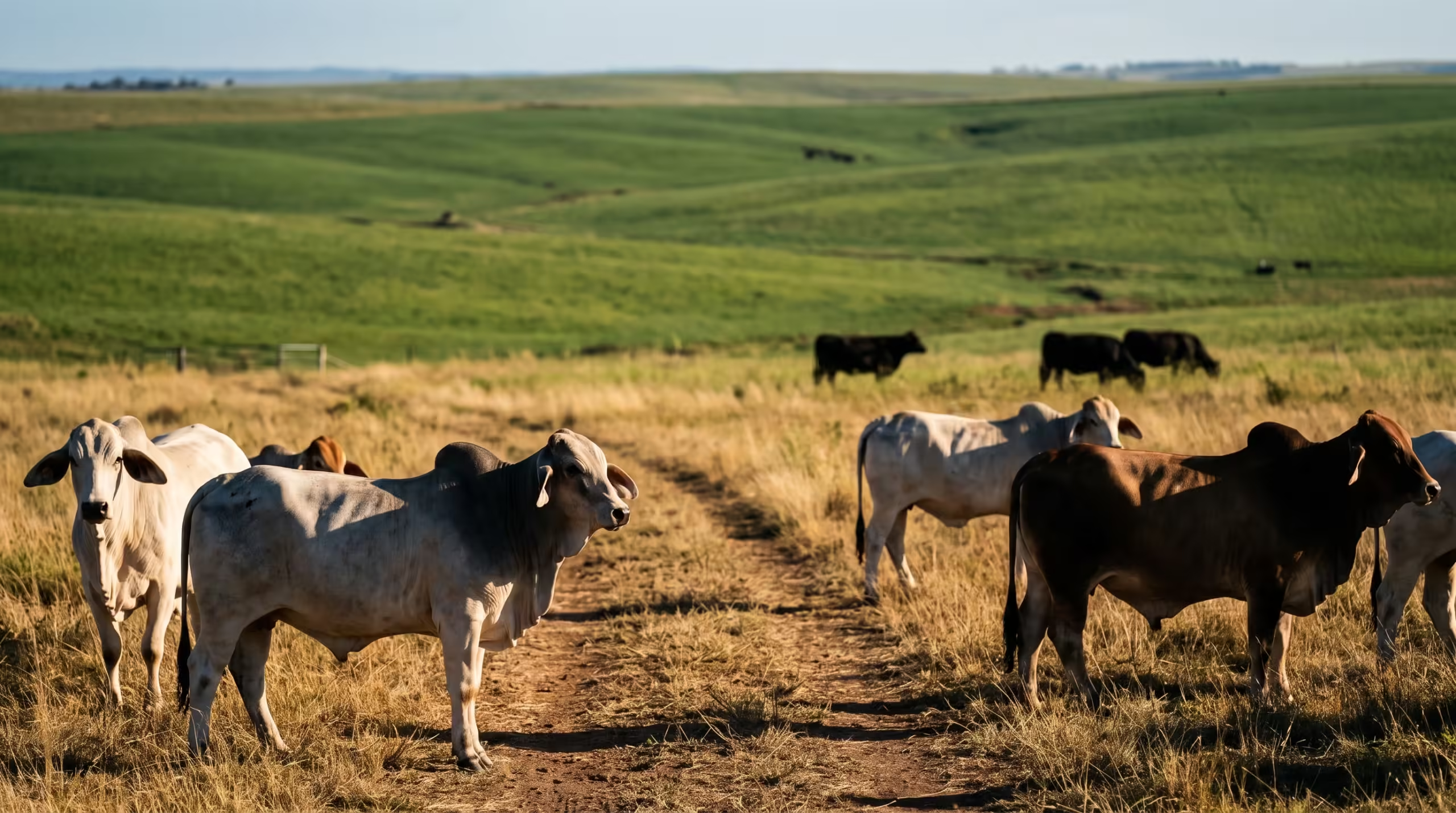
Australia runs cattle from the tropical savannas of the Top End to the cool, high-rainfall flats of southern Tasmania, and almost nothing about the job is the same at both ends. Country, rainfall, breed type, biosecurity rules, vegetation law, transport distance and market access all shift the moment you cross a state border — and those shifts land directly on your cost of production and your turnoff options. This guide walks through cattle farming by state across Australia, what each state is genuinely good at, what it costs you in constraints, and how producers in each region make the numbers work.
If you are researching a purchase, weighing up an interstate move, or simply want a clearer picture of who you are competing with at the rail, start here and then work down into the detail. Our broader regional cattle farming in Australia hub carries the deeper regional breakdowns beneath this page.
Why state lines matter more than they look
Cattle do not care about borders, but four things do.
- Regulation. Vegetation management, water licensing, stock route access, animal welfare standards and land tenure are administered by state governments. Queensland’s vegetation management framework, the Local Land Services structure in NSW and the various pastoral lease conditions in the rangelands all shape what you can legally do with country you own or lease.
- Biosecurity zones. The cattle tick line is the clearest example. It cuts through Queensland and northern NSW and exists in modified form in WA and the NT, and it governs how, when and at what cost you can shift stock south or west.
- Market infrastructure. Where the works are, where the saleyards are, and where the live export ports sit determines your freight bill and your realistic buyer pool. A hundred head is a very different proposition three hours from a large processor than it is eight hours from anywhere.
- Climate and pasture base. Summer-dominant tropical rainfall, uniform temperate rainfall and winter-dominant Mediterranean rainfall each demand a different herd calendar. Joining, weaning and turnoff dates that work in the New England will not work on the Barkly.
Meat & Livestock Australia (MLA) publishes market indicators and regional analysis that make the national picture legible, and ABARES tracks farm performance and commodity outlooks that put state differences into economic terms. Between the two, plus your own state agriculture department, you can usually build a fair picture of any region before you inspect a single paddock.
The national picture at a glance
The table below is a broad-brush comparison. It is a starting point for orientation, not a substitute for local advice.
| State / Territory | Dominant systems | Typical cattle types | Main turnoff channels | Key constraints |
|---|---|---|---|---|
| Queensland | Extensive northern breeding, central backgrounding, southern finishing and feedlotting | Brahman and composites north, British and Euro infusion south | Live export, feedlots, large domestic and export works, saleyards | Ticks, buffalo fly, seasonal variability, vegetation rules, wild dogs |
| New South Wales | Breeding in the tablelands and slopes, mixed farming in the west, finishing and feedlotting throughout | Angus, Hereford, Shorthorn, Angus-cross; Bos indicus influence in the north | Saleyards (EYCI contributors), over-the-hooks, feedlots, online sales | Drought exposure west, land price near the coast, tick line in the north |
| Victoria | High-rainfall breeding and finishing, intensive dairy, feedlot backgrounding | Angus and Angus-cross, Hereford, Holstein and Jersey dairy | Saleyards, processors, dairy beef pathways, MSA-graded grassfed | Land price, scale limits, wet-winter pugging and footrot pressure |
| South Australia | South East high-rainfall finishing, mid-north mixed farming, pastoral breeding | Angus and Hereford in the south, Bos indicus influence in the far north | Saleyards, processors, interstate feeder trade | Rainfall reliability, distance to works from pastoral country, water |
| Western Australia | Northern pastoral breeding, southern high-rainfall finishing and dairy | Brahman and composites in the north, Angus and Murray Grey in the south | Live export, local processors, interstate transfer, saleyards | Isolation, freight, limited processing capacity, tick zones |
| Northern Territory | Large-scale extensive breeding on pastoral leases | Brahman and Brahman composites | Live export via Darwin, southern feeder and backgrounding markets | Distance, wet-season access, limited local processing, water infrastructure |
| Tasmania | Grassfed beef finishing, strong dairy sector, irrigated pasture | Angus, Hereford, Angus-cross, Friesian dairy beef | Local processors, mainland transfer, branded grassfed programmes | Scale, Bass Strait freight, limited processing options |
Queensland: the volume engine
Queensland carries the largest share of the national herd and covers the widest span of production systems of any state. Understanding Queensland means understanding that it is really four or five cattle regions stacked into one jurisdiction.
Country and systems
The Gulf, Cape and northern forest country run big breeding operations on tropical pasture, with turnoff heavily influenced by wet-season access and live export demand. The Channel Country and the west run extensive breeding and growing on native pasture and floodplain. Central Queensland — Brigalow belt, Fitzroy and the coastal ranges — is the backgrounding and growing heartland, feeding cattle into feedlots and works. The Darling Downs and south-east are the finishing and feedlot centre, with grain access, processing capacity and proximity to the eastern seaboard.
Breeds and herd management
Bos indicus content is non-negotiable through most of the north for tick resistance, heat tolerance and buffalo fly performance. Brahman remains the backbone, with composites such as Droughtmaster, Santa Gertrudis, Belmont Red and Brangus widely used to lift fertility, temperament and carcase traits without giving up adaptation. Moving south and east, British and European content increases as tick pressure eases and market specifications tighten around marbling and eating quality.
Controlled joining is a persistent theme in northern herd improvement work promoted by MLA and the Queensland Department of Primary Industries. So is pregnancy testing, culling on reproductive performance, and phosphorus supplementation on deficient country — the latter is one of the highest-return interventions available on much northern country, and it is still under-adopted.
Markets
Queensland producers have genuine optionality: live export out of Townsville and other northern ports, a large feedlot sector, several major export processors, and an active saleyard network including Roma, Dalby and Gracemere feeding into national price discovery. For a more detailed operational rundown, see our guide to beef cattle farming in Queensland.
Watch points
- Vegetation management rules materially affect what you can do with regrowth and thickened country. Get current advice before you plan any clearing.
- AgForce is the peak body for Queensland broadacre producers and is worth engaging with on land management, biosecurity and market access issues.
- Wild dog and feral pig pressure is a real production cost in many districts, and coordinated control almost always outperforms going it alone.
New South Wales: the price-setting state
NSW sits at the centre of eastern price discovery. A large share of the saleyards contributing to the EYCI are in NSW, which means national sentiment is often read through NSW yardings first.
Country and systems
The Northern and Southern Tablelands and the New England are strong breeding country with reliable pasture and established genetics. The slopes carry mixed farming operations where cattle fit alongside cropping, and the western division runs extensive systems exposed to sharp seasonal swings. The North Coast carries subtropical country with tick and fly pressure, while the Riverina and southern irrigation districts support intensive finishing and feedlot backgrounding.
Herd management and markets
Angus dominates the southern and tablelands herd, often crossed with Hereford for the maternal package. Bos indicus influence increases north of the tick line. Turnoff pathways are broad: physical saleyards, over-the-hooks grids, online interfaced auctions, feeder contracts and direct-to-processor supply into MSA-underpinned programmes.
Local Land Services administers biosecurity, travelling stock reserves and district rating in NSW, and remains the first port of call for tick, footrot and movement compliance questions. NSW Department of Primary Industries publishes practical extension material on pasture management and drought feeding that holds up well in the paddock.
Watch points
- Drought exposure west of the divide is the single biggest structural risk. Producers who work to a written trigger-point plan — set stocking rates, agistment options and sale dates in advance — consistently come out ahead of those who react late.
- Land values near the coast and tablelands can make a purely grassfed breeding enterprise hard to justify on return-to-capital alone, which pushes many operations toward trading, finishing or value-adding.
Victoria: intensity and infrastructure
Victoria trades scale for productivity. Rainfall is more reliable than most of the mainland, the pasture base is generally improved, and the processing and saleyard infrastructure is close at hand.
Country and systems
Gippsland and the south-west are the high-rainfall powerhouses, running both beef finishing and a large share of the national dairy herd. The north-east carries hill country breeding operations, while the Mallee and Wimmera run cattle in mixed farming systems alongside cropping. Irrigation districts in the north support intensive dairy and fodder production.
Herd management
Angus and Angus-cross dominate beef herds, with Hereford, Murray Grey and European infusion where producers are chasing growth and yield. Rotational grazing, soil fertility management and tight calving spreads are the standard levers. Agriculture Victoria extension material on pasture utilisation and feed budgeting is well matched to these systems.
The dairy sector also feeds a significant beef pathway. Dairy-beef crossbreeding, particularly using beef genetics over the lower end of the dairy herd, has become a serious income stream rather than an afterthought, and it changes what turns up in the feeder and vealer sections at Victorian yardings.
Watch points
- Wet winters mean pugging, footrot and pasture damage. Containment areas or sacrifice paddocks pay for themselves quickly on heavy country.
- Land price limits expansion. Growth in Victoria usually comes from lifting kilograms produced per hectare rather than from buying the neighbour.
South Australia: two states in one
South Australia splits cleanly between the reliable South East and the vast pastoral north.
South East and mid-north
The South East runs high-rainfall finishing country with strong pasture growth and good access to processors and saleyards. Angus and Hereford genetics dominate, and grassfed finishing to domestic and export weights is the standard model. The mid-north and Yorke Peninsula run cattle within mixed farming enterprises, with stubbles and fodder crops carrying stock through summer.
Pastoral north
Pastoral leases in the far north run extensive breeding operations at very low stocking densities, with turnoff typically heading east or into feeder and backgrounding channels. Water infrastructure and distance to markets are the dominant cost drivers. The dog fence is a significant piece of infrastructure for stock protection across the pastoral zone.
PIRSA administers biosecurity, livestock movement and land management in South Australia, and SA producers should keep property identification codes and NLIS records tight given the volume of interstate movement in and out of the state.
Western Australia: distance as the defining variable
WA is effectively two cattle industries separated by thousands of kilometres.
The north
The Kimberley and Pilbara run large-scale Brahman and composite breeding herds on pastoral lease country, oriented heavily toward live export through Broome, Port Hedland and Wyndham, and toward southern and interstate feeder markets. Wet-season access, water point infrastructure, mustering logistics and bull management are the operational priorities. Herd performance work here focuses hard on weaning rates and on getting cows back in calf.
The south
The south-west, Great Southern and south coast run high-rainfall finishing and breeding operations with British breed genetics, plus a dairy sector. Cattle frequently sit within mixed farming enterprises alongside cropping and sheep. Processing capacity in the west is more limited than in the eastern states, which makes over-the-hooks grids, live export and interstate transfer all relevant options depending on the season.
Because the EYCI is drawn from eastern saleyards, WA producers watch western indicators and local yardings instead. Our roundup on navigating cattle sales in Western Australia covers how sellers in the west actually get cattle to market.
Watch points
- Freight is the number one cost lever. Getting truck loads right, minimising empty running and coordinating with neighbours makes a measurable difference.
- The Department of Primary Industries and Regional Development (DPIRD) administers movement, biosecurity and tick zone requirements in WA — confirm requirements before organising transport, not after.
Northern Territory: scale, seasons and live export
The Territory is breeding country first and last. Properties are large, stocking rates are low, and the enterprise model is built around producing store and feeder cattle for live export and for southern backgrounding and finishing.
Systems
Brahman and Brahman-composite herds dominate. The wet season effectively defines the calendar: mustering, weaning, husbandry and turnoff all happen in windows dictated by access and by cow condition. Weaner management is one of the highest-leverage practices in Territory herds — pulling weaners off cows early protects cow condition, lifts re-conception and shortens the calving spread.
Water infrastructure, fencing to control grazing distribution, and phosphorus supplementation on deficient soils are the recurring capital and operational themes. The NT’s primary industries department and MLA both invest in northern beef research covering these areas, and much of that work translates directly to the Kimberley and northern Queensland too.
Markets
Darwin is the principal live export gateway, and demand from South East Asian markets has a direct and rapid effect on Territory prices. Southern feeder and backgrounding buyers provide the alternative pathway, though freight distances are long. Territory producers benefit from watching both channels rather than assuming either is permanently the better option.
Tasmania: small area, high output
Tasmania punches above its area. Reliable rainfall, cool-season pasture growth and expanding irrigation make it strong finishing country, and it supports a substantial dairy sector alongside beef.
Systems and markets
Angus and Angus-cross grassfed finishing systems dominate, with dairy beef contributing volume. Branded grassfed programmes and clean, disease-favourable status are genuine marketing assets. Processing options are more limited than on the mainland, and Bass Strait freight adds cost to any cattle moving north, so many Tasmanian operations focus on maximising value per head rather than chasing volume.
The state’s natural resources and environment department administers biosecurity and livestock movement, and Tasmania guards its favourable disease status closely. Anyone bringing stock across the strait should expect scrutiny and should plan for it.
Cross-border essentials every producer should have sorted
NLIS and traceability
NLIS applies nationally. Every beast needs an approved device before leaving its property of birth, and every movement needs to be recorded against the correct property identification code. State departments administer the system, and the practical differences show up in tag ordering, movement documentation and audit expectations. Sloppy NLIS records cost real money at sale time and can hold up consignments.
Vendor declarations and program eligibility
The National Vendor Declaration travels with the cattle and underpins food safety and market access claims. Livestock Production Assurance accreditation, MSA registration and any program-specific requirements — grassfed, antibiotic-free, EU eligibility — all sit on top of it. Buyers increasingly price on documentation quality, not just on the cattle in front of them.
Biosecurity movements
- Cattle tick: movements from infested to protected zones require inspection, treatment and certification. Build the time and cost into your plan.
- Johne’s disease: manage through a documented biosecurity plan, known-status purchases and vendor questioning rather than assumption.
- Footrot: a live issue in high-rainfall southern country. Inspect and quarantine incoming stock.
- Pestivirus and other reproductive diseases: test and vaccinate strategically, particularly before introducing bulls or heifers from unknown herds.
Reading the market from wherever you sit
MLA’s suite of indicators — including the EYCI, national feeder, restocker and processor cow indicators — gives you a consistent read on direction, even where the physical market you sell into is different. ABARES commodity outlooks and farm survey material add the medium-term view on herd rebuilding, export demand and input costs. Use both alongside your local saleyard reports and your agent’s read on the week, and you will avoid the two classic errors: selling into a falling market because you did not notice, and holding cattle past their optimal window because you were waiting for a price that had already peaked.
Matching enterprise to country
If you are choosing where to run cattle, or reassessing whether your current system suits your country, work through these questions honestly.
- What does your country reliably grow, in the worst three years out of ten? Build the core herd around that, and use trading stock for the good years.
- How far are you from your realistic buyers? Freight per head to the works, the yards or the port is a fixed drag on every beast you sell.
- Are you a breeder, a grower or a finisher? Trying to be all three on country that only suits one is the most common structural mistake in Australian beef.
- What are the non-negotiable local constraints? Ticks, dogs, phosphorus deficiency, wet-season access, pugging, water security. Every region has them. Price them into the budget before you buy.
- What genetics does your market actually pay for? Adaptation traits matter in the north; carcase and eating quality traits carry more weight in southern grid-based systems. Buy bulls accordingly.
The producers who consistently perform, in every state, are the ones who match the enterprise to the country rather than fighting it — then measure what matters. Weaning percentage, kilograms of beef produced per hectare, cost of production per kilogram and turnoff weight for age will tell you more about your business than any headline price ever will.
Frequently asked questions
Which state is best for beef cattle farming in Australia?
There is no single best state. The right answer depends on rainfall reliability, land price, distance to processing and the market you want to supply. Northern Queensland, the NT and the Kimberley suit large-scale breeding herds aimed at live export and southern feeder markets, while southern NSW, Victoria and Tasmania favour higher-input finishing systems close to abattoirs and saleyards.
Do I need an NLIS tag in every state?
Yes. NLIS is a national system and every beast must carry an approved NLIS device before it moves off the property of birth, with movements recorded on the NLIS database. State agriculture departments administer the scheme locally, so tag arrangements, PIC registration and movement paperwork such as the NVD are checked at the state level.
Does the EYCI apply to Western Australian and Northern Territory cattle?
The EYCI is built from young cattle sold through eastern states saleyards, so for WA and NT producers it is a national sentiment guide rather than a direct price. Western producers generally watch the western young cattle indicator and local saleyard reports, while Territory sellers track live export demand and over-the-hooks grids more closely than any eastern yarding index.
What are the main biosecurity differences between states?
The most significant are the cattle tick zones running through Queensland, northern NSW and parts of WA and the NT, and the tick-free status southern states work to protect. Moving cattle from an infested zone into a protected zone usually requires inspection, treatment and certification through the relevant state agriculture department, so plan those movements well ahead of trucking.
How much country do I need to run cattle profitably?
It varies enormously by carrying capacity — a hectare of improved pasture in Gippsland or northern Tasmania will carry many times what a hectare of Barkly or Gascoyne country will. Work in adult equivalents rather than hectares, use your state department’s local carrying capacity guidance, and build the budget around total herd size, turnoff and cost of production rather than paddock area.
More on this topic: Beef Cattle Farming in Australia, the complete guide.

1 comment
[…] See also: Cattle Farming by State: The Complete Australian Guide. […]