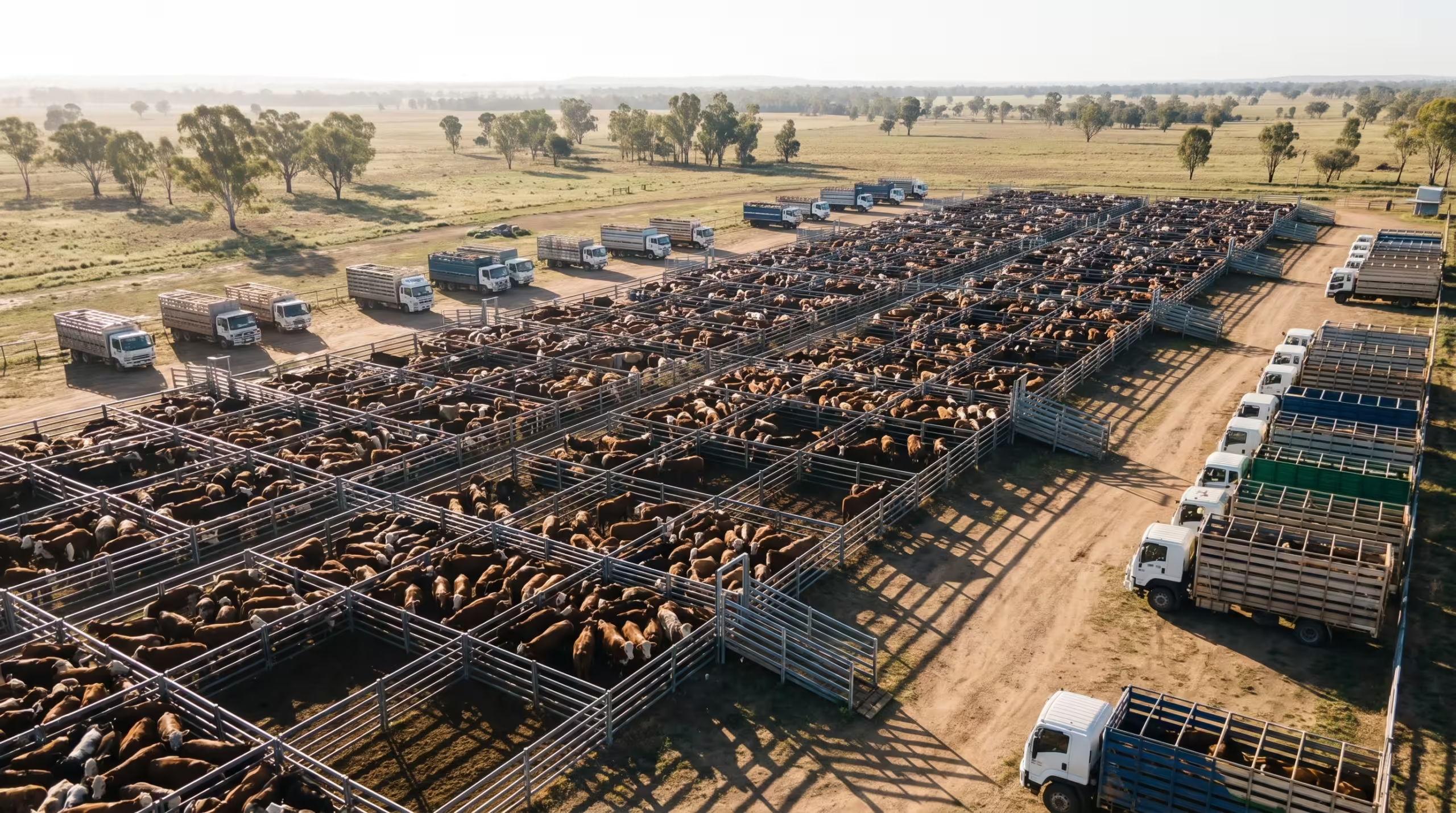

Cattle prices move differently in every state. Your nearest saleyard, your freight bill, your buyer pool and your season all shape the cheque you bank. This state cattle market report for Australia sets out how each state’s market works, which indicators to watch and where to find the numbers each week. Use it alongside the latest saleyard reports to decide where, when and how you sell.
How to Read a State Cattle Market Report
MLA’s National Livestock Reporting Service collects prices from saleyards, processor grids and online sales across the country. MLA publishes the data free at mla.com.au. You get daily saleyard reports, weekly summaries and the national indicators in one place.
Read the report for the yard you sell at. Then read the indicators. The yard report tells you what happened on sale day. The indicators tell you which way the wider market is heading.
The Indicators Worth Tracking
- EYCI (Eastern Young Cattle Indicator): tracks young cattle sold through saleyards in Queensland, New South Wales and Victoria. Eastern producers treat it as the headline price signal.
- WYCI (Western Young Cattle Indicator): the equivalent measure for Western Australian saleyards.
- National Restocker Yearling Steer Indicator: shows what restockers pay for yearling steers to grow out on grass.
- National Feeder Steer Indicator: tracks steers bought to enter feedlots.
- National Heavy Steer Indicator: tracks finished steers sold to processors.
- National Processor Cow and Medium Cow Indicators: track cull cow values. Watch these closely when you destock.
Liveweight Versus Carcase Weight
Saleyard reports quote prices in cents per kilogram liveweight (c/kg lwt). Processor grids quote cents per kilogram carcase weight (c/kg cwt). To compare the two, convert using the dressing percentage of your cattle.
Here is the arithmetic. Divide 100 by the dressing percentage. A steer dressing at 54 per cent gives you 100 divided by 54, or about 1.85. Multiply the liveweight price by 1.85 to find the carcase equivalent. Ask your buyer or processor for the real dressing figures on your cattle. Breed, fat cover, gut fill and curfew time all change the result.
Queensland
Queensland runs the largest cattle herd of any state. It sets the tone for the eastern market. When Queensland producers buy, prices firm across the east. When a dry season forces them to sell, extra supply floods the yards in Queensland and New South Wales.
Main Selling Centres
- Roma: Australia’s largest cattle selling centre, with store and prime sales drawing buyers from across the eastern states.
- Dalby: close to Darling Downs feedlots, with strong feeder demand.
- Gracemere: the Central Queensland Livestock Exchange near Rockhampton, servicing central Queensland breeders and processors.
- Charters Towers: the main yard for northern breeders, with a heavy flow of Brahman and Brahman-cross cattle.
What Drives Queensland Prices
Feedlots on the Darling Downs compete with processors and restockers for young cattle. Northern cattle also head offshore through live export ports such as Townsville. Your price in the north depends on export demand as much as on the domestic market.
Biosecurity shapes movement. If you run cattle inside the cattle tick infested zone, you need inspection and treatment before cattle cross into the tick free zone or into New South Wales. Check current rules with the Queensland Department of Primary Industries before you book a truck.
AgForce represents Queensland producers on market access, transport and drought policy. Follow its updates for changes affecting your costs. For a full breakdown of selling options in the state, read our guide to the cattle market in Queensland.
New South Wales
New South Wales sits between the two largest eastern markets. Buyers from Queensland and Victoria both bid at its yards. In a good season, you face competition from restockers on both borders.
Main Selling Centres
- Wagga Wagga Livestock Marketing Centre: one of the busiest cattle yards in the state, serving the Riverina and southern tablelands.
- Tamworth: close to feedlots on the Liverpool Plains and in the New England region.
- Casino: the Northern Rivers Livestock Exchange, drawing on coastal and northern breeders.
- Dubbo: a central west hub for prime and store cattle.
What Drives New South Wales Prices
Northern New South Wales follows Queensland feedlot demand. Southern New South Wales moves closer to Victorian prices. Watch the EYCI and the feeder steer indicator together if you sell in the north. Watch the restocker indicator if you sell store cattle in the south.
Local Land Services manages Property Identification Codes and stock movement records in the state. The NSW Department of Primary Industries publishes seasonal conditions reports and drought support information worth checking before you make turnoff decisions.
Victoria
Victoria combines beef and dairy. Cull dairy cows and dairy-bred calves add a steady supply to the market alongside beef cattle. Southern grass and reliable spring growth in good years produce a run of vealers and yearlings.
Main Selling Centres
- Wodonga: the north east hub, close to the New South Wales border.
- Leongatha: the main Gippsland yard, with strong dairy cow and grass-fed numbers.
- Pakenham: close to Melbourne processors.
- Ballarat: serving central and western Victoria.
What Drives Victorian Prices
Processors in Victoria buy heavily for both domestic and export trade. Cow prices matter here more than in most states, because dairy culls form a large share of yardings. If you run a dairy herd, track the processor cow indicator before you offload culls.
Agriculture Victoria publishes NLIS requirements, animal health rules and seasonal information for Victorian producers.
South Australia
South Australia splits into two markets. The pastoral north runs breeders on large holdings and supplies store cattle. The higher rainfall south east finishes cattle on grass and supplies processors and restockers.
Main Selling Centres
- Mount Gambier: the main south east yard, close to the Victorian border.
- Naracoorte: a large south east selling centre for store and prime cattle.
- Dublin: the SA Livestock Exchange north of Adelaide.
What Drives South Australian Prices
South east buyers often trade across the border with western Victoria. Pastoral cattle from the north travel long distances to market, so freight takes a bigger share of your return. Primary Industries and Regions SA sets animal health and movement rules for the state.
Western Australia
Western Australia runs its own market. Distance from the eastern states means few cattle cross the Nullarbor in either direction. WA prices follow local supply, local processor demand and live export demand.
Main Selling Centres
- Muchea Livestock Centre: north of Perth, the main cattle selling centre in the state.
- Boyanup: serving the south west.
- Mount Barker: serving the Great Southern region.
What Drives Western Australian Prices
Kimberley and Pilbara stations supply cattle for live export through northern ports such as Broome and Wyndham. Southern producers sell to local processors and feedlots. Watch the WYCI instead of the EYCI, because eastern prices do not translate directly to WA.
WA enforces strict entry conditions on livestock from other states. The Department of Primary Industries and Regional Development publishes the current requirements.
Northern Territory
The Northern Territory runs large pastoral breeding operations, mostly Brahman and Brahman-cross cattle suited to the tropics. Most turnoff leaves through the Port of Darwin on live export vessels.
What Drives Territory Prices
Indonesia buys more Australian live cattle than any other market. Vietnam also takes a share. Your price depends on import permits, exchange rates, shipping availability and feeder cattle demand in those countries. Domestic saleyard indicators matter less here than export prices quoted by exporters.
The NT Cattlemen’s Association tracks live export conditions and policy affecting Territory producers.
Tasmania
Tasmania produces grass-fed cattle in a cool, reliable rainfall climate. The state markets its beef on its clean, grass-fed status. Processors at Longford and Smithton buy a large share of local turnoff.
What Drives Tasmanian Prices
Bass Strait freight adds cost to cattle moving to and from the mainland. Most cattle sell to Tasmanian processors or through local yards such as Powranna near Launceston. The Department of Natural Resources and Environment Tasmania sets entry rules for cattle coming into the state.
State Comparison at a Glance
| State | Main selling centres | Key buyers | Signal to watch | Watch-out |
|---|---|---|---|---|
| Queensland | Roma, Dalby, Gracemere, Charters Towers | Feedlots, processors, restockers, live exporters | EYCI, feeder steer indicator | Tick line movement rules |
| New South Wales | Wagga Wagga, Tamworth, Casino, Dubbo | Restockers, feedlots, processors | EYCI, restocker yearling steer indicator | Competing buyer pools north and south |
| Victoria | Wodonga, Leongatha, Pakenham, Ballarat | Processors, restockers | EYCI, processor cow indicator | Dairy cull supply |
| South Australia | Mount Gambier, Naracoorte, Dublin | Processors, restockers | Restocker and heavy steer indicators | Long freight from the pastoral north |
| Western Australia | Muchea, Boyanup, Mount Barker | Processors, feedlots, live exporters | WYCI | Strict interstate entry conditions |
| Northern Territory | Direct sale to exporters | Live exporters | Exporter price quotes | Import permits and shipping |
| Tasmania | Powranna | Local processors | Processor grids | Bass Strait freight |
Why Prices Differ Between States
Price gaps between states follow clear causes. Know them and you know when to send cattle further afield.
- Freight: every kilometre adds cost. A higher price at a distant yard means nothing if trucking eats the margin.
- Season: rain lifts restocker demand. Dry conditions push cattle onto the market and drag prices down.
- Processor capacity: when plants run full shifts, they compete harder for finished cattle.
- Live export: northern prices rise and fall with offshore demand.
- Biosecurity: tick zones and state entry rules limit which buyers bid on your cattle.
- Herd cycle: producers rebuilding herds hold females back, and supply drops. Producers destocking send more cattle to market.
ABARES publishes quarterly forecasts for cattle prices, slaughter and exports in its Agricultural Commodities report. MLA releases cattle industry projections each year. Read both to see where analysts expect supply and prices to head. Check the Bureau of Meteorology outlooks and our cattle seasonal outlook for the rainfall picture behind restocker demand.
NLIS and Selling Across State Lines
The National Livestock Identification System tracks every head of cattle from property to processor. Integrity Systems Company, an MLA subsidiary, runs the NLIS database.
- Tag every animal with an NLIS device before it leaves your property.
- Hold a current Property Identification Code for each property you run.
- Complete a National Vendor Declaration for every consignment.
- Make sure the receiving party records the movement on the NLIS database within the required timeframe.
- Check entry conditions in the destination state before cattle leave.
Errors in NLIS records slow sales and risk penalties. Keep your records clean and reconcile your property balance on the database.
Practical Steps Before You Sell
- Check the indicator for your class of cattle each week, and note the trend over several weeks.
- Read the last few sale reports from two or three yards within trucking distance.
- Get freight quotes for each option and subtract them from the expected price.
- Compare saleyard prices with processor grids, converting to the same weight basis.
- Check online selling platforms such as AuctionsPlus for another set of buyers.
- Talk to your agent about buyer attendance and expected yardings.
- Confirm NLIS, NVD and any interstate entry paperwork before cattle load.
To see how buyers set the price on sale day, read how cattle prices are set in Australia. Our Australian cattle market guide pulls the indicators together in one place. For weekly market movements and industry updates, follow our Cattle News coverage.
Frequently Asked Questions
What is the EYCI and why does it matter?
The EYCI is the Eastern Young Cattle Indicator. MLA calculates it from young cattle sold through saleyards in Queensland, New South Wales and Victoria. Eastern producers and buyers use it as the headline price signal for the young cattle market.
Where do I find daily saleyard prices for my state?
MLA publishes saleyard reports and national indicators free at mla.com.au. Its National Livestock Reporting Service covers the major selling centres in each state. Your local agent also sends sale results after each market.
Why do cattle prices differ between states?
Freight costs, seasonal conditions, processor capacity, live export demand and biosecurity rules all differ from state to state. Each of these changes the number of buyers bidding on your cattle. A gap between states often reflects the cost of trucking cattle from one market to another.
Do I need NLIS tags to sell cattle interstate?
Yes. Every animal leaving your property needs an NLIS device, and every movement needs recording on the NLIS database against your Property Identification Code. Some states also set extra entry conditions, so check with the department in the destination state before you book a truck.
Which is the largest cattle saleyard in Australia?
Roma Saleyards in south west Queensland is Australia’s largest cattle selling centre. It draws restocker, feedlot and processor buyers from across the eastern states. Check MLA’s Roma report each week for current yardings and prices.