
Australian cattle prices come from buyers bidding against each other for your cattle. Saleyard auctions, over-the-hooks grids, online sales and direct deals each set a price in their own way. Supply, export demand, the season, the dollar and processor capacity move all of them. This guide shows how each price is built, how to read the indicators and what you control.
Prices in Australia are quoted in cents per kilogram. Most producers see two versions: live weight and carcase weight. Mixing them up is the most common mistake. Read the unit first, every time.
The four ways Australian cattle are sold
You choose how to sell. Each method suits a different type of animal and a different risk.
Saleyard auction
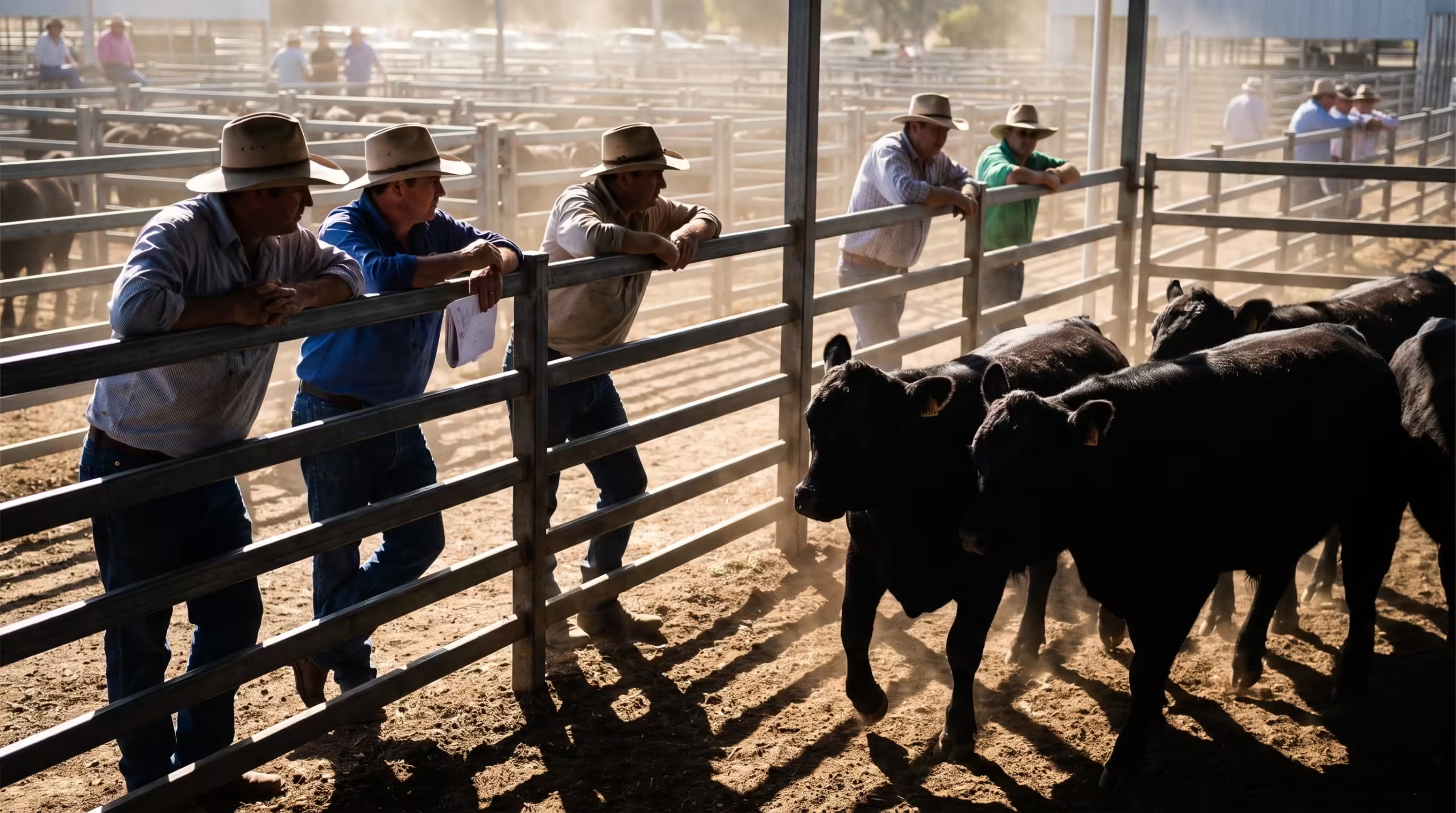
Buyers bid in a ring. The auctioneer calls the price. Cattle sell by the head or by weight. Saleyards give open price discovery and many buyers in one place. They suit store cattle, weaners and mixed lines. You pay agent commission, yard fees and freight. You also carry the risk of a poor sale day.
Over-the-hooks (OTH)
You sell direct to a processor. The processor pays on the carcase after slaughter. The price follows a grid. The grid pays more for the right weight, fat depth and age. It cuts the price for cattle outside the target. Meat Standards Australia (MSA) grades add premiums or discounts. OTH suits finished cattle and gives clear feedback on carcase quality. Learn the grid before you finish a mob.
Paddock or private sale
You and the buyer agree on a price by phone, often through an agent. Weight and delivery terms matter. Check the weighing method, the pay-weight rules and the payment date. Check your buyer’s record.
Online sales
Platforms such as AuctionsPlus let you list cattle with photos, weights and descriptions. Buyers bid from anywhere. Online sales widen your buyer pool and save the cattle a trip to the yards. They rely on honest descriptions. Give accurate data. Buyers will check it against the delivered cattle.
Live weight and carcase weight
Live weight (lwt) is the weight of the animal on the scale. Carcase weight (cwt) is the weight of the carcase after slaughter, with the hide, head, feet and gut removed. Dressing percentage links the two. It is carcase weight divided by live weight, shown as a percentage.
Here is a simple example. The numbers are for illustration only. They are not a market price.
- A steer weighs 600 kg live.
- Assume a dressing percentage of 55 per cent.
- The carcase weighs 330 kg.
- At 600 cents per kg carcase weight, the carcase is worth $1,980.
- To receive the same $1,980 on a live-weight basis, you need 330 cents per kg live weight.
The two quotes, 600 and 330, describe the same money. A buyer who quotes 600 c/kg cwt and a buyer who quotes 330 c/kg lwt are offering the same price. Always convert before you compare. A change in dressing percentage of one or two points shifts the result, so ask what dressing percentage each buyer assumes.
Get the latest cattle market updates straight to your inbox. Subscribe free to Cattle Weekly’s weekly newsletter. Subscribe here
The indicators you hear about
Indicators turn thousands of sales into one number. They show direction. They do not show the price for your cattle.
Meat & Livestock Australia (MLA) publishes cattle price indicators through its National Livestock Reporting Service. You find them at mla.com.au. The best known is the Eastern Young Cattle Indicator (EYCI). It tracks the price of young cattle sold at saleyards across the eastern states, in cents per kilogram live weight. Other indicators cover western young cattle and heavy steers. Read the definition of each before you use it. Each one covers a different type of animal and a different set of yards.
Use the indicators in three ways.
- Trend. Is the market rising, flat or falling over the past month?
- Benchmark. Is your sale result above or below a similar class of cattle on the day?
- Timing. Does the trend fit your plan to sell, hold or restock?
Our explainer on the latest cattle market report shows how to read these figures in practice. For the full picture, see the Australian cattle market and prices guide.
What moves cattle prices
Six forces set the direction. You do not control any of them. You are able to plan around all of them.
1. Supply
When many cattle reach the market at once, prices fall. When few come forward, prices rise. Supply follows herd size, the breeding cycle and the season. A dry spell pushes producers to sell breeders and young cattle early. This adds supply fast. The Australian Bureau of Agricultural and Resource Economics and Sciences (ABARES) tracks herd and turn-off data in its commodity reports, at agriculture.gov.au/abares.
2. Export demand
Australia exports a large share of its beef. Overseas buyers set much of the price for export-grade cattle. Japan, the United States, China and South Korea are major markets. When overseas demand rises, processors bid higher for cattle. When it falls, the grid price drops. Our guide on how Australia became a world beef exporter gives the background.
3. Trade policy and tariffs
Tariffs and quotas change what an overseas buyer pays. A new tariff in a major market lowers what processors offer you. A new trade deal does the opposite. Read the effect of each policy on your class of cattle. See the impact of the China beef tariff on Australian farmers.
4. Season and feed
Good rain lifts demand for store cattle. Restockers bid up the price of weaners and young steers. Dry conditions do the reverse. Feed costs also matter for feedlots. Grain price changes the margin a feedlot is willing to pay.
5. The Australian dollar
A lower dollar makes Australian beef cheaper overseas, which supports demand. A higher dollar does the opposite. Export prices are set in foreign currency, so the exchange rate changes what comes back to you in AUD.
6. Processor capacity
Processors need a steady flow of cattle to run plants at full capacity. Labour shortages, plant shutdowns and holiday periods cut the number of cattle they take. Fewer kill slots means more cattle waiting, and a softer price. Ask your buyer about kill dates before you commit cattle.
How to read a saleyard report
A saleyard report lists each class of cattle, the number yarded and a price range. Read it in this order.
- Check the yarding. A large yarding often eases prices. A small yarding often lifts them.
- Find your class. Match your cattle by sex, weight range and condition. A heavy steer and a light weaner are different markets.
- Look at the range. The gap between the low and high price shows how much quality mattered on the day. A wide gap means buyers paid up for the best lines.
- Compare the trend. Check the same class over several weeks, not one sale.
- Note the unit. Some classes sell in cents per kilogram. Others sell in dollars per head.
MLA publishes saleyard reports and market summaries on its market information pages. Use them as a check on what your agent tells you. Ask your agent for the comparable sales behind any price estimate.
Why two mobs of cattle sell at different prices
Two mobs at the same sale rarely bring the same price. Buyers pay for the traits they need and discount the rest.
- Uniformity. An even line of cattle sells better than a mixed draft.
- Weight and frame. Buyers have a target weight for their feed or their grid.
- Condition. Fat score and muscle matter to processors and to restockers alike.
- Breed and genetics. Buyers know which lines perform in their system.
- Health and history. Vaccination, weaning and treatment records give buyers confidence. Some buyers pay more for cattle with a clear program.
- Location. Freight to the buyer comes off the price you receive.
Prepare your cattle weeks before sale. Draft them into even lines. Record your vaccination and weaning dates. Have the paperwork ready. Each step costs little and builds trust with buyers.
What you control
You do not set the market. You do set your own result.
- Match cattle to the grid. Know the weight, fat and age limits. Finish cattle inside them.
- Know your dressing percentage. Record it by mob. It lets you compare live and carcase quotes.
- Compare the full cost of each method. Add freight, commission, shrink and fees.
- Keep your NLIS records correct. Buyers need accurate National Livestock Identification System (NLIS) tags and transfers. Errors delay payment.
- Time your sale to your own cash flow. A forced sale in a weak week costs more than a planned one.
- Talk to more than one buyer. Two quotes beat one.
For related reading, see our look at key trends in the beef cattle market.
A short checklist before you sell
- Check today’s indicator for your class of cattle on the MLA site.
- Get two quotes. Convert both to the same unit.
- Add all selling costs to each quote.
- Check the NLIS tags and the National Vendor Declaration are ready.
- Confirm the payment date in writing.
- Record the result so you learn from it.
Frequently asked questions
How are cattle prices set in Australia?
Buyers set prices by bidding or by grid. At saleyards, buyers bid against each other. In over-the-hooks sales, a processor pays on a grid based on carcase weight, fat and age. Supply, export demand, season, the dollar and processor capacity move both.
What is the EYCI?
The Eastern Young Cattle Indicator is a price indicator published by MLA. It tracks young cattle sold at saleyards in the eastern states, in cents per kilogram live weight. It shows market direction. It does not give the price of your cattle.
What is the difference between live weight and carcase weight prices?
Live weight prices apply to the weight of the animal on the scale. Carcase weight prices apply to the weight after slaughter. Dressing percentage links them. Convert both quotes to one unit before you compare.
Where do I find current cattle prices?
MLA publishes daily and weekly indicators and saleyard reports at mla.com.au. Your agent and your processor also give you prices for your class of cattle.
Is it better to sell at the saleyard or over the hooks?
It depends on the cattle. Saleyards suit store cattle and mixed lines. Over the hooks suits finished cattle within the grid. Compare the net return per head from each method, after all costs.