
Starting a cattle farm in Australia typically costs between $500,000 and $2 million AUD for a small to mid-sized operation, depending on your location, scale, and whether you lease or buy land. The single largest cost is land, followed by cattle, fencing, water infrastructure, and a year’s worth of operating capital. This guide breaks down every cost category so you can plan a realistic budget before you commit.
The gap between those figures is wide because land prices vary dramatically — from $100 per hectare in the arid Northern Territory to over $10,000 per hectare in high-rainfall Victoria. Your total startup cost is largely determined by where in Australia you want to farm and how many cattle you want to run from day one.
The Main Startup Costs: A Quick Overview
Before diving into each category, here is a summary of what a new cattle farmer in Australia needs to budget for:
| Cost Category | Small Operation (20–50 head) | Medium Operation (100–200 head) |
|---|---|---|
| Land (purchase) | $300,000–$1.5M | $800,000–$5M+ |
| Cattle | $60,000–$200,000 | $300,000–$800,000 |
| Fencing | $15,000–$60,000 | $50,000–$200,000 |
| Water infrastructure | $10,000–$40,000 | $40,000–$150,000 |
| Yards and handling | $15,000–$60,000 | $60,000–$200,000 |
| Machinery and equipment | $20,000–$80,000 | $80,000–$250,000 |
| Operating capital (year 1) | $30,000–$80,000 | $100,000–$300,000 |
| Estimated total | $450,000–$2M | $1.4M–$6.9M |
Note: Land lease rather than purchase dramatically reduces upfront capital — see the Finance section below.
Land: Your Biggest Variable
Land is the dominant cost in any cattle farming startup, and it is where Australian conditions vary most dramatically.
Land Prices by Region
Australia’s carrying capacity — the number of cattle a property can support per hectare — determines how much land you need to buy and, therefore, your total land bill. In high-rainfall zones such as coastal Victoria and southern New South Wales, one Animal Equivalent (AE) requires approximately 1–2 hectares. In the arid north — outback Queensland, Northern Territory, and the Kimberley — the same animal needs 25 to 100+ hectares of country. For a full breakdown of carrying capacity by region, see our guide on how much land you need to farm cattle in Australia.
Indicative land prices as of 2025–26:
Broadacre farmland medians vary enormously across Australia. According to Rural Bank’s Australian Farmland Values reports, recent medians ranged from around $1,578/ha in Central Queensland to $14,946/ha in North Queensland (2025 H1), while Victoria ranged from $9,031/ha in Central Victoria to $24,747/ha in South & West Gippsland (2025 H1). In NSW, 2024 annual medians spanned from $498/ha in Far West NSW to $12,956/ha on the North Coast. Overall, broadacre farmland medians range from roughly $500/ha in Australia’s cheapest western rangeland districts to $20,000/ha or more in premium high-rainfall grazing regions. The exact price for any parcel depends on region, rainfall, parcel size, improvements, water access, and buyer demand in that market.
Source: Rural Bank Australian Farmland Values reports (2024–2025)
The practical implication: A 100-cow operation in high-rainfall Victoria might require 150–200 hectares — at $10,000–$20,000/ha, that is $1.5 to $4 million for the land alone. The same 100-cow herd in tropical north Queensland requires 1,000–2,500 hectares, but at much lower per-hectare prices. The total outlay can still be comparable, but the management challenges and infrastructure costs are entirely different.
Lease Instead of Buy
Many new entrants reduce startup costs significantly by leasing rather than purchasing land. Agistment (paying per head to graze on someone else’s property) is a common first step for small operators building a herd before committing to a property purchase. Crown land leases in Queensland, the NT, and WA also provide a lower-cost pathway to large northern operations, though availability and conditions vary by state.
Cattle Purchase Costs
After land, cattle are the second-largest upfront cost. Prices depend on breed, age, gender, and market conditions at the time of purchase.
Breeding Cattle (Cows and Heifers)
For a beef breeding operation, you are typically buying PTIC (Pregnancy Tested In Calf) cows or heifers to build your herd:
- PTIC cows (mixed age): averaging around $2,328/head in early April 2026 (AuctionsPlus Weekly Cattle Market Report); prices vary with breed, age, pregnancy stage, and condition
- PTIC heifers (joining age): averaging around $2,408/head in early April 2026 (AuctionsPlus); premium joined females with strong breed credentials can sell materially above this
- Registered stud females: $3,000–$10,000+ for elite genetics
Bulls
A quality bull is one of the highest-return investments in any cattle enterprise. A single bull can service 25–30 cows per season, meaning you need approximately one bull per 25–30 breeding females.
- Commercial bulls (Angus, Hereford, Brangus): $4,000–$12,000/head
- Registered stud bulls with performance data: $8,000–$30,000+/head
According to Meat & Livestock Australia (MLA), bull selection is one of the highest-leverage decisions a beef producer makes, directly affecting carcase weight, fertility, and temperament across the entire calf drop.
Cattle Cost Examples by Scale
| Operation Size | Cows | Bulls | Estimated Cattle Cost |
|---|---|---|---|
| Starter (20 cows) | 20 PTIC cows @ $2,500 | 1 bull @ $6,000 | ~$56,000 |
| Small (50 cows) | 50 PTIC cows @ $2,500 | 2 bulls @ $6,000 | ~$137,000 |
| Medium (100 cows) | 100 PTIC cows @ $2,500 | 4 bulls @ $7,000 | ~$278,000 |
Infrastructure: Fencing, Water, and Yards
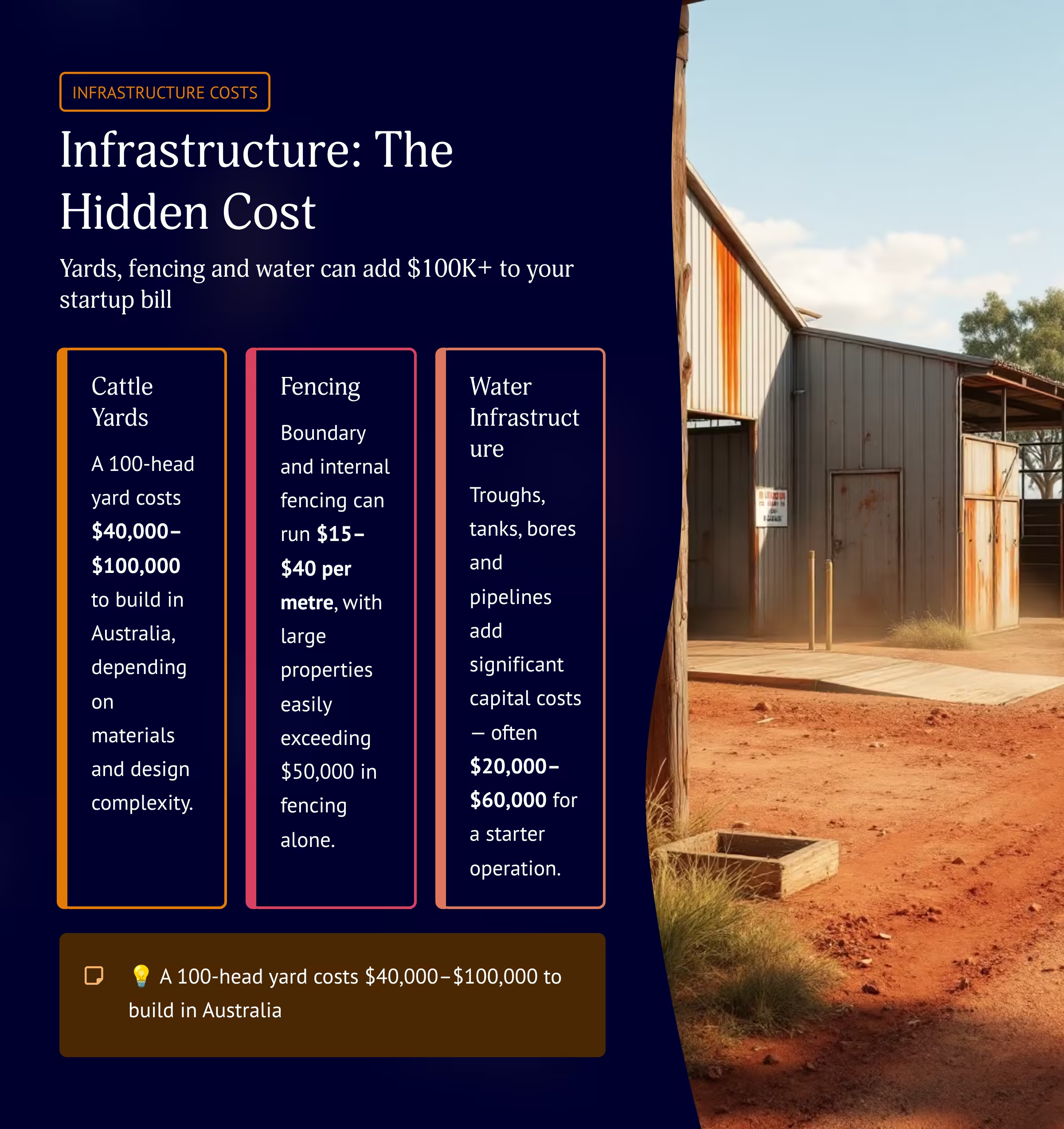
Infrastructure costs are often underestimated by new entrants. A property with poor fencing, inadequate water, and no proper yards will lose money faster than the cattle market can fix.
Get the latest cattle market updates straight to your inbox — subscribe free to Cattle Weekly’s weekly newsletter. Subscribe here
Fencing
Fencing cost depends on terrain, fence type, and whether you are building new or repairing existing fences. As a guide:
- Plain wire boundary fence (new): $8,000–$15,000 per kilometre installed
- Steel post internal subdivision fence: $6,000–$12,000 per kilometre installed
- Electric fencing (temporary or subdivision): $1,000–$3,500 per kilometre
A 400-hectare property with 8km of boundary and 4km of internal subdivision fencing could require $70,000–$130,000 in fencing alone if the existing fences are in poor condition.
Water Infrastructure
Reliable water is non-negotiable. Cattle need approximately 50–100 litres per head per day in moderate conditions, significantly more in summer heat. Costs vary widely depending on whether you are connecting to an existing bore, sinking a new bore, or relying on surface water with earthworks dams.
- New bore (drilling only, excluding pump): $30,000–$80,000+ depending on depth
- Solar-powered pump and tank system: $8,000–$20,000
- Earthworks dam construction: $15,000–$60,000 depending on size and soil type
- Reticulated water system (troughs + poly pipe): $5,000–$25,000
Cattle Yards and Handling Equipment
Properly designed cattle yards are essential for safe mustering, drafting, pregnancy testing, vaccination, weaning, and loading. A poorly built set of yards costs you in time, labour, injury risk, and animal welfare.
- Small portable steel yard set (50-head capacity): $15,000–$30,000
- Permanent timber and steel yards (100-head): $40,000–$100,000
- Full commercial yards with crush, vet facilities, loading ramp (200-head+): $100,000–$250,000+
Industry guide: Meat & Livestock Australia’s Beef Cattle Yards Design Manual provides specifications for efficient yard layouts — available free at mla.com.au.
Machinery and Equipment
Minimum machinery requirements for a cattle operation include:
| Item | Estimated Cost (New) | Second-Hand Option |
|---|---|---|
| 4WD ute or dual-cab | $45,000–$80,000 | $15,000–$35,000 |
| Tractor (60–100hp) | $60,000–$120,000 | $20,000–$50,000 |
| Stock trailer/float | $15,000–$40,000 | $8,000–$20,000 |
| Motorbike or quad | $8,000–$18,000 | $3,000–$8,000 |
| Spray equipment, post-hole digger, etc. | $5,000–$20,000 | — |
Buying quality second-hand machinery significantly reduces upfront costs without meaningful operational disadvantage for most smaller properties.
Operating Capital for Year One
New farms rarely turn a profit in year one. You need a cash reserve to cover costs before your first calf crop sells — typically 12–18 months into a breeding operation.
Annual Operating Costs to Budget For
- Feed and supplementary feeding (drought risk): $5,000–$40,000+ depending on season
- Veterinary and animal health (vaccinations, drenching, pregnancy testing): $15–$40/head/year
- Labour (if hiring any casual help): $30,000–$80,000/year
- Fuel and vehicle running costs: $10,000–$30,000/year
- Rates, insurance, and administration: $5,000–$20,000/year
- Freight and saleyard fees: $2,000–$10,000/year
ABARES publishes specialist beef farm financial benchmarks, but public reporting is presented at the farm-business level rather than as a simple national cash-cost-per-AE figure. Costs vary materially by region, rainfall, enterprise structure, scale, and season — producers should build enterprise budgets using local benchmarks from ABARES (agriculture.gov.au/abares) or MLA’s benchmarking programs rather than rely on a single national rule of thumb.
Hidden Costs New Farmers Often Miss
Several regulatory and administrative costs catch new entrants off guard:
- Property Identification Code (PIC): Free to register in most states, but required before you can buy, sell, or move livestock. Registration is through your state agriculture department.
- National Livestock Identification System (NLIS) tags: Mandatory for all cattle. Tags cost approximately $3–$5 per head. Every animal moved must be tagged and registered in the NLIS database.
- Brand registration: State-specific requirements; typically $50–$200 to register a livestock brand.
- Land transfer stamp duty: A significant cost often overlooked when budgeting for property purchase — rates vary by state and purchase price. Seek advice from a rural conveyancer.
- Biosecurity obligations: Some states require vendor declarations, health certificates, or treatments (tick dipping in tick-free zone buffer areas of Queensland) before stock movements.
How to Finance a Cattle Farm in Australia
Most new entrants cannot fund a cattle operation outright. Common pathways include:
Rural Finance Options
- Rabobank, Rural Bank, and ANZ Agri all offer specialist agricultural loans with land and livestock as security. Loan-to-value ratios (LVR) for rural properties typically range from 50–65%.
- Farm Management Deposits (FMDs): Allow farming businesses to set aside pre-tax income in good years to draw on in poor years — not a startup tool, but important for ongoing financial management.
- AgriStarter Loans (Queensland): The Queensland Rural and Industry Development Authority (QRIDA) offers concessional loans for new entrant farmers. Other states have equivalent programs — check your state government’s rural finance authority.
Government Grants and Support
- Beginning Farmer and Young Farmer programs are available in some states, particularly for producers under 40 or inheriting a family enterprise.
- Drought assistance programs can support operating costs during dry periods — contact your state agriculture department or the National Drought and North Queensland Flood Response.
For a full overview of grants and government support available to cattle farmers, see our guide to Cattle Farming Grants and Government Support in Australia For a complete introduction to beef cattle farming in Australia, see our Beef Cattle Farming in Australia: The Complete Guide..
Is Starting a Cattle Farm Worth the Cost?
The upfront investment is substantial, but so is the long-term asset value. Australian beef farms are land-backed, meaning the property itself typically appreciates over time even in difficult market periods.
The key variable is not the startup cost — it is the cost of production per kilogram of beef sold, compared with the market price at the time of selling. MLA benchmarking shows that the most profitable Australian beef producers consistently achieve lower cost of production through better pasture management, higher weaning rates, and lower mortality, not necessarily by running more cattle. For a detailed look at profitability, see our guide to whether cattle farming is profitable in Australia.
If you are serious about entering the industry, engage a rural accountant and an agricultural consultant before committing capital. A property-specific enterprise budget — accounting for your land’s carrying capacity, your target market, and your finance costs — is the single most important planning document you can produce before writing a cheque.

Frequently Asked Questions
Is cattle farming profitable in Australia?
Cattle farming can be profitable in Australia, but profitability varies significantly with season, market prices, and cost of production. MLA benchmarking shows that the top-performing beef producers achieve returns well above the industry average through efficient pasture management and genetics selection, while lower-performing operations struggle to cover costs in poor seasons.
How much does a 100-head cattle yard cost?
A functional 100-head cattle yard in Australia costs approximately $40,000–$100,000 for permanent timber and steel construction, depending on the complexity of the design, terrain, and whether you include a covered crush, vet facilities, and loading ramp. Portable yard sets for smaller operations start from around $15,000–$30,000.
How many cows can you have on 4 acres?
Four acres (approximately 1.6 hectares) is generally too small to sustainably carry cattle in Australia without significant supplementary feeding. In high-rainfall areas, one Animal Equivalent (AE) requires 1–2 hectares; 4 acres might support one small cow on irrigated improved pasture at best. Most viable cattle operations require substantially more land.
What type of cattle farming is most profitable?
The most profitable form of cattle farming in Australia depends on location, capital, and market access. Backgrounding — buying weaner cattle, growing them on pasture, and selling as feedlot-ready cattle — can generate strong returns in good seasons with relatively low infrastructure investment. Breeding enterprises suit properties with reliable rainfall and quality pasture. Feedlot operations require high capital but offer more predictable margins through contracted supply agreements.
Can I start a cattle farm with $200,000?
$200,000 AUD is very limited for a standalone cattle farming operation in Australia. It could work as a deposit on a rural property with bank financing, as agistment capital while you build a herd on leased land, or as a starting point for a small backgrounding enterprise where you own cattle but not land. Outright purchase of land and cattle for a viable operation typically requires $500,000 or more.

2 comments
For a full cost breakdown with dollar ranges by operation size, see: How Much Does It Cost to Start a Cattle Farm in Australia?
Most new entrants begin by leasing an established dairy farm with existing infrastructure — this dramatically reduces startup capital. For a broader comparison of startup costs across Australian farming enterprises, see our guide to how much it costs to start a cattle farm in Australia.