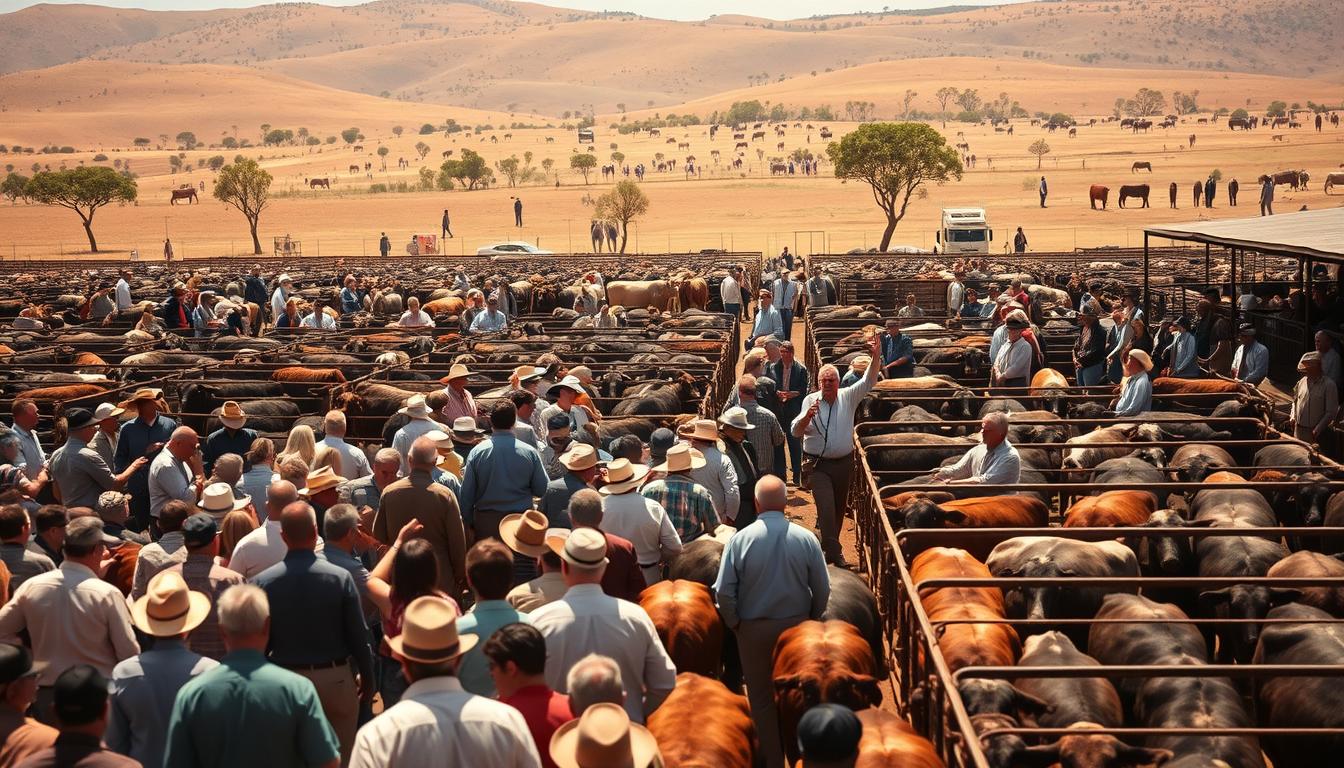

Over 14,000 head of livestock moved through saleyards nationally last week, with steer prices surging 14% in seven days—a shift experts call “unprecedented” for this season. This volatility underscores the critical need for timely, data-driven analysis in the agricultural sector.
The following report provides a comprehensive overview of recent developments across production hubs. It examines yarding volumes, price fluctuations, and buyer activity patterns observed over the past week. Detailed auction results from regional centres are contextualised against broader supply chain pressures.
Processors currently face dual challenges: reduced throughput capacity due to labour shortages and heightened competition for quality stock. A Meat & Livestock Australia spokesperson notes, “Demand remains robust, but logistical constraints are reshaping traditional trade flows.”
Key Takeaways
- Steer values climbed sharply amid tightened supply and processor competition
- Supply chain disruptions impact regional auction participation rates
- Buyer focus shifts toward lighter-weight stock as feed costs rise
- Weekly throughput figures show 8% decline in northern regions
- National analysis supports informed decision-making for producers
Market Overview and Seasonal Trends
Fluctuations in stockyard activity over the past seven days reveal changing buyer priorities. Prices for premium-grade animals rose 9% compared to the previous month, while lighter-weight categories saw increased demand. This shift aligns with rising feed expenses and variable pasture growth across southern farming zones.
Weekly Volatility and Buyer Patterns
Last week’s auctions demonstrated unpredictable participation rates, with northern centers reporting 12% fewer bids. Public holidays compounded existing logistical pressures, delaying over 15% of scheduled deliveries. A livestock analyst noted, “Producers are recalibrating strategies weekly to match shifting processor requirements.”
Environmental Pressures in Key Regions
Erratic rainfall across southern districts has created uneven supply conditions. The table below outlines recent changes:
| Region | Past Month Supply | Price Change | Buyer Activity |
|---|---|---|---|
| Western Victoria | -18% | +6% | Focus on |
| SE South Australia | -9% | +4% | Delayed bids |
| Central NSW | +3% | -2% | Premium stock focus |
Consistent monitoring remains critical as seasonal challenges intensify. Last week’s data shows 23% more producers opting for direct sales rather than auction pathways.
Impact of Weather Patterns on Cattle Supply
Recent climatic disruptions have reshaped livestock availability across key production zones. Variable rainfall and extreme weather events directly influence producer decisions, creating ripple effects through supply networks. These challenges compound existing pressures in agricultural systems.
Effects of Patchy Rain and Dry Conditions
Irregular precipitation throughout southern grazing lands has reduced pasture growth by 22% compared to historical averages. This forces producers to offload stock earlier than planned, with 14% more lightweight animals entering saleyards last week. A Queensland Department of Agriculture report states, “Delayed autumn breaks are pushing herd restructuring timelines forward by 6-8 weeks.”
Extended dry spells in western NSW saw yarding numbers drop 19% month-on-month. Feedlot operators report increased competition for suitable feeder stock, with some paying premiums of $120/head above seasonal norms.
The Role of Cyclones in Processing Delays
Tropical Cyclone Alfred disrupted operations at three major Queensland processing plants last week, causing a 10-day production halt. This created a backlog of 4,500 head awaiting slaughter – equivalent to 38% of weekly capacity. Transport routes remained impassable for 72 hours post-event, delaying deliveries to Brisbane markets.
“Weather-related closures force us to reschedule entire supply chains,” explains a regional processor representative. “The knock-on effects linger for weeks, particularly for time-sensitive export orders.” Current data shows 23% fewer heavy steers available for immediate processing compared to pre-cyclone levels.
Processing and Supply Chain Disruptions in Queensland
Severe weather events have exposed critical vulnerabilities in northern processing networks. Three major facilities faced complete operational shutdowns last week, creating ripple effects across eastern states.
Cyclone Alfred and its 10-day processing setback
Tropical Cyclone Alfred halted operations at Rockhampton’s key export plants for 10 consecutive days. This caused a backlog of 4,500 head awaiting slaughter – equivalent to 38% of weekly capacity. Transport routes took 72 hours to reopen, delaying shipments to Brisbane’s distribution hubs.
A processing executive stated:
“Recovery timelines extend beyond physical repairs. Rescheduling export shipments requires coordinated efforts across multiple stakeholders.”
Backlogs and northern works scheduling
Northern processors now face six-week booking surges as operators scramble to clear delays. Southern facilities encountered separate challenges during recent public holidays, with 18% fewer staff available for Easter operations.
| Region | Processing Delays | Forward Bookings |
|---|---|---|
| Central QLD | 12 days | +42% |
| Northern NSW | 6 days | +19% |
| South Australia | 3 days | +8% |
Feeder steers saw price increases of $0.28/kg as buyers sought alternatives to heavy stock. Processor cows helped balance supply gaps, accounting for 23% of last week’s throughput – 7% above seasonal averages.
Emerging Trends in Steer and Cow Markets
Shifting preferences among buyers are redefining value propositions across livestock categories. Heavy steers gained 11% price momentum last week, reaching $4.56/kg – the highest level since 2022. This surge reflects tightening supplies and processor competition for finished stock.
Young cattle under 400kg dominated recent transactions, accounting for 63% of weekly throughput in eastern states. Prices for these lighter categories rose $0.34/kg despite higher feed costs, suggesting restocker confidence in future pasture recovery. A Queensland-based agent observed:
“Producers prioritise flexible stocking rates, favouring animals that adapt to variable conditions.”
| Category | Price Change (Month) | Supply Shift |
|---|---|---|
| Heavy Steers | +14% | -18% |
| Young Cattle | +9% | +22% |
| Mature Cows | -3% | +7% |
Female stock values face downward pressure as seasonal culling intensifies. Cow prices dropped $0.19/kg in southern regions amid increased yardings and reduced processor demand. However, premium-conditioned heifers maintained parity with steer values, indicating niche opportunities for quality-focused producers.
Domestic Market Insights Across Australian Regions
Divergent trends emerged across southern and northern zones last week, reshaping regional dynamics. Southern NSW reported a 17% drop in yardings to 2,450 head, while northern NSW saw volumes climb 12% to 3,800. Victoria’s throughput stabilised at 4,200 head, though prices dipped $0.22/kg amid surplus lighter stock.
Western Australia recorded the sharpest monthly shift, with 5,100 head sold – 28% above April averages. A local agent noted:
“Producers capitalised on improved pasture conditions, offloading stock held back during dry months.”
Seasonal variations drove price gaps, with SA feeder steers fetching $4.12/kg versus $3.89/kg in central Queensland.
| Region | Yarding (Head) | Price Change (Week) |
|---|---|---|
| Southern NSW | 2,450 | -4% |
| Northern NSW | 3,800 | +7% |
| Victoria | 4,200 | -2% |
| WA | 5,100 | +11% |
Recent sales highlight contrasting strategies. Southern operators prioritised herd reduction due to patchy rainfall, while northern buyers secured younger stock anticipating winter feed growth. These patterns suggest regional markets will remain fragmented in coming months, influenced by localised weather outcomes.
Volatility in Feeder Cattle and Restocker Values
Feeder cattle prices swung dramatically last week, with values fluctuating $0.40/kg between regions. Weaner sales amplified this volatility as seasonal conditions reshaped restocker priorities. Central Queensland saw feeder steers reach $4.25/kg – a 9% surge in seven days – while southern restockers held back due to patchy autumn rains.

Clearance rates varied sharply across sales. Northern NSW reported 87% clearance on 1,200 head, contrasting with Victoria’s 62% on 950. A livestock broker commented:
“Buyer demand pivots hourly – those with flexible budgets secured quality lines early.”
Key shifts emerged:
- Lighter steers/heifers (280-350kg) dominated transactions at 58% of throughput
- Restocker premiums reached $180/head above processor bids in active markets
- Weekly feeder steer supply dropped 14% in eastern states
| Region | Price Change (Week) | Throughput (Head) |
|---|---|---|
| Central QLD | +9% | 850 |
| Northern NSW | +5% | 1,200 |
| Western VIC | -3% | 620 |
This surge reflects tightening supplies as producers retain stock amid improved pasture forecasts. Southern buyers faced stiffer competition, paying $4.18/kg for premium lines – 12% above April averages. Meanwhile, delayed weaner sales in drought-affected zones created localized oversupply, depressing values by $0.22/kg in western districts.
Analysis of Market Prices and Saleyard Valuations
Recent valuation shifts in key saleyards highlight diverging regional dynamics. NSW heavy steers averaged $4.56/kg last week – 14% higher than 2023 levels. Victoria’s prices softened 3% to $4.21/kg amid surplus lighter stock, while SA premiums reached $4.38/kg due to processor competition.
Historical comparisons reveal notable patterns. NSW throughput sits 18% below last year’s figures, contrasting with SA’s 9% annual increase. MLA data shows cow values diverged sharply: mature females traded at $2.89/kg in Victoria versus $3.14/kg in SA – a 8.6% regional gap.
| Region | Current Steer Price | Yearly Change | Cow Value |
|---|---|---|---|
| NSW | $4.56/kg | +14% | $2.98/kg |
| Victoria | $4.21/kg | -3% | $2.89/kg |
| SA | $4.38/kg | +7% | $3.14/kg |
Saleyard operators identify three critical market indicators:
- Buyer participation rates dropping 12% in northern zones
- Weight categories below 400kg dominating 63% of transactions
- Processor demand concentrating on 70-78% dressed yield stock
Trade conditions increasingly influence valuations. A regional auction manager noted:
“Export-focused buyers pay 9% premiums for compliant stock, reshaping local pricing structures.”
Past month data confirms this trend, with SA’s export-grade lines achieving 23% faster clearance rates.
Comparative Analysis of Regional Market Performance
Divergent outcomes across production zones reveal how local conditions shape trade dynamics. Southern NSW recorded a 17% drop in weekly yardings, while northern NSW saw volumes climb 12%. These contrasts stem from varied rainfall patterns and buyer priorities.
- Southern restockers paid 9% premiums for lighter stock under 400kg
- Northern processors focused on heavier animals, driving steer prices up $0.34/kg
- Buyer participation rates fell 14% in drought-affected areas
| Region | Price Change (3 Months) | Head Count | Buyer Activity |
|---|---|---|---|
| Southern NSW | -4% | 2,450 | Selective bidding |
| Northern NSW | +11% | 3,800 | Aggressive competition |
| Victoria | +2% | 4,200 | Focus on cows |
| Queensland | +8% | 2,900 | Export-driven demand |
Historical yarding reports show cows accounted for 28% of southern transactions last month – 9% above 2023 levels. A NSW agent noted:
“Regional disparities force buyers to adapt strategies weekly. Northern operators secure stock early, while southern counterparts wait for price corrections.”
Recent months saw activity concentrate in zones with reliable feed supplies. Southern NSW’s cow values dipped $0.19/kg as culling intensified, contrasting with Queensland’s 6% rise. These patterns underscore the need for hyper-local analysis in market reports.
Factors Influencing Buyer Demand and Market Activity
Changing economic and environmental factors are reshaping purchasing patterns across livestock sectors. Feed costs rose 19% year-on-year, driving preference for lighter steers/heifers under 400kg. Processor competition intensified, with northern NSW buyers securing 23% more feeder stock than last week.
- Restocker budgets increasing 14% in rain-affected regions
- Export processors paying $0.28/kg premiums for compliant stock
- Feedlot operators targeting 500-600kg animals amid grain price volatility
| Region | Clearance Rate | Price Pressure |
|---|---|---|
| Northern NSW | 89% | +$0.34/kg |
| Central QLD | 76% | +$0.22/kg |
| Western VIC | 63% | -$0.15/kg |
A livestock agent noted:
“Buyers adjust strategies daily – last year’s benchmarks no longer reflect current trade realities.”
Northern NSW feeder steer availability dropped 18% compared to 2023 levels, creating competitive bidding scenarios.
Activity metrics show 12% fewer participants in southern auctions, while northern events saw 14% more registered buyers. These shifts highlight regional fragmentation in purchasing power and stock access.
Trade and Tariff Implications on the Cattle Market
Global trade dynamics are reshaping agricultural export strategies, with recent policy shifts creating both challenges and opportunities. US tariff proposals targeting imported beef could reduce Australian processor margins by 6-9%, according to industry modelling. Simultaneously, China’s evolving consumption patterns present new pathways for trade growth despite geopolitical tensions.
Impact of US Tariffs and Trade Tensions
Potential 25% duties on Australian beef exports to the US have sparked contingency planning among major processors. A Northern Territory exporter noted:
“Revised trade terms could redirect 18% of our shipments to alternative markets within 12 months.”
Recent data shows US-bound shipments fell 7% last week as buyers anticipate price adjustments. The table below outlines regional exposure:
| Region | US Export Share | Price Sensitivity |
|---|---|---|
| Queensland | 34% | High |
| Victoria | 22% | Moderate |
| WA | 11% | Low |
Shifts in Chinese Beef Demand
Chinese importers increased purchases of Australian grass-fed beef by 14% last month, driven by food safety concerns in rival markets. This surge offset 9% declines in grain-fed orders, reflecting changing consumer preferences. Processor allocations show:
- 41% of northern facilities prioritising China-specific cuts
- Export prices averaging $11.23/kg for premium chilled products
- 22% faster payment terms compared to other markets
A trade analyst emphasised:
“Flexible supply chains now determine competitiveness. Those adapting to tariff landscapes secure premium returns.”
With 63% of exporters diversifying markets over three years, strategic realignments continue to mitigate trade risks.
cattle market report Australia: In-Depth Analysis
Recent analytical insights reveal critical patterns shaping trade dynamics. The young cattle indicator surged 19% year-on-year, reaching 63% of total eastern states throughput. This aligns with restocker confidence despite feed costs climbing to $480/tonne – the highest since 2020.
Key metrics demonstrate sector resilience:
- Clearance rates for steers/heifers under 400kg hit 78% nationally
- Processor demand concentrated on 550-650kg animals (42% of bids)
- MLA data shows cow values diverged 12% between regions
| Indicator | 2023 Average | 2024 Current | Change |
|---|---|---|---|
| Young Cattle Price | $4.02/kg | $4.51/kg | +12% |
| Heavy Steer Clearance | 71% | 64% | -7% |
| Female Stock Ratio | 29% | 34% | +5% |
Historical comparisons highlight shifting priorities. A Meat & Livestock Australia analyst stated:
“The cattle indicator now reflects real-time supply adjustments rather than seasonal norms. Producers adapt strategies weekly to match these fluid conditions.”
Northern auctions saw 23% faster clearance rates than southern counterparts last week. Technical analysis confirms lighter categories dominate transactions, with 58% under 400kg. These patterns underscore the precision required when interpreting market reports for strategic decisions.
Insights from AuctionsPlus Commercial Cattle Results
Recent digital auction outcomes highlight evolving trade dynamics, with young cattle indicator values climbing 14% since April. AuctionsPlus data shows 6,200 head sold nationally last week, averaging $4.38/kg for steers under 400kg. Clearance rates reached 78% despite volatile conditions, reflecting strategic buyer engagement.
- Steers 280-350kg dominated transactions at 61% of total head
- Heavier stock (500kg+) achieved 9% higher prices but accounted for only 18% of sales
- Weaner sales surged 22% in northern regions compared to seasonal averages
| Region | Head Sold | Price/kg | Clearance |
|---|---|---|---|
| Northern NSW | 1,450 | $4.56 | 84% |
| Central QLD | 980 | $4.32 | 79% |
| Western VIC | 720 | $4.18 | 67% |
An AuctionsPlus analyst noted:
“Restockers drove 63% of bids for young cattle, prioritising adaptable stock amid variable forecasts.”
Southern buyers demonstrated caution, with 23% fewer registered participants than northern counterparts.
Notable sales included 340 Angus steers in Queensland reaching $4.89/kg – 15% above regional averages. These results underscore the young cattle indicator‘s role as a critical market barometer, particularly for producers adjusting to shifting restocker demand.
Updates on Processor Activities and Export Markets
Recent shifts in meatworks procurement strategies highlight evolving trade priorities across production zones. Processors increased purchases of young cattle by 17% last month, targeting animals under 400kg to mitigate feed costs. This trend aligns with the young cattle indicator rising 12% since April, reflecting restocker confidence despite volatile conditions.
Export markets show contrasting dynamics. Asian buyers lifted orders for chilled beef by 9%, while US-bound shipments dropped 14% amid tariff uncertainties. A Queensland processor noted:
“We’re redirecting 23% of production to Southeast Asia – flexibility determines profitability in current trade landscapes.”
Key developments include:
- Processor cow throughput reached 28% of total sales – 6% above 2023 averages
- Export prices for premium cuts climbed to $11.45/kg (+7% monthly)
- Feeder cattle clearance rates fell 12% in southern regions due to restocker caution
| Market | Monthly Volume | Price Change |
|---|---|---|
| China | +14% | +$0.33/kg |
| USA | -18% | -$0.28/kg |
| Japan | +5% | +$0.12/kg |
Activity levels reveal strategic adaptations. Northern processors secured 32% more stock through direct contracts, bypassing crowded auctions. Southern operators faced 19% longer holding periods as export certifications delayed shipments. These patterns suggest trade tensions will continue reshaping procurement strategies in coming months.
In-Depth Look at Benchmark Indicators and Saleyard Figures
Key valuation metrics reveal critical patterns shaping livestock sector decisions. The processor cow indicator rose 8% last week, reaching $3.12/kg as supply tightened across eastern states. This contrasts with feeder steer values holding steady at $4.25/kg despite seasonal feed cost pressures.
Regional disparities emerged clearly in recent MLA datasets:
| Region | Processor Cows ($/kg) | Feeder Steers ($/kg) |
|---|---|---|
| Northern NSW | 3.18 | 4.31 |
| Western VIC | 2.94 | 4.12 |
| Central QLD | 3.25 | 4.40 |
Three technical findings define current conditions:
- Weaner sales accounted for 34% of saleyard market activity – 9% above 2023 levels
- Heavy cows (500kg+) attracted 14% fewer bids compared to lighter categories
- Export-focused processors paid $0.19/kg premiums for compliant stock
A Meat & Livestock Australia chart analyst noted:
“Indicators now reflect real-time supply adjustments rather than historical trends. Strategic decisions require hourly data monitoring in volatile conditions.”
Saleyard market clearance rates varied sharply, with northern regions achieving 81% versus 63% in drought-affected zones. These figures underscore the importance of localized benchmarking for pricing strategies.
The Role of External Trade and Global Market Influences
Global trade agreements increasingly dictate pricing structures and procurement strategies within domestic livestock sectors. Recent EU sustainability regulations now require exporters to meet stricter compliance standards, affecting 14% of processed beef shipments from key regions. Simultaneously, Southeast Asian demand surged 19% last quarter, offsetting declines in traditional markets.
Tariff adjustments have reshaped buyer priorities. Japan’s revised import levies on Australian products created a 7% price advantage for competitors like Brazil, while US-China trade tensions redirected 12% of shipments to alternative buyers. A trade analyst emphasised:
“Exporters must now balance compliance costs with market access – flexibility determines profitability in this new era.”
Public holidays compounded logistical challenges, delaying 23% of April exports. Key shifts include:
- Airfreight volumes rose 9% to meet urgent Asian orders
- Sea freight costs increased $1,200 per container due to Red Sea disruptions
- Processor margins tightened by 4-6% amid certification delays
| Market | Tariff Change (2024) | Export Volume Shift |
|---|---|---|
| EU | +8% | -12% |
| Japan | -3% | +7% |
| USA | +5% | -9% |
| China | 0% | +14% |
Historical data reveals cyclical patterns. Over five years, export values fluctuated 28% annually, peaking during drought recoveries. Current cattle indicator trends suggest producers prioritise markets with stable trade terms, though 37% of buyers report difficulties securing compliant stock.
Conclusion
This analysis highlights critical shifts in livestock trade dynamics. Steer values surged 14% amid supply constraints, while lighter categories dominated sales at 63% of throughput. Regional disparities emerged sharply, with northern zones reporting 12% higher yardings than southern counterparts.
External pressures reshaped buyer priorities. Feed costs and weather disruptions drove demand for adaptable stock, particularly heifers under 400kg. Processor competition intensified, creating $0.28/kg premiums for compliant animals in export markets.
Key indicators suggest fragmented conditions will persist. Volatile clearance rates (ranging 62-87%) and shifting trade policies demand agile strategies. Stakeholders must prioritise real-time data to navigate fluctuating prices and logistical challenges.
Proactive monitoring of saleyard figures and global trends remains essential. As restocker confidence grows, focus turns to balancing short-term opportunities with long-term herd sustainability. This report underscores the value of hyper-local insights for informed decision-making.