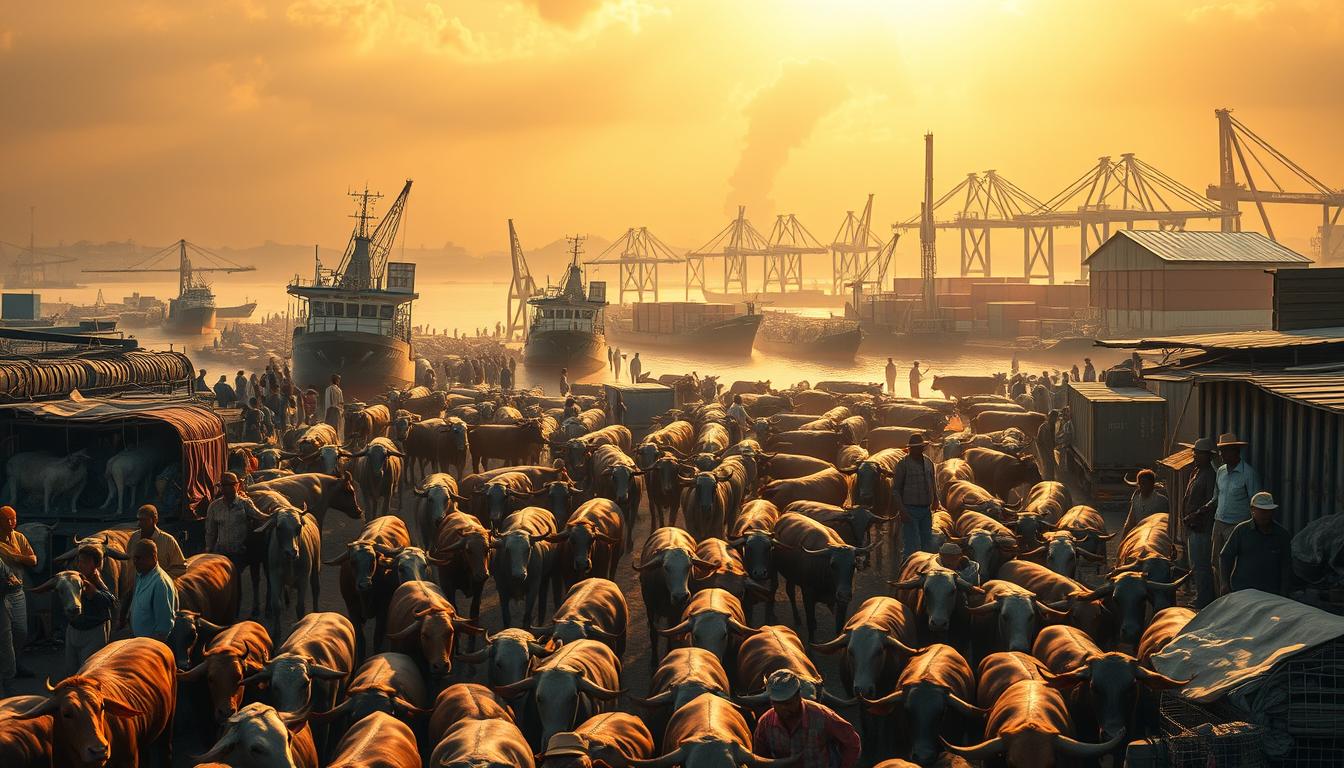

Surprising fact: Australian live shipments are forecast at about 750,000 head in 2024 — barely half the historic peak of 1.3 million head, showing how measured recovery still is.
This report sets a clear baseline for producers. Northern supply regions — Northern Territory, north Queensland and WA — supply roughly two-thirds of shipments. A strong 2023 wet season helped rebuild numbers into 2024.
Darwin feeder steers sat near AUD $3.35/kg liveweight in mid‑2025, with Indonesian destination values around $4.6–$4.9/kg. Policy moves, like Indonesia lifting quotas in June 2025, help demand but permits and costs still shape actual trade.
Biosecurity overhangs, depot availability and vessel bookings matter as much as on‑farm gains. Producers should weigh live export demand against domestic restocker and feedlot offers when timing sales.
Key Takeaways
- Live shipments are rebuilding (2024 forecast ~750,000 head) but remain below past peaks.
- Northern regions drive most supply; seasonal timing affects cashflow and logistics.
- Darwin feeder steer and destination prices give a practical baseline for selling decisions.
- Policy changes and permits influence volumes more than headline quotas.
- Keep monitoring depot availability, vessel slots and biosecurity signals before committing stock.
Australia’s live cattle market now: prices, volumes and seasonality at a glance
Regional yardings and vessel slots are shaping how stock moves through the northern supply chain. NT, WA and north Queensland remain the backbone of shipments, with Queensland’s share rising to roughly 25–30% in recent years.
Feeder and slaughter signals
Feeder values in Darwin sit at about AUD $3.35/kg liveweight through the dry. That figure shows how northern feeder signals can decouple from southern saleyards during the season.
Volumes and shipping origins
Australian live shipments are forecast at 750,000 head in 2024, up from 550,000 in 2023 after the strong 2023 wet season helped the herd rebuild. Portland remains focused on dairy lines, while NT, WA and north Queensland supply most volume.
Seasonal flow and supply timing
Queensland typically peaks in Q1, WA mid-year and NT later in the season. Producers in Townsville often weigh the live channel against restocker and feedlot options; the spread between channels will decide yardings.
- Plan around seasonality: align mustering, road trains and depots with known peaks.
- Watch vessel schedules: a few delayed sailings can push local markets quickly.
- Keep cashflow flexible: premiums often arise as flows move from QLD to WA then NT.
cattle export price trends: key drivers shaping 2024-2025
Recent data show domestic steer indices and port-level quotes move almost in lockstep, giving producers clearer signals on timing and margins.
The EYCI and a Live Export Index (Broome, Townsville, Darwin average) record a monthly correlation of 0.83 and an annual correlation of 0.94. That tight link means shifts in restocker and feeder sentiment usually feed through to port bids within weeks.
Domestic-index spreads and what they mean
The EYCI averages about a 7% premium to the Live Export Index. Most of the time the spread sits inside a modest band: 70% of observations fall between a 6.5% discount and a 20% premium. The 95% range is roughly a 20% discount to a 33.5% premium.
Biosecurity and market access risks
Biosecurity remains a live factor. The August 2023 LSD detection in Indonesia led to suspensions at around half of pre-export quarantine depots in NT, WA and Queensland. Shipments continued via other depots but flexibility and costs tightened.
- Practical rule: track monthly EYCI vs port quotes to spot extremes.
- Risk check: confirm depot status and protocols before booking.
| Metric | Value | Typical range | Current |
|---|---|---|---|
| Monthly correlation (EYCI vs port) | 0.83 | — | 0.83 |
| Annual correlation | 0.94 | — | 0.94 |
| Average EYCI premium | 7% | -20% to +33.5% (95%) | ~14% |
Regional demand lens: Indonesia, Vietnam and the Philippines in the current trade
Across Indonesia, Vietnam and the Philippines, demand looks firm rather than frantic — buyers balance multiple suppliers and costs before lifting volumes.
Indonesia
Policy: June 2025 removed quota caps but permits remain. Under IA‑CEPA the TRQ rose to 700,000 head for 2025.
Early July slaughter prices sat near AUD 4.6–4.9/kg depending on island and sex. Permits and freight still control actual volume, as 2024 exports (537,274 head) fell short of available permits.
Vietnam
Imported stock carry a clear premium. Australian bulls and steers top the price stack while Thai animals trade slightly lower.
Feed note: tariff cuts on corn and soybean meal to zero should ease lotfeed margins. Border closures at the Thai‑Cambodian frontier are a supply risk to monitor.
Philippines & competitive dynamics
Slaughter steer rates and retail beef are steady. FX shifts affect AUD returns and buyer appetite.
| Market | Typical AUD/kg | Key drivers | Current notes |
|---|---|---|---|
| Indonesia | 4.62–4.90 | Permits, freight, feed costs | Quota caps removed; permits still required |
| Vietnam | 4.72–4.81 (imported) | Imported premium, feed tariffs, border flows | Tariff cuts aid feed margins |
| Philippines | ~3.43 (slaughter LW) | FX, domestic demand | Retail beef steady; dairy growth noted |
Conclusion
Producers face a steady-to-firmer outlook as 2024 volumes rebuild to about 750,000 head and demand across Indonesia, Vietnam and the Philippines stays reliable.
Key markers are clear: Darwin feeder steers near AUD $3.35/kg LW, Indonesia slaughter at ~AUD $4.6–$4.9/kg, Vietnam holding a premium and the Philippines near AUD $3.43/kg LW.
The EYCI-port link remains tight (monthly 0.83; annual 0.94) and the typical EYCI premium sits near 7% (current spread ~14%), so use the spread as a practical guide when weighing offers.
Plan around the season — Queensland early, WA mid-year, NT later — check depot status, lock freight and watch FX. The news is constructive: sensible demand and a clear path to better returns through timing and cost control in trade.